The tax is a percentage of the price — never of the total
Sales tax looks simple, and mostly is: the shop collects a percentage of the selling price for the tax authority, and you pay the two added together. The mistakes happen at the edges. People divide by the rate when they should multiply, work backwards from a receipt total by subtracting the percentage of the total (which is not the same number), or forget that the rate on the receipt is usually three taxes wearing one coat — a state rate, a county rate and a city rate stacked together. This calculator handles both directions in the open: forwards from a price to a total, and backwards from a total to the price and tax inside it, with the two parts always adding back to the whole. It pairs naturally with the discount calculator: a discount shrinks the price first, and tax is then charged on what remains — the order matters, and the worked example below shows both steps.
The formulas, with every term defined
Tax amount = price before tax × tax rate ÷ 100 · Total = price before tax + tax amountPrice before tax = total ÷ (1 + tax rate ÷ 100) · Tax inside a total = total − price before tax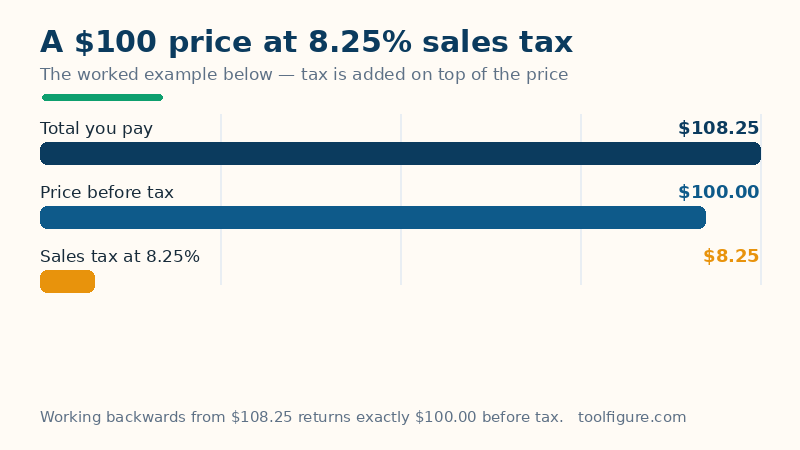
Read it in words. The tax rate is the combined percentage where the purchase happens — if a state charges 6.25% and the county and city add 2.00% between them, the rate to enter is 8.25%, because each layer is charged on the same price and the layers simply add. Going forwards, the tax is that percentage of the price, rounded to the nearest cent, and the total is the price plus the rounded tax — the rounding rule is stated because a register does exactly this, and it is why the parts on this page always sum exactly to the total. Going backwards is where most people slip: the price inside a total is not the total minus the rate percent of the total. A total of $108.25 at 8.25% is not hiding $8.93 of tax (8.25% of 108.25); it is hiding $8.25, because the tax was charged on $100, not on $108.25. Dividing the total by 1.0825 undoes the original multiplication, which is the only direction that round-trips.
Worked example: a $100 price at 8.25%
The defaults above enter a price of $100.00 at a combined rate of 8.25%. The tax is 100 × 8.25 ÷ 100 = $8.25, and the total is 100 + 8.25 = $108.25. Run the same figures backwards — a receipt total of $108.25 at 8.25% — and the calculator divides 108.25 ÷ 1.0825 = $100.00 before tax, leaving exactly $8.25 of tax: the two directions agree, as they must. The table under the result holds the same $100 price against common rates (0% → $100.00 total, 5% → $105.00, 6% → $106.00, 7.25% → $107.25, 10% → $110.00), which is the quickest way to feel how much of a cross-border price difference is really the tax.
More prices, both directions
| Case | Price before tax | Rate | Tax | Total |
|---|---|---|---|---|
| Worked example | $100.00 | 8.25% | $8.25 | $108.25 |
| Power tool | $250.00 | 6% | $15.00 | $265.00 |
| Headphones | $59.99 | 7.25% | $4.35 | $64.34 |
| Laptop | $1,000.00 | 10% | $100.00 | $1,100.00 |
| Groceries run (where taxed) | $45.00 | 8.25% | $3.71 | $48.71 |
| Receipt backwards | $100.00 | 7.25% | $7.25 | $107.25 |
| Receipt backwards | $200.00 | 10% | $20.00 | $220.00 |
| Receipt backwards | $49.99 | 8% | $4.00 | $53.99 |
Two rows deserve a second look. The headphones: 59.99 × 7.25% is $4.3493 before rounding, which the register rounds to $4.35 — on small prices the rounding is a visible share of the tax, and either neighbouring cent can be the honest answer depending on the register's rule. And the discount order: a $120 jacket at 25% off is $90 before tax, so at 8% the tax is $7.20 and the true final price is $97.20 — not the $103.68 you would get by taxing the full $120 first. Where a discount applies, tax follows the discounted price.
Reading a tax figure honestly — the limits
Three cautions belong with any total here. This page does not know your rate. Combined rates run from 0% in a few US states to over 10% in some city districts, they change when local budgets change, and different goods are taxed differently in different places — some states exempt groceries or clothing, some tax them at a reduced rate. Enter the combined rate from your receipt or your tax authority, not from memory of a neighbouring town. A percentage fee is not the whole bill in some places: a handful of jurisdictions add small fixed district charges on top of the percentage, which a percentage-only calculator cannot reproduce. And this is arithmetic, not tax advice: what a business must collect, remit or may reclaim is a question for the authority's rules or an accountant. What this page guarantees is narrower and checkable: at the rate you enter, the tax, the price and the total add up — in both directions.
Frequently asked questions
How is sales tax calculated?
Multiply the price before tax by the rate and divide by 100, then add the result to the price. A $100 price at 8.25% carries $8.25 of tax and a $108.25 total. The tax is rounded to the nearest cent before the total is formed, which is what a shop register does, so the figures on this page always add up exactly.
How do I work out the price before tax from a receipt total?
Divide the total by 1 plus the rate as a decimal: at 8.25%, divide by 1.0825. A $108.25 total divides back to exactly $100.00, with $8.25 of tax. Do not subtract 8.25% of the total instead — that gives $99.32, because the percentage of the larger total is bigger than the tax that was actually charged on the smaller price.
Is sales tax charged before or after a discount?
On the discounted price, in the usual case. A $120 jacket at 25% off sells for $90, and tax is charged on the $90: at 8% that is $7.20 of tax and a $97.20 final price. Manufacturer coupons and rebates can be treated differently in some places, but a store discount reduces the taxable price before the rate is applied.
Why is the rate different in different towns?
Because the rate on a receipt is usually several taxes added together: a state rate, plus a county rate, plus sometimes a city or transit-district rate. Two shops a few miles apart can sit in different districts and charge different combined rates on the same item. That is also why this calculator asks you to enter the combined rate rather than guessing it from the state alone.
Does this calculator know the tax rate where I live?
No — deliberately. Rates differ by town and district, change over time, and vary by what is being bought, so any rate this page printed from memory could quietly be wrong. Enter the combined rate from your receipt or your state or local tax authority's published table, and the arithmetic here will be exact for that rate.