The roll on the shelf is not the paper on the wall — the repeat sees to that
Wallpaper arithmetic goes wrong in a predictable place: people divide the wall area by the area printed on the roll and believe the answer. A roll's printed area is the paper in the roll. What reaches the wall is less, for two honest reasons. Every strip is cut longer than the wall — a trimming allowance at top and bottom — and on a patterned paper each strip must start at the same point in the pattern, so the cut length is rounded up to a whole number of pattern repeats, and the offcut between strips is usually waste. This calculator works the way a decorator orders: net wall area first (gross walls minus doors and windows), then the wall area one roll genuinely covers — its full strips times their width times the ceiling height — and the division rounded up to whole rolls. If the room is an odd shape, the square footage calculator will check its measurements first.
The formulas, with every term defined
Net wall area = 2 × (length + width) × ceiling height − doors × 21 sq ft − windows × 15 sq ftStrip length = ceiling height + 4 in trimming, rounded UP to a whole number of pattern repeats (no rounding when the repeat is 0)Strips per roll = roll length ÷ strip length, rounded DOWN · Wall covered per roll = strips per roll × roll width × ceiling heightRolls = net wall area ÷ wall covered per roll, rounded UP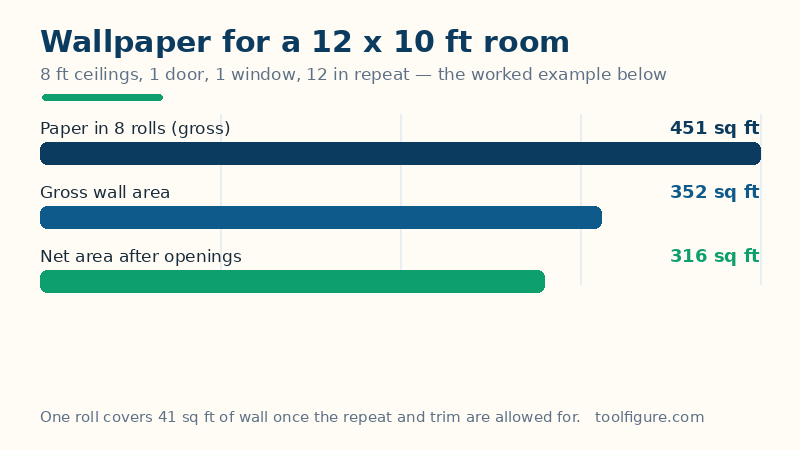
Work the worked example's roll through those lines and the gap between shelf and wall is plain: a standard roll holds 20.5 in × 33 ft = 56.38 sq ft of paper, yet at an 8 ft ceiling with a 12 in repeat it covers only 41.00 sq ft of wall. The missing quarter went on strip lengths rounded from 8 ft 4 in up to 9 ft, on the 6 ft left in the roll that is too short for a fourth strip, and on trimming. That is also why two papers with identical roll sizes can need different roll counts for the same room — the one with the larger repeat wastes more at every cut. The same room-and-openings logic, without the repeat, is what the paint calculator applies to the walls you are not papering.
Worked example: a 12 × 10 ft room, 8 ft ceilings, a 12-inch repeat
The defaults above give: perimeter 2 × (12 + 10) = 44 ft; gross wall 44 × 8 = 352 sq ft; one door and one window deduct 21 + 15 = 36 sq ft, leaving 316 sq ft to paper. Each strip is cut at 8 ft + 4 in = 8 ft 4 in, rounded up to the 12 in repeat = 9 ft. A 33 ft roll therefore yields ⌊33 ÷ 9⌋ = 3 full strips, and covers 3 × (20.5 ÷ 12) ft × 8 ft = 41.00 sq ft of wall. Rolls: 316 ÷ 41.00 = 7.71, rounded up to 8 rolls — 451.00 sq ft of paper bought, at $45 a roll a $360 order. The bar chart above draws the gross wall, the net wall and the paper in those 8 rolls.
Other rooms, counted the same way
| Room | Net wall | Strip | Per roll | Rolls | Cost |
|---|---|---|---|---|---|
| Room 12 × 10 ft, 8 ft ceiling, repeat 12 in (worked example) | 316 sq ft | 9 ft | 41.00 sq ft | 8 | $360 |
| Bedroom 10 × 10 ft, 8 ft ceiling, 1 door, 1 window | 284 sq ft | 9 ft | 41.00 sq ft | 7 | $315 |
| Living room 15 × 12 ft, 9 ft ceiling, 2 doors, 2 windows | 414 sq ft | 10 ft | 46.13 sq ft | 9 | $405 |
| Nursery 9 × 9 ft, 8 ft ceiling, 1 door, 1 window | 252 sq ft | 9 ft | 41.00 sq ft | 7 | $315 |
| Metric room 4 × 3 m, 2.4 m ceiling, roll 53 cm × 10.05 m, repeat 32 cm | 30.27 m² | 2.56 m | 3.82 m² | 8 | $360 |
The metric row is where the repeat shows its teeth. The same room in a plain, random-match paper cuts its strips at exactly 2.50 m, fits 4 strips into the 10.05 m roll instead of 3, covers 5.09 m² per roll and needs only 6 rolls — the 32 cm repeat alone costs two rolls. Large repeats on high ceilings are the expensive combination in any unit system, and they are exactly the combination a bare area division cannot see. The living-room row shows the gentler case: a 9 ft ceiling raises the strip to 10 ft, but each strip is also taller on the wall, so the roll count rises by area rather than by waste.
How to read your result, and the limits — read these
Buy every roll in one order, and check the batch or shade number on each label matches before any roll is opened. Wallpaper is printed in runs, and a roll from a different run can sit visibly off-shade in the middle of a wall; an unopened roll from the wrong batch is returnable, a hung one is not. This count assumes a rectangular room papered on all four walls at full height. A feature wall is a different, smaller job — enter the room as if only that wall existed by using its length as the perimeter basis through the net-area lines above, or paper a room with a sloping ceiling, a stairwell drop or a dado rail from the longest drop and expect extra waste the rectangle cannot model. The door and window deductions use standard sizes; a wall of floor-to-ceiling glass deducts far more than 15 sq ft, so count a very glazed room's openings honestly by adjusting the window count. Finally, keep one roll — or the leftover part-roll — unopened in a cupboard: a damaged strip can be replaced years later only from the same batch, as the flooring calculator warns for boards from the same production run.
Frequently asked questions
How many rolls of wallpaper do I need for a 12 × 10 foot room?
At 8 ft ceilings with one door, one window and a standard 20.5 in × 33 ft roll with a 12 in pattern repeat: the net wall is 316 sq ft, each roll covers 41.00 sq ft of wall once its strips are cut at 9 ft, and 316 ÷ 41 rounds up to 8 rolls — $360 at $45 a roll. The same room with no openings at all needs 9 rolls, which is why the openings are worth counting rather than guessing.
Why does the pattern repeat change the number of rolls?
Because every strip must start at the same point in the pattern, each cut is rounded up to a whole number of repeats: at an 8 ft ceiling with trimming, a strip wants 8 ft 4 in of paper but is cut at 9 ft on a 12 in repeat. Those lost inches decide how many strips fit in a roll — 3 instead of a possible 4 on the metric roll in the table above, where the repeat alone moves the order from 6 rolls to 8.
How much wallpaper is in a standard roll?
A common US single roll is 20.5 inches wide and 33 feet long — 56.38 sq ft of paper. A common European roll is 53 cm × 10.05 m — 5.33 m². Neither figure is what the roll covers on your wall: after strip lengths, pattern rounding and the short remainder at the end of the roll, the worked example's US roll covers 41.00 sq ft. Always divide by the covered figure, never the printed one.
Should I deduct doors and windows when calculating wallpaper?
Yes — at the standard sizes this calculator uses, 21 sq ft for a door and 15 sq ft for a window (1.89 m² and 1.44 m² in metric). The short pieces above a door and below a window are cut from strip offcuts and roll remainders, so the full opening genuinely comes off the area. The exception is a room that is mostly glass: there the standard window figure understates the opening, and raising the window count is the honest fix.
Should I buy an extra roll of wallpaper?
The count above already rounds up to whole rolls and wastes openly at every cut, so it is a true order figure, not a bare minimum. Even so, one extra roll from the same batch is the cheapest insurance in decorating: paper is printed in runs, shades shift between them, and a strip damaged in five years can only be matched from the same run. Most shops take back an unopened roll — check before you order.