A daily target built from your weight, not a slogan
“Drink eight glasses a day” is the most repeated water advice in the world, and it has no scientific source — nobody has ever traced it to a study. What physiology actually supports is less catchy: your water need scales mainly with your body weight (a bigger body holds and turns over more water), and then rises with exercise and heat, because sweat is the one water loss you control minute by minute. This calculator builds the day that way — a weight-based base, a measured addition for exercise, an addition for a hot day — and converts the total into litres, US cups and glasses so it is usable in a real kitchen. It counts total water: drinks plus the water inside food, which is how the reference intakes are defined too. It is general educational information, not medical advice.
The formula, with every term defined
Base water = 35 ml × body weight (kg) — the widely used planning rule of about 30–35 ml per kilogram; this page uses the top of the rangeExercise addition = 350 ml per 30 minutes of exercise (about 12 US fl oz per half hour — the standard rehydration rule of thumb)Hot-weather addition = 500 ml on a hot day or when doing physical work in heatTotal = base + exercise + hot-weather addition · About 80% of total water typically comes from drinks, about 20% from food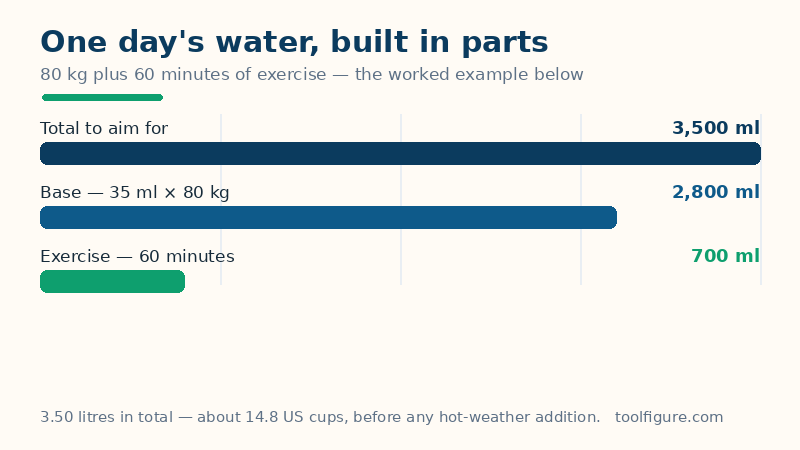
Each term is a rule of thumb and the page says so rather than dressing it up. The 35 ml per kilogram rule is the standard planning figure dietitians use when a measured prescription is not needed; the exercise addition mirrors sports-medicine guidance to replace roughly a bottle of water for every half hour of sweating work; and the hot-day addition is deliberately modest, because the honest instruction for serious heat and long exertion is not a number at all — it is to drink to thirst, weigh the sweat loss where that matters, and replace electrolytes on efforts over an hour. The reference row under your result is the check on the whole build: the US National Academies' adequate intake for total water is 3.7 litres a day for men and 2.7 litres for women, food included — a fixed population figure, useful as a cross-check against your personalised one.
Worked example: 80 kg, one hour of exercise, temperate day
The defaults above give: base = 35 × 80 = 2,800 ml; exercise = 60 ÷ 30 × 350 = 700 ml; no hot-weather addition. Total = 3,500 ml — 3.50 litres, which is about 14.8 US cups, 118.3 fl oz, or exactly 14 glasses of 250 ml. Of that total, roughly 2.80 litres would typically arrive as drinks and the rest in food — a bowl of soup, fruit and cooked grains all carry real water. The same build on a hot day adds 500 ml and reaches exactly 4.00 litres. A cross-check with different inputs: a 65 kg woman with 30 minutes of exercise gets 2,275 + 350 = 2,625 ml (2.63 litres), about 11.1 cups — a little under the National Academies' 2.7-litre reference for women, which is the right relationship: the reference is a sedentary population average, and the weight-based build moves sensibly around it. Note also how the “eight glasses” slogan fails this example in both directions: eight 250 ml glasses are 2.0 litres — short for the 80 kg exerciser, and roughly right only for a smaller, sedentary person.
The base amount, weight by weight (no exercise, temperate day)
| Body weight | Base water (35 ml/kg) |
|---|---|
| 50 kg | 1,750 ml |
| 60 kg | 2,100 ml |
| 70 kg | 2,450 ml |
| 80 kg | 2,800 ml |
| 90 kg | 3,150 ml |
| 100 kg | 3,500 ml |
The straight line is the point: water need is proportional, not a fixed quota. Each extra 10 kg of body weight carries about 350 ml of extra turnover a day — coincidentally the same as the value of half an hour of exercise in this build, which is a tidy way to remember both numbers. This weight-scaled view is the same logic the calorie calculator uses for energy, and it is why one-size slogans mislead at both ends of the weight range.
How to read your result, and the limits — read these
Aim for the total across the whole day, drinks and watery food together, and let thirst and pale-yellow urine be the daily check — for healthy adults in normal conditions, thirst is a well-tuned instrument and this figure is a planning backdrop, not a quota to force down. The honest limits: the 35 ml rule is a rule of thumb, and real needs shift with fever, vomiting or diarrhoea (when rehydration matters urgently and medical advice beats any calculator), with high-fibre or high-protein diets, with altitude, and in pregnancy and breastfeeding, where reference intakes rise. More is not always better: drinking far beyond thirst for hours — especially during endurance exercise without electrolytes — can dilute blood sodium dangerously, a condition called hyponatraemia. And one group must not use this page as written: people whose clinician has set a fluid restriction, commonly for heart failure or kidney disease — that instruction overrides every number here. If hydration is a medical question for you, take it to your clinician; if it is a planning question, the total above and a bottle you actually refill will do the job.
Frequently asked questions
How much water should I drink a day?
A practical build, used on this page: 35 ml per kilogram of body weight, plus about 350 ml per half hour of exercise, plus 500 ml on a hot day. For the worked example — 80 kg and an hour of exercise — that is 3.50 litres of total water, food included. The fixed reference figures used as a cross-check are the US National Academies' adequate intakes: 3.7 litres a day total for men, 2.7 litres for women, of which roughly 80% normally comes from drinks.
Is the '8 glasses a day' rule real?
No study supports it, and its origin has never been traced to any scientific body. Eight 250 ml glasses make 2.0 litres — close to the need of a smaller sedentary adult, well short of a larger or active one, and more than some small, sedentary people require from drinks once food water is counted. It survives because it is memorable, not because it is right; a weight-based figure is a better starting point, corrected by thirst.
Does tea, coffee and food count towards the total?
Yes. The reference intakes — and the total this calculator gives — are for water from all sources. Tea and coffee are mostly water and count in full for habitual drinkers; the mild diuretic effect of caffeine does not cancel their fluid. Food typically supplies about 20% of the day's water: fruit, vegetables, soup, yoghurt, rice and pasta all carry significant water. Only alcohol leans the other way, increasing urine output, so it is not a hydration strategy.
How much extra water do I need when I exercise?
The planning rule used here is about 350 ml (12 fl oz) for every 30 minutes of exercise — 700 ml for an hour. Heavy sweating in heat can exceed a litre an hour, and for efforts over about an hour, sports-medicine guidance adds electrolytes (sodium) to the replacement, not just water. A practical check used by athletes: weigh yourself before and after; each kilogram lost is roughly a litre of sweat to replace gradually.
Can you drink too much water?
Yes, though it is uncommon outside endurance events and certain medical situations. Drinking far more than thirst dictates over several hours can dilute blood sodium — hyponatraemia — which is dangerous. The safeguards are simple: drink to thirst rather than to a forced schedule, do not try to finish exercise heavier than you started, and include electrolytes on very long efforts. Anyone told to restrict fluids by a clinician should ignore general targets like this page's entirely.