Pace is time wearing a different outfit
Runners talk in pace — how long one kilometre or one mile takes — because it is the number you can act on mid-run: glance at a kilometre split and you know instantly whether the plan is holding. Drivers and cyclists talk in speed — how much ground one hour covers — which is the same fact turned upside down. This calculator moves between the two without friction, and runs the three jobs runners actually need: time + distance → pace (what did I just run?), pace + distance → finish time (what will this pace give me on race day?), and time + pace → distance (how far does an hour at this pace go?). It assumes one steady pace from start to finish — what that assumption costs in the real world is covered honestly below.
The formulas, with every term defined
Pace (seconds per km) = total time (seconds) ÷ distance (km)Finish time = pace (seconds per km) × distance (km)Distance (km) = total time (seconds) ÷ pace (seconds per km)Speed (km/h) = 3,600 ÷ pace (seconds per km) · Pace per mile = pace per km × 1.609344 · Speed (mph) = speed (km/h) ÷ 1.609344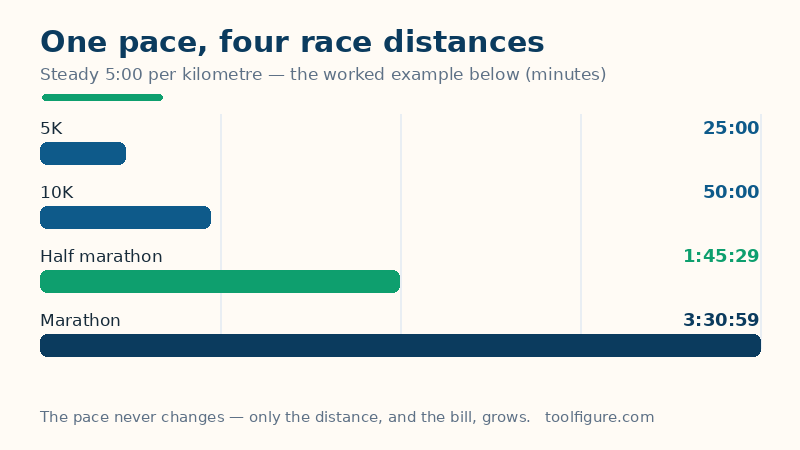
The three jobs are one relationship rearranged: time, distance and pace, where knowing any two fixes the third. The conversions rest on a single exact fact — one mile is 1.609344 kilometres. A mile takes longer than a kilometre at the same effort, so the per-mile pace is always the bigger number, and the two race distances have exact lengths too: a half marathon is 21.0975 km and a marathon is 42.195 km. Those extra metres are why multiplying a 10K time by 4.22, not by 4, predicts a marathon — and why the predicted times in the results table use the full distances.
Worked example: 10K in 50 minutes
The defaults above give: 50 minutes is 3,000 seconds, over 10 km, so pace = 3,000 ÷ 10 = 300 seconds per kilometre = 5:00/km. Per mile: 10 km is 6.214 miles, and 3,000 ÷ 6.214 = 482.8 seconds = 8:03/mile. Speed is the same run seen from the other side: 10 km in five-sixths of an hour is exactly 12.00 km/h, or 7.46 mph. Hold that one steady pace over the standard distances and the finish times fall out by simple multiplication: 5K in 25:00, 10K in 50:00, a half marathon in 1:45:29 (21.0975 × 300 seconds = 6,329 seconds) and a marathon in 3:30:59 (42.195 × 300 = 12,659 seconds). The bar chart above draws those four times — the shape of the lesson is how steeply the bill rises with distance at an unchanged pace. The other two modes check out just as cleanly: a target pace of 5:30/km over a half marathon predicts 21.0975 × 330 = 1:56:02, and one hour at 6:00/km covers 3,600 ÷ 360 = exactly 10.00 km.
What common paces are worth over race distances
| Pace per km | 10K | Half marathon | Marathon |
|---|---|---|---|
| 4:00/km | 40:00 | 1:24:23 | 2:48:47 |
| 4:30/km | 45:00 | 1:34:56 | 3:09:53 |
| 5:00/km | 50:00 | 1:45:29 | 3:30:59 |
| 5:30/km | 55:00 | 1:56:02 | 3:52:04 |
| 6:00/km | 1:00:00 | 2:06:35 | 4:13:10 |
| 6:30/km | 1:05:00 | 2:17:08 | 4:34:16 |
| 7:00/km | 1:10:00 | 2:27:41 | 4:55:22 |
Read the marathon column as a reality check on goals. A four-hour marathon — the target half of first-time marathoners seem to carry — needs 5:41/km held 42 times in a row; a five-hour marathon needs 7:07/km. The famous two-hour barrier, broken in a paced exhibition run in 2019, works out at 2:51/km — a pace most runners could not hold for a single kilometre, sustained for forty-two. The table also shows why small pace changes matter more the longer the race: 30 seconds per kilometre is 5 minutes over a 10K but more than 21 minutes over a marathon. If you are fuelling those long efforts, the calorie calculator covers the daily-energy side of training, and the water intake calculator adds its exercise allowance by the half hour.
How to read your result, and the limits — read these
Every figure here assumes the pace never changes: no hills, no wind, no water stops, no fading in the final third and no finishing kick. Real races bend all of those. GPS watches add their own error — a course measured a fraction long, or corner-cutting on the trace, shifts the computed pace by seconds per kilometre, which is why the watch pace and the official chip-time pace often disagree by a little. Treadmills report the belt's speed, which is honest arithmetic but not the same effort as the same pace outdoors. And the prediction table carries the biggest caveat of all: it extrapolates one pace across distances as if endurance were free. It is not. A pace you can hold for 10K is not a pace you can hold for a marathon, because fuelling, muscle damage and heat accumulate with time, not just distance — experienced runners expect to slow by roughly 5–10 seconds per kilometre each time the distance doubles, and even that assumes proper training for the longer distance. Use the predictions to set a sensible opening pace and to convert between units without error; use your training, not a multiplier, to judge what you can hold.
Frequently asked questions
What is the difference between pace and speed?
They are the same movement described inversely. Pace is time per unit of distance (5:00 per kilometre) — smaller is faster. Speed is distance per unit of time (12.00 km/h at that pace) — bigger is faster. They convert exactly: speed in km/h = 3,600 ÷ pace in seconds per kilometre. Runners plan in pace because splits arrive one kilometre at a time; most other sports quote speed.
What pace do I need for a 4-hour marathon?
5:41 per kilometre (9:09 per mile), held evenly for 42.195 km: 14,400 seconds ÷ 42.195 km = 341 seconds per kilometre. In practice, aim to run the first half a touch slower than that and finish at the average — an even or slightly negative split is far more achievable than starting at 5:30/km and hoping, because the fade in the last 10 km is where marathon targets usually go to die.
How do I convert pace per kilometre to pace per mile?
Multiply by 1.609344, the exact number of kilometres in a mile. The worked example's 5:00/km (300 seconds) becomes 300 × 1.609344 = 482.8 seconds = 8:03 per mile. Going the other way, divide: an 8:00 mile (480 seconds) is 480 ÷ 1.609344 = 298 seconds = 4:58/km. This calculator always shows both, so the conversion never depends on your mental arithmetic mid-run.
Why does my watch pace differ from my official race pace?
Usually distance, not time. Your watch measures the line you actually ran — wider on corners, longer weaving through a crowd — and GPS position error adds a little more, so it often records 42.4 or 42.5 km for a marathon measured at exactly 42.195 km. Pace is time divided by distance, so an overstated distance flatters the pace. The official pace uses the certified course distance: chip time ÷ 42.195 km. A difference of 2–4 seconds per kilometre between the two is common and is not a fault in either number.
What is a good 5K pace?
There is no single answer — it depends entirely on the runner — but the arithmetic frames it: a 30:00 5K is 6:00/km, a 25:00 5K is the worked example's 5:00/km, and a 20:00 5K needs 4:00/km held five times. For a new runner, finishing a 5K at any steady pace is the meaningful milestone; after that, improving by 10–15 seconds per kilometre over a training block is solid, realistic progress. Judge your pace against your own last race, not against a stranger's.