Why eight hours can feel worse than seven and a half
Sleep is not a uniform tank you fill; it runs in cycles of roughly 90 minutes, each one descending from light sleep into deep sleep and back up into dreaming (REM) sleep. Waking near the end of a cycle, when sleep is lightest, tends to feel clear-headed. Waking mid-cycle — dragged out of deep sleep by an alarm set for an arbitrary “8 hours” — produces the heavy, groggy state called sleep inertia, even after a longer night. That is the whole trick this calculator performs: it counts time in whole cycles instead of whole hours. Five cycles is 7 hours 30 minutes of sleep; six cycles is 9 hours. Both are recommended targets below; a tidy-looking 8 hours is 5 cycles plus a half-finished sixth, which is exactly the arithmetic that leaves people puzzled about feeling rough.
The formula, with every term defined
One sleep cycle ≈ 90 minutes · Sleep length = cycles × 90 minutesBedtime = wake-up time − (cycles × 90 minutes) − minutes you take to fall asleepWake-up time = bedtime + minutes to fall asleep + (cycles × 90 minutes)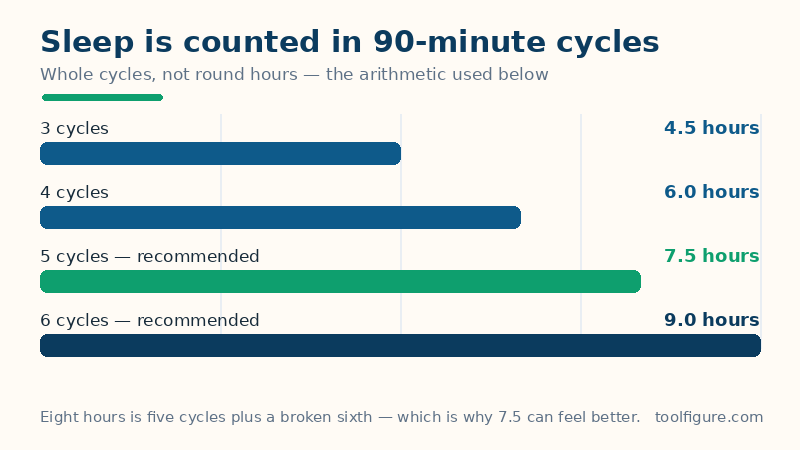
Two honest qualifications belong inside the formula box, not buried below it. First, 90 minutes is an average: measured cycles run about 80–120 minutes, they lengthen and change composition across the night, and they differ between people — which is why this page offers a choice of cycle counts rather than one magic minute. Second, the falling-asleep allowance (15 minutes by default, the commonly cited average) matters: cycles begin when you are asleep, not when the light goes off, so the count starts from lights-out plus that allowance. If you know you drift off in 5 minutes or in 40, change the field — a personal number beats the population average every time.
Worked example 1: the alarm is set for 06:30
The defaults above give, working backwards from 06:30 with a 15-minute falling-asleep allowance: six cycles (9 hours of sleep) means asleep by 21:30, so in bed at 21:15 the previous evening. Five cycles (7 hours 30 minutes) means asleep by 23:00, in bed at 22:45. Four cycles (6 hours) lands at 00:15, and three cycles (4 hours 30 minutes) at 01:45. Read that table the way it is meant to be read: the realistic choice most nights is between 21:15 and 22:45 — both complete-cycle bedtimes that also deliver totals inside the 7–9 hours most adults are advised to get. The 00:15 line is not a recommendation; it is the least-bad option for a late night, included so a short night still ends on a cycle boundary instead of in the middle of deep sleep.
Worked example 2: in bed at 23:00
Run the same arithmetic forwards: in bed at 23:00, asleep by about 23:15, and the cycles end at 03:45 (3 cycles), 05:15 (4 cycles), 06:45 (5 cycles) and 08:15 (6 cycles). Notice what happens to the person who sets a 07:00 alarm from a 23:00 bedtime: asleep at 23:15, the alarm fires 7 hours 45 minutes later — five full cycles plus 15 minutes into a sixth, on the way down towards its deep phase. Moving that alarm just 15 minutes earlier, to the 06:45 cycle end, often feels better than the “extra” quarter hour. The “Going to sleep now” button does this forward count from the current time, for the nights when the plan is simply whenever I get to bed, do not wreck the morning.
How much sleep, by age — the reference ranges
| Age group | Recommended sleep per day | In 90-minute cycles |
|---|---|---|
| Teenagers (13–17) | 8–10 hours | about 5½–6½ cycles |
| Adults (18–64) | 7–9 hours | about 5–6 cycles |
| Older adults (65+) | 7–8 hours | about 5 cycles |
| School-age children (6–12) | 9–12 hours | 6–8 cycles |
These are the widely published US CDC ranges, and the cycle column is this page's own conversion of them — which is why the calculator's recommended rows are the five- and six-cycle lines: 7½ and 9 hours bracket the adult range neatly. Children need markedly more, and their bedtimes should be set from the hours column, not from cycle counting alone. Total sleep still matters more than cycle timing: five complete cycles beat six broken ones, and no rearrangement of bedtimes turns a 4½-hour night into a healthy habit — it only makes the short night slightly less bad.
How to read your result, and the limits — read these
Treat the times as targets with a tolerance, not appointments: because real cycles vary by ±20 minutes or so, landing within about 10 minutes of a listed time captures most of the benefit, and chasing the exact minute adds stress that itself delays sleep. Consistency beats precision — a regular wake time, even at a slightly imperfect cycle point, trains the rhythm that makes all of this easier, which is why sleep clinicians fix the wake time first and let the bedtime follow. The limits that matter: this page models an average sleeper with uninterrupted sleep. Alcohol, illness, a newborn, shift work and many medications all fragment or reshape cycles in ways no arithmetic here captures, and trackers that claim to score your actual cycles from wrist movement are estimating too. Above all: if you regularly sleep 8–9 hours and still wake exhausted, or you snore heavily with witnessed pauses, or falling asleep routinely takes over an hour, the right next step is a clinician — those are symptoms to investigate, not scheduling problems to optimise.
Frequently asked questions
How long is one sleep cycle?
About 90 minutes on average — a full pass through light sleep, deep sleep and REM (dreaming) sleep. Measured cycles actually run roughly 80–120 minutes and change across the night, with deep sleep concentrated early and dreaming concentrated towards morning. The 90-minute figure is the planning average every sleep-cycle calculator uses; it is a good ruler, not a stopwatch reading of your personal night.
Is 7.5 hours of sleep really better than 8 hours?
It can feel that way, and the arithmetic shows why: 7.5 hours is exactly five complete 90-minute cycles, ending in light sleep, while 8 hours is five cycles plus 30 minutes into a sixth — often deep sleep, where being woken feels worst. That is a statement about how you feel on waking, not about total health: across weeks, regularly getting under 7 hours carries real costs regardless of cycle timing, which is why this page recommends the 5- and 6-cycle lines and treats shorter options as fallbacks.
How much sleep do I actually need?
The widely published CDC ranges are 7–9 hours for adults, 7–8 for older adults, 8–10 for teenagers and 9–12 for school-age children. Within those ranges the honest test is daytime function: needing an alarm to drag you out of deep sleep most days, falling asleep unintentionally, or relying on escalating caffeine all suggest the total — or the quality — is short, whatever the clock said.
Why does the calculator ask how long I take to fall asleep?
Because cycles are counted from when you are asleep, not from when the light goes off. If you plan a 22:45 bedtime for five cycles but actually take 45 minutes to drift off, you get about 6 hours 45 minutes of sleep and the alarm lands mid-cycle anyway. The default 15 minutes is the commonly cited average latency; set it to your own usual time and the bedtimes shift by exactly that difference.
Do naps follow the same cycle rule?
Yes, and it gives the two classic nap lengths their logic: about 20 minutes stays in light sleep and refreshes without grogginess (wake before deep sleep begins), while about 90 minutes completes a full cycle and suits a real sleep debt — the worst nap is the 45–60 minute one that ends inside deep sleep. A 90-minute nap too late in the day can also delay the night's falling asleep, so early afternoon is the usual slot.