Sold by the ton, spread by the inch — the two conversions that catch people out
Gravel is the one garden material nobody can eyeball. It arrives as a heap whose size tells you nothing, it is priced by a unit — the ton — that has no visible size at all, and it disappears into the ground as a layer whose depth you chose on a screen. The arithmetic that connects those three facts is short, and this calculator does it in the open: the bed's volume from its length, width and depth, an allowance for compaction added on top because loose gravel settles once spread, the weight that a bulk delivery is actually priced by, and the bag count for jobs too small to justify a truck. Work the area out first with the square footage calculator if the space is not a clean rectangle.
The formulas, with every term defined
Volume = length × width × depth (all in feet; depth in inches ÷ 12) · Cubic yards = cubic feet ÷ 27Order volume = exact volume × (1 + compaction % ÷ 100) · Weight (tons) = order cubic yards × density (tons per yd³)Bags = order cubic feet ÷ 0.5 ft³ per bag, rounded UP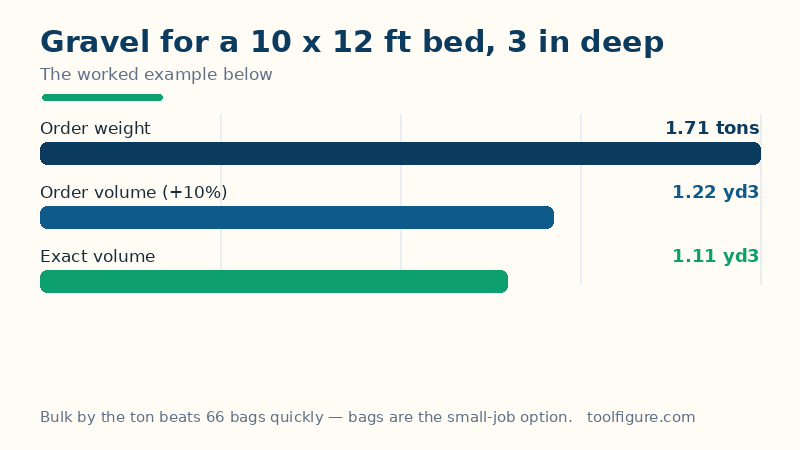
Three numbers do the heavy lifting. A cubic yard is 27 cubic feet — a 3 ft cube — which is why a layer that sounds thin still eats volume: 3 inches is a quarter of a foot, so every 108 sq ft of bed at that depth is a full cubic yard. The density of ordinary loose gravel is about 1.4 tons per cubic yard (roughly 104 lb per cubic foot, which is why a standard 0.5 ft³ bag weighs about 50 lb); rounded pea gravel runs a little lighter, dense crushed stone a little heavier, and wet material heavier again — the field is editable for exactly that reason. And the compaction allowance is not padding for its own sake: a loose 3-inch layer raked level settles toward 2½ inches underfoot and under tyres, so ordering the exact volume is ordering a layer that ends up thinner than the one you planned.
Worked example: a 10 × 12 ft bed, 3 inches deep
The defaults above give: area 10 × 12 = 120 sq ft; volume 120 × 0.25 ft = 30.00 ft³, which is 30 ÷ 27 = 1.11 yd³ (0.85 m³). Adding the 10% compaction allowance: 33.00 ft³ = 1.22 yd³ to order. At 1.4 tons per yd³ that weighs 1.22 × 1.4 = 1.71 tons, and at $45 a ton the bulk cost is $77.00. Bought bagged instead, 33.00 ÷ 0.5 = 66 bags — the row that usually ends the bags-versus-bulk debate for anything bigger than a path. The bar chart above draws the exact volume, the order volume and the weight.
Other jobs, measured the same way
| Job | Exact volume | Order (+10%) | Weight | Bags |
|---|---|---|---|---|
| Bed 10 × 12 ft, 3 in deep (worked example) | 1.11 yd³ | 1.22 yd³ | 1.71 tons | 66 |
| Patio base 10 × 10 ft, 4 in deep | 1.23 yd³ | 1.36 yd³ | 1.90 tons | 74 |
| Garden path 20 × 3 ft, 2 in deep | 0.37 yd³ | 0.41 yd³ | 0.57 tons | 22 |
| Driveway 20 × 20 ft, 4 in deep | 4.94 yd³ | 5.43 yd³ | 7.60 tons | 294 |
| Metric bed 3 × 4 m, 50 mm deep | 0.60 m³ | 0.66 m³ | 1.21 tons | 47 |
Read the driveway row as the warning it is: doubling both dimensions of the worked example quadruples the area, and the deeper layer takes the order to 7.6 tons — a full truck, not a trailer job, and 294 bags if bought the slow way. Depth is the lever with the longest reach: on the worked example's bed, going from 3 inches to 4 adds a third to every figure in the row, which is why the depth a landscaper quotes is worth checking against the job — paths are happy at 2 inches, driveway bases want 4 or more, and decorative beds sit in between.
How to read your result, and the limits — read these
The exact volume assumes a level bed of even depth, and real ground is neither: a bed dug into a slope, or soil that dips in the middle, takes more than the rectangle promises, which is the second job the 10% allowance quietly does. Measure the depth you will actually finish at — after the soil underneath is levelled and firmed — not the depth of the hole as dug. The weight is an estimate built on the density you set: suppliers' stone varies, a rain-soaked load weighs more than the same volume dry, and the weighbridge figure on the delivery ticket, not this page, is what you are charged for — treat the tonnage here as the number to order and budget by, and expect the ticket to land within roughly a tenth of it. One more distinction worth knowing: a ton here is the US short ton of 2,000 lb; a metric tonne is 1,000 kg (about 2,205 lb), and suppliers outside the US quote in tonnes — the calculator's weight at the worked example is 1.71 short tons, about 1.55 tonnes. For a base that must carry weight, the layer under the gravel matters as much as the gravel: the concrete calculator covers the poured alternative for the same footprint.
Frequently asked questions
How much gravel do I need for a 10 × 12 foot area?
At the usual 3-inch depth: the volume is 120 sq ft × 0.25 ft = 30 cubic feet = 1.11 cubic yards. Add 10% for compaction and you order 1.22 cubic yards, which at the standard density of 1.4 tons per cubic yard weighs 1.71 tons — or 66 bags of 0.5 cubic feet if the job is being done bagged. Depth changes everything: the same area at 4 inches needs 2.07 tons before the allowance.
How many tons are in a cubic yard of gravel?
About 1.4 tons for ordinary loose gravel — the figure this calculator starts from. The honest range is roughly 1.3 to 1.6: rounded pea gravel sits at the light end, dense crushed stone and wet material at the heavy end. That spread is why the density is an editable field here, and why a supplier's weighbridge ticket can differ from any calculator's estimate by about a tenth without anyone making an error.
How deep should gravel be?
It depends on the traffic the layer carries. A decorative bed or a garden path is well served at 2 inches; a driveway or parking area wants 4 inches or more over a firm base, because tyres push a thin layer aside and expose the soil. Whatever depth you choose, enter the finished depth — the level after the ground beneath has been levelled and compacted, not the depth of the hole as first dug.
How many bags of gravel equal a ton?
A standard bag holds 0.5 cubic feet and weighs about 50 lb at gravel's usual density, so a ton (2,000 lb) is roughly 40 bags — and the worked example's 1.71-ton order is 66 bags. That conversion is the practical dividing line between the two ways of buying: under about half a ton, bags are convenient; above it, a bulk delivery by the ton is almost always cheaper per unit and a great deal less carrying.
Why does the calculator add 10% on top of the exact volume?
Because loose gravel does not stay loose. Spread, raked and then walked or driven on, it settles into itself — a 3-inch layer finishes nearer 2½ inches — and some is always lost to spillage, edges and uneven ground along the way. Ordering the exact mathematical volume guarantees a layer thinner than planned or a second trip; the 10% is the trade's standard allowance, shown openly here so you can raise it for rough ground or set it to zero for a contained, level bed.