One converter, four kinds of measurement — and no factor hidden
Most conversion mistakes are not arithmetic mistakes. They are unit mistakes: a US gallon read as a UK gallon (they differ by about 20%), a stone read as a pound, a temperature converted with a ratio when temperature does not work by ratio at all. This converter handles the four groups people convert daily — length, weight, volume and temperature — states the exact factor behind each one, and answers in every unit in the group at once, so the figure a recipe, parcel label, landlord or weather forecast uses is already on the page. The measuring tools elsewhere on this site lean on the same factors: the square footage calculator converts its areas exactly this way.
How the conversion works, with every factor defined
Base amount = value × the from-unit's factor · Converted value = base amount ÷ the to-unit's factorLength, base metre: mm 0.001 · cm 0.01 · inch 0.0254 · foot 0.3048 · yard 0.9144 · mile 1,609.344Weight, base kilogram: gram 0.001 · ounce 0.028349523125 · pound 0.45359237 · stone 6.35029318 · tonne 1,000Volume, base litre: ml 0.001 · US tsp 0.00492892159375 · US tbsp 0.01478676478125 · fl oz 0.0295735295625 · US cup 0.2365882365 · US gallon 3.785411784 · UK gallon 4.54609Temperature (formulas, not factors): °F = °C × 9/5 + 32 · K = °C + 273.15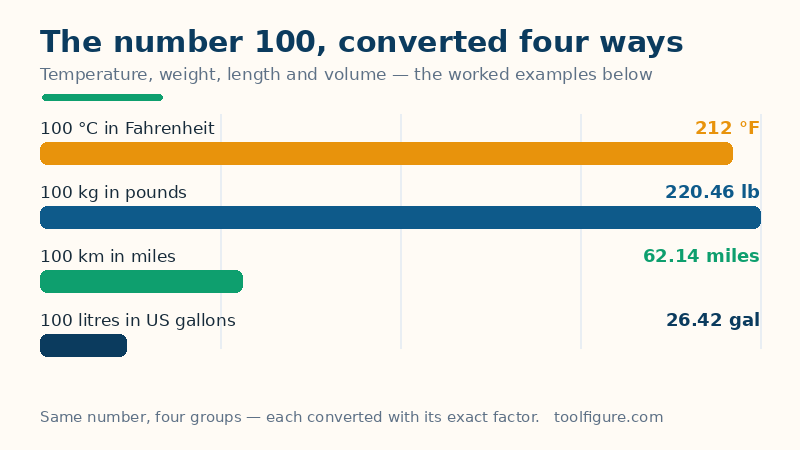
These factors are definitions, not measurements. Since 1959 the inch has been defined as exactly 25.4 millimetres, which makes the foot exactly 0.3048 metres and the mile exactly 1,609.344 metres; the pound is defined as exactly 0.45359237 kilograms; the US gallon is defined as exactly 231 cubic inches, which works out to 3.785411784 litres. That is why conversions done with them can be checked to the last digit — and why there is no excuse for a converter that quietly uses 1.6 for the mile. Temperature is the genuine exception on the page: Celsius and Fahrenheit disagree about where zero is as well as about how big a degree is, so a factor alone would give wrong answers, and the formulas above are applied instead. Kelvin shares the Celsius degree and simply starts at absolute zero.
Worked example: 10 kilometres in miles, feet and inches
The defaults above convert 10 kilometres. Through the base unit: 10 × 1,000 = 10,000 metres. Dividing by each factor in turn gives the whole row on the right: 6.2137 miles (10,000 ÷ 1,609.344), 32,808.399 feet (÷ 0.3048), 10,936.133 yards (÷ 0.9144) and 393,700.7874 inches (÷ 0.0254), alongside 10,000,000 millimetres and 1,000,000 centimetres. Two habits follow from the method. First, converting to a bigger unit always makes the number smaller — 10 of anything becoming 6.2137 of a larger thing is the correct shape — and if a converter ever tells you 10 km is 16 miles, it has divided the wrong way. Second, the familiar road distances fall straight out of the same factors: a marathon's 42.195 km is 26.2188 miles, and a 6-foot person is 6 × 0.3048 = 1.8288 metres (182.88 cm) tall.
The conversions people actually ask for
| Conversion | Answer | How it is worked |
|---|---|---|
| 10 kilometres to miles (worked example) | 6.2137 miles | 10,000 m ÷ 1,609.344 |
| 80 kilograms to pounds | 176.3698 lb | 80 ÷ 0.45359237 |
| 1 pound to kilograms | 0.4536 kg | The definition itself, rounded to 4 places |
| 70 kilograms to stone | 11.0231 st | 70 ÷ 6.35029318 |
| 20 °C to Fahrenheit | 68 °F | 20 × 9/5 + 32 |
| 37 °C (body temperature) to Fahrenheit | 98.6 °F | 37 × 9/5 + 32; 310.15 K |
| 100 °C to Fahrenheit | 212 °F | Water's boiling point, at standard pressure |
| 1 US gallon to litres | 3.7854 L | The definition, rounded to 4 places |
| 250 ml to US cups | 1.0567 cups | 0.25 ÷ 0.2365882365 |
| 1 litre to US fluid ounces | 33.814 fl oz | 1 ÷ 0.0295735295625 |
Three rows deserve a second look. The −40 curiosity is real: −40 °C and −40 °F are the same temperature (233.15 K), the one point where the two scales cross — try it above. The gallon row hides the commonest trap on the page: the UK gallon is 4.54609 litres, about a fifth larger than the US gallon, which is why a car's fuel economy figure cannot be carried across the Atlantic unconverted. And the stone — 14 pounds exactly — survives in UK and Irish body-weight talk long after it left the shops, so a weight given as "11 stone" is 69.85 kg, not a typo.
How to read your result, and the limits
Results are shown to at most four decimal places, which is more precision than any tape measure, scale or jug can justify — for real use, round the answer to the precision of the thing you measured with. Two limits matter more than precision. Same name, different unit: beyond the two gallons, watch the ton family (a metric tonne is 1,000 kg; a US short ton is 907.18 kg; a UK long ton is 1,016.05 kg — this page uses the metric tonne, labelled as such) and the fluid ounce (the UK fluid ounce is about 4% smaller than the US one). Cooking measures are volumes wearing costumes: a US cup of flour and a US cup of water share a volume but not a weight, so volume-to-weight cooking conversions need the ingredient-specific approach of a dedicated cooking converter, not this page's pure volume factors. Finally, temperature conversions for weather, cooking and the body are exact with the formulas above; scientific work below −273.15 °C does not exist, and the converter says so rather than printing a number colder than absolute zero.
Frequently asked questions
How many miles is 10 kilometres?
6.2137 miles. Ten kilometres is 10,000 metres, and a mile is exactly 1,609.344 metres, so 10,000 ÷ 1,609.344 = 6.2137. The quick mental version — kilometres × 0.62 — gives 6.2, close enough for a road sign but not for a race result, which is why this page uses the exact factor.
Why is the UK gallon bigger than the US gallon?
They were standardised separately. The US gallon is 231 cubic inches — exactly 3.785411784 litres — while the UK (imperial) gallon is 4.54609 litres, about 20% larger. It is the single most common conversion error between the two countries: fuel economy, fuel tanks and large recipes all shift by a fifth if the wrong gallon is used. Both are listed separately above.
Why does temperature not convert with a factor like the others?
Because the scales disagree about zero as well as about degree size. 0 °C is 32 °F, not 0 °F, so a pure factor would turn freezing water into 0 °F. The formulas handle both shifts: °F = °C × 9/5 + 32, and kelvin adds 273.15 to Celsius. The scales cross at exactly one point: −40 °C = −40 °F.
How many pounds are there in 80 kilograms?
176.3698 lb — 80 ÷ 0.45359237, the exact definition of the pound. Rounded the way a bathroom scale shows it, 80 kg is 176.4 lb, or about 12 stone 8 lb in the UK style (a stone is exactly 14 lb).
Are these conversion factors exact?
Yes — for the units on this page they are definitions, not measurements. The inch has been defined as exactly 25.4 mm since 1959, the pound as exactly 0.45359237 kg, and the US gallon as exactly 231 cubic inches. Any remaining error in a conversion comes from how roughly the original value was measured, never from the factor.