Seven letters, added and — just six times — subtracted
Roman numerals are a tally system that grew up: seven symbols carry fixed values, and a number is written by laying symbols largest-first and adding them. Almost everything is addition. The single twist is that six pairs work backwards: a smaller symbol placed immediately before a bigger one is subtracted instead of added, so 4 is IV (5 − 1) rather than IIII. That one rule is the whole system — there is no place value, no zero, and no symbol ever repeats more than three times. Once the pairs are familiar, a date carved over a doorway or printed in a book's front matter reads like ordinary arithmetic, which is all this converter does: it builds (or takes apart) the numeral piece by piece and shows you every piece, in the same spirit as the step-by-step working on the fraction calculator.
The symbols and the six subtractive pairs, as formulas
I = 1 · V = 5 · X = 10 · L = 50 · C = 100 · D = 500 · M = 1,000IV = 4 · IX = 9 · XL = 40 · XC = 90 · CD = 400 · CM = 900To build a number: take the largest piece that fits, write it, subtract it, and repeat on what is left until nothing remains.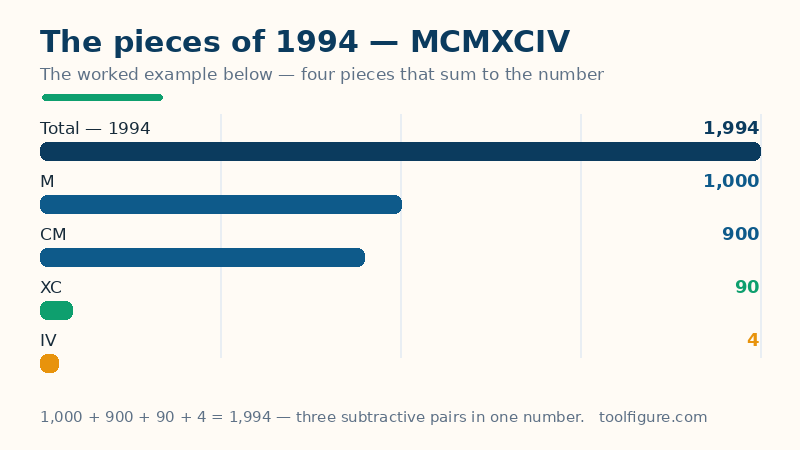
Every term earns its place. The seven symbols are the only letters the system uses. The six subtractive pairs exist so no symbol needs a fourth repetition: without them 4, 9, 40, 90, 400 and 900 would be IIII, VIIII, XXXX, LXXXX, CCCC and DCCCC. The building rule is greedy and provably settles on the standard form: largest piece first, every time. Reading runs the other way: scan left to right, adding each symbol — except that a symbol immediately followed by a larger one is subtracted, which is exactly the six pairs above and nothing else. A numeral this page accepts must also rebuild to itself under the building rule; that round-trip check is how non-standard spellings like IIII or VX are caught and corrected instead of quietly read.
Worked example: 1994, built piece by piece
The defaults above convert 1994. The largest piece that fits is 1,000 — M — leaving 994. The largest piece that now fits is not D (500 would leave 494, but 900 fits first): CM, leaving 94. Then XC (90) leaves 4, and IV finishes it. So 1994 = MCMXCIV: four pieces, seven symbols, and the pieces add back 1,000 + 900 + 90 + 4 = 1,994 exactly — the running-total column beside your result shows that sum being built. Read in reverse, the same numeral parses as M (1,000), then C before M subtracts (900), X before C subtracts (90), I before V subtracts (4). It is the classic teaching example precisely because it uses three of the six subtractive pairs in a single number.
Numbers people actually look up
| Number | Roman numeral | Why it is asked for |
|---|---|---|
| 1994 (worked example) | MCMXCIV | Uses the CM, XC and IV pairs at once |
| 4 | IV | Not IIII — the first subtractive pair |
| 9 | IX | Not VIIII |
| 44 | XLIV | Two pairs: XL (40) + IV (4) |
| 99 | XCIX | Not IC — I can only precede V or X |
| 444 | CDXLIV | CD (400) + XL (40) + IV (4) |
| 888 | DCCCLXXXVIII | The long way round: 12 symbols, no pairs needed |
| 944 | CMXLIV | CM (900) + XLIV (44) |
| 2026 | MMXXVI | The current year, as carved on new buildings |
| 3999 | MMMCMXCIX | The largest standard numeral |
Two rows deserve a pause. 99 as XCIX, never IC: a symbol may only subtract from the next two larger values — I (1) pairs with V and X, X (10) with L and C, C (100) with D and M — so 99 must be built as 90 + 9, not 100 − 1. And 888 as DCCCLXXXVIII shows the system's other extreme: when no pair applies, honest repetition does the work, three C's, three X's and three I's in a row.
Reading a numeral honestly — the limits
Three boundaries are worth stating plainly. The range ends at 3,999. Larger numbers were historically written with an overline (a vinculum) multiplying a numeral by 1,000, and forms vary by source; rather than invent one standard, this page stops where the universal one does. There is no zero and no negatives and no fractions — the system counted whole things, and later Roman fractions (based on twelfths) are a separate notation entirely. Old inscriptions break the rules on purpose. Many traditional clock faces show IIII for 4, and ancient and medieval texts use spellings no modern rulebook accepts; this converter will correct those to the standard form and tell you it did, which is what you want for dates, outlines, page numbers and chapter headings — the places Roman numerals still work for a living.
Frequently asked questions
What is 2026 in Roman numerals?
MMXXVI. It is built as 2,000 (MM) + 20 (XX) + 5 (V) + 1 (I), with no subtractive pairs needed. The year before, 2025, is MMXXV, and 2024 — which does need a pair — is MMXXIV.
Why is 4 written IV and not IIII?
Because in the standard form no symbol repeats more than three times, and 4 is the first place a fourth repetition would appear. The subtractive pair IV — 5 minus 1 — replaces it. Many traditional clock faces deliberately keep IIII, a long-standing clockmaker's convention; this converter uses the standard form and will correct IIII to IV, saying so.
What is the largest number in Roman numerals?
3,999, written MMMCMXCIX, in the standard form this page uses. Beyond it, historical writers placed an overline over a numeral to multiply it by 1,000 — so an overlined V means 5,000 — but that notation is not applied consistently across sources, so the converter stops at 3,999 rather than guess. The longest standard numeral in range is 3,888: MMMDCCCLXXXVIII, at 15 symbols.
Is there a Roman numeral for zero?
No. The Roman system counted things that existed, and zero arrived in Europe centuries later through Arabic and Indian mathematics. Medieval writers sometimes used N, for nulla (nothing), in tables, but it was never part of the counting system itself — which is why this converter reports zero as outside the system instead of inventing a symbol.
Why is 99 XCIX and not IC?
Because subtraction is rationed: a symbol may only be subtracted from the next two larger values. I (1) may precede V (5) or X (10); X (10) may precede L (50) or C (100); C (100) may precede D (500) or M (1,000). IC would subtract 1 from 100, skipping a rank, so 99 is built honestly as 90 + 9: XCIX.