Counting backwards from the period that has not happened yet
Most people assume ovulation sits in the middle of the cycle. For a textbook 28-day cycle it does — but the rule that actually drives this calculator is different, and more reliable: ovulation happens about 14 days before the next period starts, whatever the cycle length. The stretch after ovulation (the luteal phase) is fairly steady at around 14 days in most cycles, while the stretch before it is what stretches and shrinks when a cycle runs long or short. So the estimate is a piece of backwards counting: lay the cycle out from the last period, mark where the next period should fall, and count 14 days back. Around that day sits the fertile window — the handful of days when conception is possible at all — because sperm can survive for up to about five days waiting, while an egg lives for only about a day after release. This page runs that arithmetic for your cycle length, shows the next three cycles on the same rule, and links naturally to the due date calculator once a pregnancy begins.
The formulas, with every term defined
Ovulation day = first day of last period + (cycle length − 14) daysFertile window = ovulation day − 5 days … ovulation day + 1 dayNext period = first day of last period + cycle length · Estimated due date = ovulation day + 266 days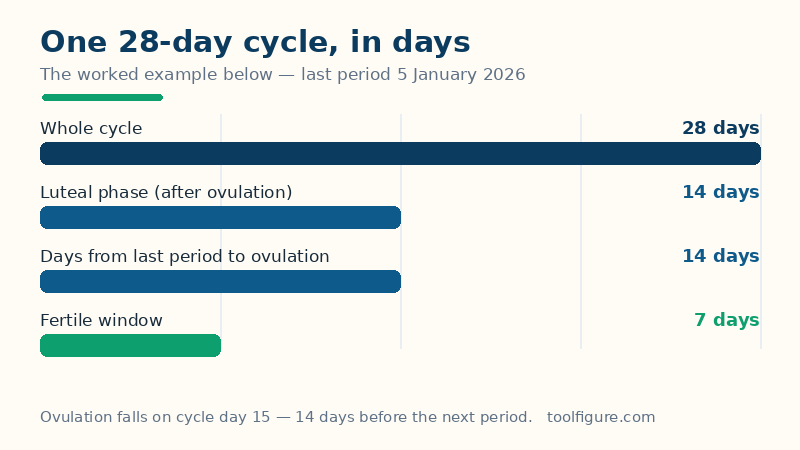
Read it in words. Cycle length is the count of days from the first day of one period to the first day of the next — not the number of bleeding days. The 14 is the average luteal phase: the days from ovulation to the next period. Subtracting it from the cycle length gives the days from the last period to ovulation, which is why a 28-day cycle ovulates around day 15 of the cycle (the last period itself is day 1) while a 35-day cycle does not ovulate until around day 22 — a week later, not in the middle. The fertile window adds the biology at both ends: five days before for sperm survival, one day after for the egg's short life, seven calendar days in total, with the two or three days nearest ovulation generally considered the most likely. The due date line is the same 266 days from conception that the due date page uses, so the two calculators agree exactly.
Worked example: a 28-day cycle starting Monday 5 January 2026
The defaults above enter a last period starting Monday 5 January 2026 with a 28-day cycle. Ovulation: 5 January + (28 − 14) = 5 January + 14 days = Monday 19 January 2026, which is cycle day 15. The fertile window runs five days before to one day after: Wednesday 14 January to Tuesday 20 January 2026. The next period is due 28 days after the last one began: Monday 2 February 2026. And if conception happens this cycle, ovulation + 266 days puts the estimated due date on Monday 12 October 2026 — the same date the due date calculator gives for this last period, as it should. The table under the result carries the rule forward: the next cycle starts 2 February with estimated ovulation on 16 February, and the one after starts 2 March with ovulation on 16 March 2026.
Longer and shorter cycles move ovulation, not the luteal phase
| Cycle length | Ovulation (from 5 Jan 2026) | Fertile window | Next period | Est. due date |
|---|---|---|---|---|
| 24 days | Thu 15 Jan 2026 | 10 – 16 Jan | 29 Jan 2026 | 8 Oct 2026 |
| 28 days (worked example) | Mon 19 Jan 2026 | 14 – 20 Jan | 2 Feb 2026 | 12 Oct 2026 |
| 32 days | Fri 23 Jan 2026 | 18 – 24 Jan | 6 Feb 2026 | 16 Oct 2026 |
| 35 days | Mon 26 Jan 2026 | 21 – 27 Jan | 9 Feb 2026 | 19 Oct 2026 |
Read the pattern down the table: the gap between ovulation and the next period is 14 days in every row, while the gap between the last period and ovulation grows from 10 days to 21. That is the single most useful fact on this page — someone with a 35-day cycle who plans around "day 14" is aiming about a week early. A second check with different dates: a last period on Tuesday 10 March 2026 with a 32-day cycle gives ovulation on Saturday 28 March, a fertile window of 23–29 March, a next period on 11 April and an estimated due date of 19 December 2026.
Reading an estimate honestly — the limits
Three cautions belong with every date here. It is a model, not a measurement. Real luteal phases vary — roughly 10 to 16 days across people and cycles — and ovulation can shift with illness, stress, travel and disrupted sleep, so treat the fertile window as the centre of a wider range rather than a fence. Ovulation predictor kits, basal temperature charting and cervical-mucus tracking measure your actual cycle and narrow the estimate in a way calendar maths cannot. Irregular cycles widen everything: if your cycle length swings by a week or more, a single "usual" length will misplace ovulation by days in many cycles. And this is never contraception: a calendar estimate must not be relied on to avoid pregnancy — sperm survival and early or late ovulation defeat tidy windows regularly. If a period is late, a pregnancy test answers the question this page cannot; if cycles are persistently very irregular, painful or absent, that is a conversation for a clinician, not a calculator.
Frequently asked questions
How is the ovulation date calculated?
By counting backwards from the next period. Ovulation happens about 14 days before a period starts, so the calculator adds your cycle length to the first day of your last period to find the next period, then subtracts 14 days. For a 28-day cycle starting 5 January 2026 that gives ovulation on 19 January 2026 — cycle day 15, not day 14, because the period day itself counts as day 1.
What exactly is the fertile window?
The days in a cycle when conception is possible: about five days before ovulation, the day itself, and one day after — seven calendar days here. Sperm can survive up to about five days in the body, while an egg lives roughly a day, which is why the window leans before ovulation rather than after it. The days closest to ovulation are generally the most likely.
My cycle is 35 days. Do I still ovulate on day 14?
No — that is the most common misunderstanding this page exists to correct. The steady part of the cycle is the roughly 14 days after ovulation, not the part before it. On a 35-day cycle ovulation falls around day 22; the table above shows a 35-day cycle starting 5 January 2026 ovulating on 26 January, a full week after the 28-day example.
Can I use this calculator to avoid pregnancy?
No. It is a calendar estimate built on an average luteal phase, and real ovulation moves with stress, illness, travel and ordinary variation. The fertile window it prints is the centre of the likely range, not its edges. Do not rely on it — or on any calendar calculator — as contraception.
How accurate is the estimated due date shown here?
It is the standard estimate, not a scan date. The calculator adds 266 days to the estimated ovulation day, which for a 28-day cycle is exactly the 280 days from the last period that the due date calculator uses — both pages give 12 October 2026 for a 5 January 2026 last period. An early ultrasound can revise the date, and only a minority of babies arrive on the estimate itself.