A power is multiplication with a counter attached
An exponent is an instruction to multiply a number by itself, over and over: the base is the number, the exponent (or power) is the count. Three to the power four is 3 × 3 × 3 × 3 = 81 — four threes, multiplied. That one idea, extended honestly, covers everything this calculator does: an exponent of 0 (multiply by the base zero times, leaving the starting 1), negative exponents (divide instead — the reciprocal of the positive power), and fractional exponents (roots in disguise — the power 0.5 is the square root, which the square root calculator unpacks). Powers are also the engine under half the finance on this site: the compound interest formula is a power wearing a dollar sign. This page strips the idea back to the arithmetic and shows the multiplication itself wherever the exponent is a small whole number, so a result can be checked by hand instead of trusted.
The rules, with every term defined
base ^ exponent: for a whole-number exponent, the base multiplied by itself that many timesbase ^ 0 = 1 (any base but 0) · base ^ (−n) = 1 ÷ (base ^ n) · base ^ (1/2) = the square root of the basebase ^ (a × b) = (base ^ a) ^ b · log10(base ^ exponent) = exponent × log10(base)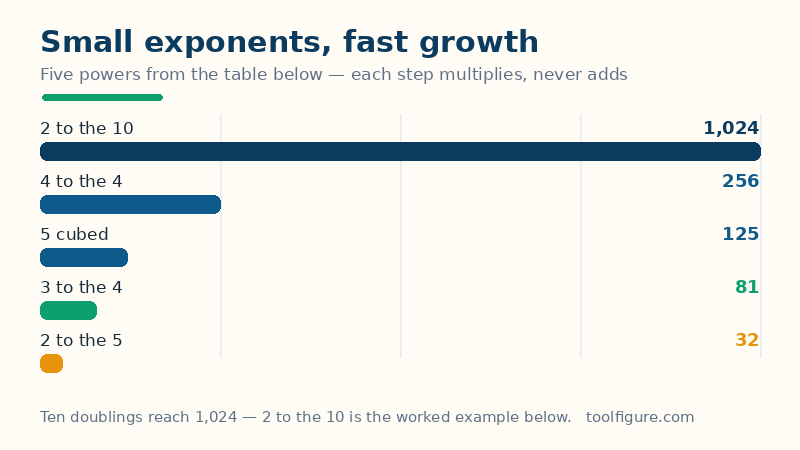
Read it in words. Each step up in the exponent multiplies by the base once more; each step down divides by it — which is why the ladder must pass through 1 at exponent 0 (2^3 = 8, 2^2 = 4, 2^1 = 2, so 2^0 = 1) and why negative exponents land on fractions (2^−1 = 1/2, 2^−3 = 1/8 = 0.125). A fractional exponent splits into a power and a root: 9^0.5 is the square root of 9, which is 3, and 3^0.5 ≈ 1.7321 is the square root of 3 wearing exponent notation. The last rule in the box is the calculator's built-in check, printed under every positive result: the base-10 logarithm of the answer must equal the exponent times the logarithm of the base — for 2^10, log10(1,024) = 3.0103, and 10 × log10(2) = 3.0103. It is the same machinery the scientific calculator exposes key by key; this page keeps the focus on the single operation.
Worked example: 2 to the power 10
The defaults above enter a base of 2 and an exponent of 10. Multiplied out, that is 2 × 2 × 2 × 2 × 2 × 2 × 2 × 2 × 2 × 2 — ten twos. Halfway there, five twos make 2^5 = 32, and the whole product is 32 × 32 = 1,024: ten doublings carry 2 past a thousand. The result table shows the reciprocal, 1 ÷ 1,024 = 0.00097656 (which is 2^−10), the neighbours 2^9 = 512 and 2^11 = 2,048 — each exactly half and double, as steps on a doubling ladder must be — and the logarithm check, 3.0103 on both sides. The number 1,024 is also why computing counts storage in powers of two: 2^10 bytes is one kibibyte, and the "kilo" of early computing was 1,024, not 1,000.
Powers worth recognising on sight
| Power | Meaning | Result |
|---|---|---|
| 2^10 (worked example) | ten doublings | 1,024 |
| 2^5 | five doublings | 32 |
| 3^4 | 3 × 3 × 3 × 3 | 81 |
| 5^3 (5 cubed) | 5 × 5 × 5 | 125 |
| 4^4 | 4 × 4 × 4 × 4 | 256 |
| 7^3 (7 cubed) | 7 × 7 × 7 | 343 |
| 10^4 | a 1 and four 0s | 10,000 |
| 2^16 | sixteen doublings | 65,536 |
| 2^−3 | 1 ÷ 2^3 = 1/8 | 0.125 |
| 10^−2 | 1 ÷ 100 | 0.01 |
| 9^0.5 | the square root of 9 | 3 |
| 3^0.5 | the square root of 3 | 1.7321 |
| 5^0 | any base to the 0 | 1 |
| (−2)^3 | odd power keeps the sign | −8 |
| (−2)^2 | even power clears the sign | 4 |
Read the table as three families. The whole-number powers grow by multiplication, which is why they outrun intuition: 2^16 is not "a bit more than 2^10", it is 64 times it. The negative powers are the same ladder read downwards, shrinking below 1 — 0.125 and 0.01 are 1/8 and 1/100 exactly. And the fractional powers are roots: an exponent of 0.5 asks "what, squared, gives the base?", so 9^0.5 = 3 exactly while 3^0.5 is the irrational 1.7321…, printed to four decimal places. The chart near the top draws five of the whole-number rows as bars — the jump from 32 to 1,024 across the table is the multiplication doing its work. A base between 0 and 1 reverses the direction entirely: 0.5^3 = 0.125, shrinking at every step, which is the arithmetic of decay and of discount factors.
Reading a power honestly — the limits
Four cautions belong with any figure here. Size runs out fast. Doubles — the numbers every browser calculates with — top out at about 10^308; ask for 10^400 and this page says the result overflows instead of printing a confident wrong answer, and a tiny result like 10^−400 underflows to 0 with the same explanation attached. Negative bases are picky: a whole-number exponent is fine ((−2)^3 = −8, (−2)^2 = 4), but a fractional exponent on a negative base has no real-number answer, and the calculator refuses rather than print a complex number as if it were real. 0^0 is genuinely undefined — the counting definition gives no answer, textbooks that adopt 1 do so as a convention for empty products, and this page names the gap instead of picking a side silently; 0 to a negative power is worse, a division by zero. And decimals are rounded at the last digit: irrational results like 3^0.5 are shown to four decimal places (1.7321), and long whole numbers beyond fifteen digits switch to scientific notation (2^60 = 1.1529 × 10^18) rather than print digits the arithmetic cannot guarantee.
Frequently asked questions
What is 2 to the power 10?
1,024. It is ten twos multiplied: 2 × 2 × 2 × 2 × 2 × 2 × 2 × 2 × 2 × 2. The halfway point is useful to know — 2^5 = 32, and the full product is 32 × 32. The number matters beyond maths class: 2^10 bytes is one kibibyte, so the earliest computer memory sizes (1,024, 65,536 = 2^16) are all powers of two.
Why is any number to the power 0 equal to 1?
Because the ladder forces it. Each step down in the exponent divides by the base: 2^3 = 8, 2^2 = 4, 2^1 = 2 — so the next step, 2^0, is 2 ÷ 2 = 1. The same holds for every base except 0 itself: 5^0 = 1 and 10^0 = 1. It is not a rule pasted on top of the pattern; it is the pattern, continued one step further.
What does a negative exponent mean?
One over the positive power. 2^−3 = 1 ÷ 2^3 = 1/8 = 0.125, and 10^−2 = 1/100 = 0.01. The calculator prints this reciprocal under every result, labelled with the negative exponent it equals — so 2^10 = 1,024 comes with its mirror 2^−10 = 0.00097656. A negative exponent never makes a result negative; it makes it small.
What is a fractional exponent, like the power 0.5?
A root. The exponent 0.5 is the square root: 9^0.5 = 3 because 3 squared is 9, and 4^0.5 = 2 exactly. Irrational bases give irrational answers — 3^0.5 = 1.7321 to four decimal places. The general rule splits the fraction: a power of 1/n is the nth root, and a power like 0.75 is a power and a root combined, which is why fractional exponents on negative bases are refused here — they leave the real numbers.
How big can an exponent result get?
Until about 10 to the power 308 — the ceiling of the double-precision numbers browsers compute with. Within range, big results switch to scientific notation rather than fake exact digits: 2^60 is shown as 1.1529 × 10^18. Past the ceiling the calculator shows an overflow message and stops, which is the honest answer — the true value exists, but no ordinary calculator display can hold it.