Three sides are enough — if they can form a triangle at all
Give a triangle's three side lengths and the triangle is completely fixed: there is only one shape, up to flipping it over, that those three lengths can make. That is why surveyors triangulate and why three measurements are enough for this calculator to return the area, the perimeter, all three angles and the heights. But three lengths do not always make a triangle. Lay a 2-unit and a 3-unit strip end to end and they still cannot reach around a 10-unit side: the two shorter sides must together beat the longest, a rule called the triangle inequality. This page checks it before anything else and explains the failure instead of printing a nonsense area — the check most quick calculators skip. For the special case where one angle is known to be 90 degrees, the Pythagorean theorem calculator is the faster route; this page handles every triangle, right-angled or not.
The formulas, with every term defined
Perimeter P = a + b + c · Semiperimeter s = P ÷ 2 · Area = √(s × (s − a) × (s − b) × (s − c))Angle A = arccos((b² + c² − a²) ÷ (2 × b × c)) — and likewise for B and C · Height to side a = 2 × area ÷ a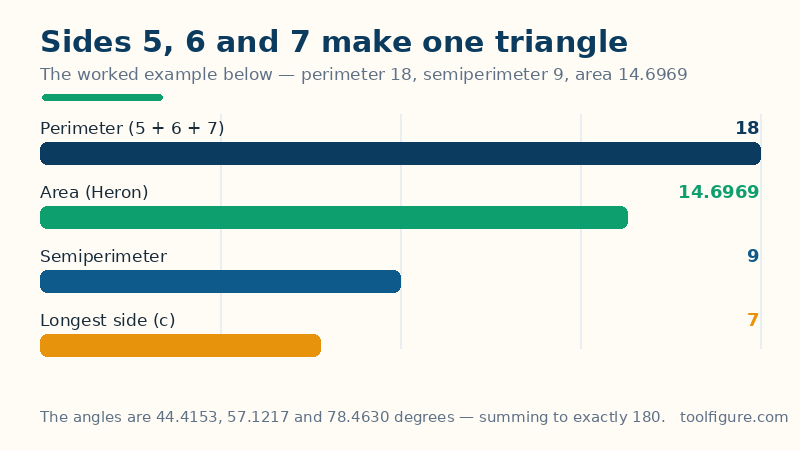
Read it in words. The sides are a, b and c; the angle named with the same letter sits opposite that side, so angle A is the corner between sides b and c, facing side a. The perimeter is the walk around the outside. The semiperimeter s is simply half of it — an intermediate, but the one Heron's area formula is built from. Heron's formula (the square-root line) is the remarkable part: it finds the area from the sides alone, with no height and no angle ever measured. The law of cosines then recovers each angle from the sides — it is the Pythagorean theorem generalised, and it reduces to Pythagoras exactly when an angle is 90 degrees. Each height (altitude) follows from the area: since area is also half of base times height, the height to any side is twice the area divided by that side. A triangle is acute when every angle is under 90 degrees, right when one is exactly 90, and obtuse when one exceeds 90; by sides it is equilateral (all equal), isosceles (two equal) or scalene (all different).
Worked example: sides of 5, 6 and 7
The defaults above enter sides a = 5, b = 6, c = 7. First the check: 5 + 6 = 11 beats 7, so the triangle exists. The perimeter is 5 + 6 + 7 = 18, so the semiperimeter s is 9. Heron's formula gives area = √(9 × (9 − 5) × (9 − 6) × (9 − 7)) = √(9 × 4 × 3 × 2) = √216 = 14.6969 square units. The law of cosines gives angle A = 44.4153°, angle B = 57.1217° and angle C = 78.463° — and the built-in check is that they sum to exactly 180 degrees, which they do. The largest angle, 78.463°, is under 90, and no two sides are equal, so this is a scalene, acute triangle. Its heights are 5.8788 to side a, 4.8990 to side b and 4.1991 to side c — note the tallest height belongs to the shortest side, because the same area spread over a shorter base must stand taller.
Five triangles, five different characters
| Sides | Area | Angle A | Angle B | Angle C | Type |
|---|---|---|---|---|---|
| 3 – 4 – 5 | 6 | 36.8699° | 53.1301° | 90° | Scalene, right |
| 5 – 5 – 5 | 10.8253 | 60° | 60° | 60° | Equilateral, acute |
| 5 – 5 – 8 | 12 | 36.8699° | 36.8699° | 106.2602° | Isosceles, obtuse |
| 2 – 3 – 4 | 2.9047 | 28.9550° | 46.5675° | 104.4775° | Scalene, obtuse |
| 10 – 10 – 12 | 48 | 53.1301° | 53.1301° | 73.7398° | Isosceles, acute |
| 5 – 6 – 7 (worked example) | 14.6969 | 44.4153° | 57.1217° | 78.463° | Scalene, acute |
Read the equal-side rows for a pattern worth remembering: whenever two sides match, the angles opposite them match too — 36.8699° twice in the 5–5–8 row, 53.1301° twice in the 10–10–12 row — and in the equilateral row all three collapse to 60°. The 3–4–5 row is the familiar right triangle wearing this page's clothing: Heron gives its area as exactly 6 (the same half-of-3-times-4 the legs give directly), and its largest angle lands on exactly 90.0000°. And the 2–3–4 row shows how close a triangle can sit to failing altogether: 2 + 3 beats 4 by a single unit, and the result is a thin, obtuse sliver with an area under 3 despite a perimeter of 9. For the area of a triangular patch of ground priced by the unit, the square footage calculator carries the base-times-height version into square feet and acres.
Reading a triangle answer honestly — the limits
Three cautions belong with any result here. Nearly-flat triangles amplify measurement error. When two sides only just beat the third, the area depends on a small difference between large numbers, and a 1% measuring error in a side can move the area by far more than 1% — measure thin triangles twice. The angle sum is a check, not a coincidence: the calculator computes the third angle as 180 minus the other two, so the printed angles always sum exactly; if you entered rounded side lengths, the true triangle's angles can differ in the last decimal places shown. And these are flat (Euclidean) triangles: on the curved surface of the Earth, very large triangles — hundreds of kilometres a side — have angles summing to slightly more than 180 degrees, which is surveyors' spherical geometry, not an error here. At tape-measure and plot-of-land scales, the arithmetic on this page is exact.
Frequently asked questions
How do you find the area of a triangle from its three sides?
Use Heron's formula. Halve the perimeter to get the semiperimeter s, then the area is the square root of s × (s − a) × (s − b) × (s − c). For sides 5, 6 and 7: s is 9, so the area is √(9 × 4 × 3 × 2) = √216 = 14.6969 — the worked example above, with every step shown. No height or angle needs to be measured.
What is the triangle inequality?
The rule that any two sides of a triangle, added together, must be longer than the third side. Lengths of 2, 3 and 10 cannot form a triangle because 2 + 3 is less than 10 — the short sides cannot meet around the long one. When two sides exactly equal the third, the shape collapses flat into a line. This calculator checks the rule first and explains a failure instead of printing an impossible area.
How are the angles worked out from the sides?
By the law of cosines: angle A = arccos((b² + c² − a²) ÷ (2 × b × c)), with A opposite side a, and likewise for the others. For sides 5, 6 and 7 the angles are 44.4153°, 57.1217° and 78.463°, summing to exactly 180°. When a triangle is right-angled, the law of cosines reduces to the Pythagorean theorem — the 3–4–5 triangle's largest angle comes out at exactly 90°.
What makes a triangle acute, right or obtuse?
Its largest angle. Under 90 degrees the triangle is acute (the 5–6–7 example, at 78.463°), exactly 90 makes it right (3–4–5), and over 90 makes it obtuse (5–5–8, at 106.2602°). Separately, by sides: all equal is equilateral, two equal is isosceles, and all different is scalene — the calculator reports both classifications for every result.
Why is the height different for each side?
Because any side can serve as the base, and the area is fixed. Height to a side equals twice the area divided by that side, so the shortest side carries the tallest height: in the 5–6–7 example the heights are 5.8788 to side 5, 4.8990 to side 6 and 4.1991 to side 7. The same area spread over a shorter base has to stand taller — which is why a height is meaningless until you say which side it belongs to.