Four measurements, one number tying them together
A circle is completely described by a single measurement. Know how far it is from the centre to the edge and you know how wide it is, how far it is around the outside, and how much surface sits inside — because one constant, pi (π), links all four quantities in fixed ratios that never change, whatever the size of the circle. That is what makes this calculator useful in both directions: measure whichever quantity is easiest to reach — the width of a round table, the string around a tree trunk, the area of a pizza on a menu — and it recovers the rest, including the radius you would need to set a compass or mark out the circle in the first place. The one slip that ruins circle arithmetic is also the oldest: using the diameter where the radius belongs. Every formula on this page is written with the radius named, and the calculator converts for you, so the slip has nowhere to hide.
The formulas, with every term defined
Diameter d = 2 × r · Circumference C = 2 × π × r = π × d · Area A = π × r²Radius from area: r = √(A ÷ π) · Radius from circumference: r = C ÷ (2 × π) · Radius from diameter: r = d ÷ 2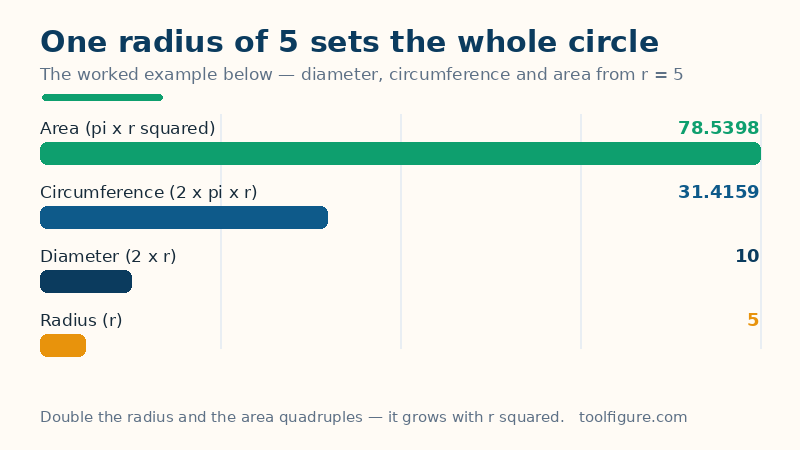
Read it in words. The radius (r) is the distance from the centre of the circle to any point on its edge. The diameter (d) is the distance straight across through the centre — exactly two radii, which is why d = 2 × r and why confusing the two doubles or halves everything downstream. The circumference (C) is the distance around the edge. Pi (π) is the ratio those two always keep: circumference divided by diameter is π for every circle that has ever existed, approximately 3.1416 — the check line under the result divides your circle's C by its d and shows π coming back. The area (A) is the surface inside, counted in square units, and it grows with the square of the radius: double the radius and the area does not double, it quadruples. The reverse formulas simply run the same equations backwards — the square root in the area version is the step the square root calculator isolates.
Worked example: a circle of radius 5
The defaults above enter a radius of 5. The diameter is 2 × 5 = 10. The circumference is 2 × π × 5 = 31.4159. The area is π × 5² = π × 25 = 78.5398 square units — note the 25 in that step: r squared, printed in the breakdown table, is what pi is multiplied by. The check divides circumference by diameter: 31.4159 ÷ 10 = 3.1416, pi itself. Every direction round-trips to this same circle: enter a diameter of 10, a circumference of 31.4159 or an area of 78.5398 in the modes above and the radius comes back as 5.
Circles at other sizes — and measured the other way
| Given | Radius | Diameter | Circumference | Area |
|---|---|---|---|---|
| Radius 1 | 1 | 2 | 6.2832 | 3.1416 |
| Radius 3 | 3 | 6 | 18.8496 | 28.2743 |
| Radius 5 (worked example) | 5 | 10 | 31.4159 | 78.5398 |
| Radius 7 | 7 | 14 | 43.9823 | 153.938 |
| Radius 10 | 10 | 20 | 62.8319 | 314.1593 |
| Area 100 | 5.6419 | 11.2838 | 35.4491 | 100 |
| Circumference 50 | 7.9577 | 15.9155 | 50 | 198.9437 |
Two lessons hide in that table. The first is the square law in action: going from radius 5 to radius 10 doubles the circumference (31.4159 to 62.8319) but multiplies the area by four (78.5398 to 314.1593). It is why a 14-inch pizza — radius 7, area 153.938 square inches — is almost exactly two 10-inch pizzas, not the modest step up the diameter suggests; menus price the diameter, but you eat the area. The second is that the reverse rows are the practical ones: an area of 100 gives a radius of 5.6419 through the square root, and a tape measure reading 50 around a post gives a radius of 7.9577 without ever finding the centre. For the area of a round patch of ground priced by the unit, the square footage calculator carries the same circle formula into square feet, yards and acres.
Reading a circle answer honestly — the limits
Three cautions belong with any result here. Pi never terminates. The calculator works with pi to full machine precision and prints four decimal places; the true circumference of a radius-5 circle is 31.415926… continuing forever, so the last printed digit is a rounding, not an exactness — irrelevant with a tape measure, but the reason the pi check reads 3.1416 rather than an endless string. Measurement error squares in the area. A radius measured 10% too large gives an area 21% too large (1.1 squared is 1.21), because the radius enters the area formula twice — measure the diameter and halve it if the centre is hard to find, since that halves the same error's effect. And real circles are rarely perfect: a worn wheel, a hand-dug pond or a tree trunk is an approximation of a circle, and the answer describes the ideal circle with your measurement, which for a trunk measured by tape is exactly what a forester's diameter estimate does too. Measure carefully, in one unit, and the geometry itself is exact.
Frequently asked questions
What are the formulas for a circle?
Diameter is twice the radius (d = 2 × r). Circumference is 2 × pi × radius, which is the same as pi × diameter. Area is pi × radius squared (A = π × r²). For a radius of 5: diameter 10, circumference 31.4159 and area 78.5398 — the worked example above, with every step shown.
How do I find the radius from the circumference?
Divide the circumference by 2 × pi (about 6.2832). A circumference of 50 gives a radius of 50 ÷ 6.2832 = 7.9577, and doubling it gives the diameter, 15.9155. This is the version to use when you can wrap a tape around something round — a post, a trunk, a pipe — but cannot measure across its centre.
How do I find the radius from the area?
Divide the area by pi and take the square root of the result. An area of 100 gives 100 ÷ pi = 31.83099, and the square root of that is a radius of 5.6419, so the diameter is 11.2838 and the circumference 35.4491. The calculator's area mode runs exactly this, and the square root step is why r appears squared in the area formula.
What happens if I use the diameter instead of the radius in the area formula?
The area comes out four times too big, not two — because the radius is squared. A circle of diameter 10 has a true radius of 5 and an area of 78.5398; feeding 10 into pi × r squared gives 314.1593, the area of a circle twice as wide. It is the most common circle error there is, and it is why this calculator asks which measurement you actually have and converts it itself.
What value of pi does this calculator use?
Pi to full machine precision (3.141592653589793…) in the arithmetic, with results printed to four decimal places — 3.1416 in the circumference-divided-by-diameter check shown under every result. Pi is irrational, so no decimal ever finishes it; four places is far beyond the accuracy of any tape measure, ruler or string you might measure the circle with.