The compound interest formula, run backwards
A sum of money promised in the future is not worth that sum today, because money in hand can be put to work in the meantime. Present value is the honest translation: what a known future amount is worth in today's money, at a stated annual rate over a stated wait. It is the exact reverse of the compound interest calculator — that page grows a deposit forward into a future value; this page discounts a future value back into a deposit. The two meet in the middle: $6,139.13 invested today at 5% becomes $10,000 in ten years, and $10,000 due in ten years at 5% is worth $6,139.13 today. Same equation, read in opposite directions. Settlements offered as "cash now or more later", lease and loan buyouts, lottery and pension lump sums, and any contract that trades money across time are all present-value questions wearing different clothes.
The formulas, with every term defined
Present value = future value ÷ (1 + r ÷ n) ^ (n × t) · Discount = future value − present valueContinuous compounding: present value = future value × e ^ (−r × t) · Effective annual rate = (1 + r ÷ n) ^ n − 1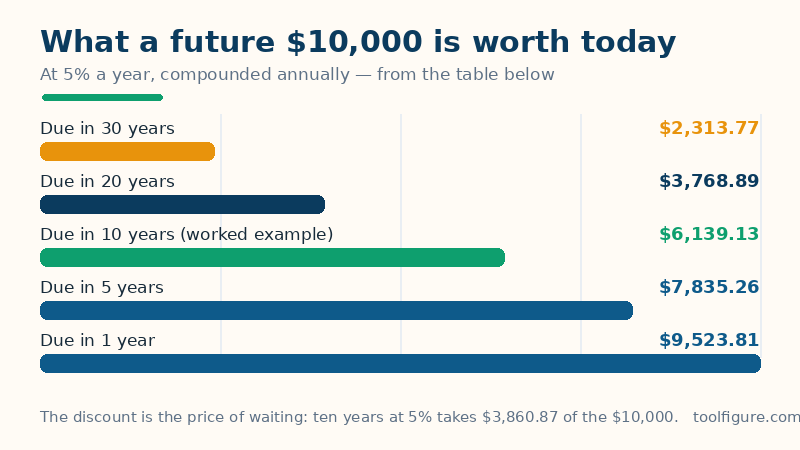
Read it in words. The future value is the sum you will receive. The rate r is the annual rate written as a decimal (5% = 0.05) — properly, your discount rate: the return the money could earn elsewhere, or the rate at which waiting costs you. The n is how many times a year interest compounds, and t is the wait in years. Dividing by (1 + r ÷ n) raised to n × t strips out exactly the growth that period would have added. The discount is what the wait itself costs, and the discount factor (present ÷ future) is the share of the future sum that survives in today's money — multiply any same-rate, same-wait sum by it. With continuous compounding the growth factor becomes e^(r × t) and the discounting is its mirror, e^(−r × t). The effective annual rate restates any compounding choice as the single yearly rate that would do the same work, which is the only fair way to compare two frequencies.
Worked example: $10,000 in ten years at 5%
The defaults above enter a future value of $10,000, a rate of 5%, a wait of 10 years and annual compounding. The growth factor is 1.05^10 = 1.6289, so the present value is 10,000 ÷ 1.6289 = $6,139.13. The discount for waiting is 10,000 − 6,139.13 = $3,860.87 — 38.61% of the future sum is the price of the ten-year wait at this rate, and the discount factor is 0.6139: about 61 cents of every promised dollar survives as today's money. Check it forwards if you like: $6,139.13 growing at 5% for ten years lands back on $10,000 (to the cent, allowing for rounding), which is the whole claim of the page in one line.
The same $10,000, waited for longer — and discounted harder
| Case | Wait / rate | Present value | Discount |
|---|---|---|---|
| Worked example | 10 years at 5% | $6,139.13 | $3,860.87 |
| Short wait | 1 year at 5% | $9,523.81 | $476.19 |
| Five years | 5 years at 5% | $7,835.26 | $2,164.74 |
| Twenty years | 20 years at 5% | $3,768.89 | $6,231.11 |
| Thirty years | 30 years at 5% | $2,313.77 | $7,686.23 |
| Gentler rate | 10 years at 3% | $7,440.94 | $2,559.06 |
| Harder rate | 10 years at 7% | $5,083.49 | $4,916.51 |
| Hardest rate shown | 10 years at 10% | $3,855.43 | $6,144.57 |
Two lessons sit in that table. Time compounds against a future sum just as it compounds for a saver: the second decade at 5% takes another $2,370.24 away (from $6,139.13 to $3,768.89), more than the first five years took. And the rate is a lever, not a detail — moving from 3% to 7% over the same ten years cuts the value by $2,357.45. The 3% row should look familiar: it is exactly the figure the inflation calculator prints for what $10,000 in ten years is worth in today's buying power at 3% inflation — because inflation discounting is present value, with the inflation rate as the discount rate. Compounding frequency, by contrast, is a small effect at honest rates: the same example compounded monthly is worth $6,071.61 today (effective rate 5.1162%) and continuously $6,065.31 (5.1271%) — real money, but tens of dollars where the rate choice moves thousands.
Reading a present value honestly — the limits
Four cautions belong with any figure here. The discount rate is an assumption, and it is doing most of the work. A "safe" rate (what a deposit pays) and a "risky-project" rate can differ by ten points, and the table above shows what that does to the answer — anyone presenting a present value without naming their rate is presenting an opinion as arithmetic. This tool values one single sum. Regular payments in or out — an annuity, a lease, a salary — need each payment discounted separately and summed; a pension's lump-sum offer cannot be judged by discounting its total as if it arrived in one payment at the end. Risk and taxes are not in the formula: a promised sum from a shaky payer is worth less than the same sum from a government, and tax on the eventual receipt changes the comparison again. And a negative rate reverses everything, honestly: at −2% for ten years the calculator returns $12,238.81 — in a deflationary world a future dollar buys more, so it is worth more today. The arithmetic never hides which way it is pointing; the judgement about which rate describes your situation stays yours.
Frequently asked questions
What is present value, in plain words?
The value today of money you will only receive later. Because today's money can earn a return, a future sum is discounted — shrunk — by the growth it would have earned over the wait. $10,000 arriving in ten years, at a 5% rate, is worth $6,139.13 today: invest that amount at 5% and it grows into exactly the $10,000 on the day it was due.
What discount rate should I use?
The rate that matches what the wait actually costs you. For a safe, guaranteed future sum, people commonly use a deposit or government-bond rate. For a business project, the rate is usually the return the same money could earn in your next-best use — your opportunity cost. The page's table shows why the choice matters: over ten years, 3% values $10,000 at $7,440.94 while 7% values it at $5,083.49. State your rate whenever you quote a present value.
Is present value just future value backwards?
Yes — the same equation read the other way. Future value multiplies today's sum by the growth factor; present value divides the future sum by it. At 5% over ten years the factor is 1.6289: $6,139.13 × 1.6289 = $10,000 going forward, and $10,000 ÷ 1.6289 = $6,139.13 coming back. The compound interest calculator on this site runs the forward direction with regular contributions added.
How much does compounding frequency change the answer?
A little, at ordinary rates. The worked example is worth $6,139.13 today compounded annually, $6,084.13 quarterly, $6,071.61 monthly and $6,065.31 continuously — a spread of $73.82 across every frequency, because more frequent compounding raises the effective annual rate (5.0000% annually becomes 5.1271% continuously) and a higher effective rate discounts harder. Frequency is worth stating, but it never outweighs the rate or the wait.
What is $20,000 in 15 years worth at 6%?
$8,345.30, compounded annually. The growth factor is 1.06^15 ≈ 2.3966, and 20,000 ÷ 2.3966 = $8,345.30; the fifteen-year wait at 6% costs $11,654.70 of today's money, well over half the future sum. Long waits at middling rates are exactly where present value surprises people — which is why lump-sum offers for distant payments deserve this calculation before any decision.