A logarithm is an exponent, read backwards
The exponent calculator starts from a base and a power and multiplies its way to a result. A logarithm starts from the result and asks the reverse question: to what power must this base be raised to give that number? The logarithm of 1,000 in base 10 is 3, because 10^3 = 1,000. That single idea explains every behaviour that makes logarithms look strange at first: the logarithm of 1 is 0 in every base (any base to the power 0 is 1), the logarithm of the base itself is 1, numbers between 0 and 1 have negative logarithms (10^−0.3010 = 0.5), and zero and negative numbers have no logarithm at all — no power of a positive base can reach them. Logarithms turn multiplication into addition and growth into straight lines, which is why they sit underneath sound levels, earthquake scales, acidity, and the interest mathematics elsewhere on this site. This page answers in any base and proves each answer by raising the base back to it — the antilog check printed in every result table.
The formulas, with every term defined
log base b of x = y means exactly: b ^ y = xChange of base: log base b of x = ln(x) \u00f7 ln(b) = log10(x) \u00f7 log10(b)Rules: log(a \u00d7 b) = log(a) + log(b) · log(a \u00f7 b) = log(a) \u2212 log(b) · log(a ^ n) = n \u00d7 log(a)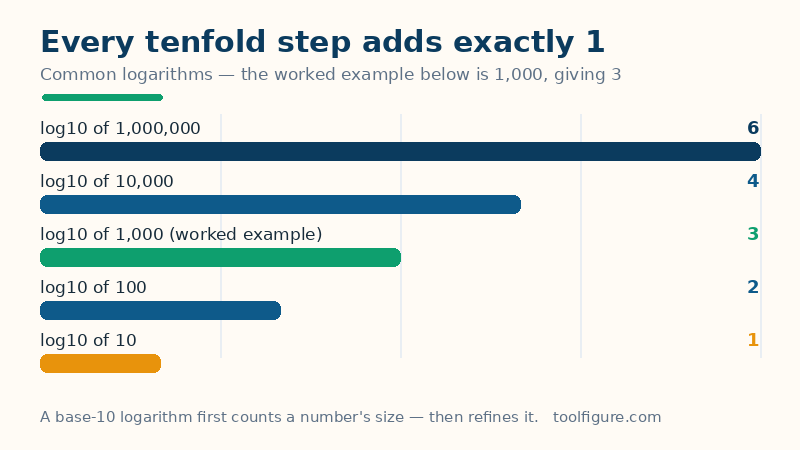
Read it in words. The base b is the number being repeatedly multiplied — it must be positive and not 1, because 1 to any power stays 1 and a negative base's powers jump in sign. The x is the number you have reached; it must be positive, for the reason above. The answer y is a count of multiplications, and it need not be a whole number: log10 of 50 is 1.6990, sitting between 10^1 = 10 and 10^2 = 100, closer to 100 as it should be. Three bases have their own names and buttons on every scientific calculator: base 10 is the common logarithm (written log), base e ≈ 2.71828 is the natural logarithm (written ln, and the one growth and interest formulas use), and base 2 is the binary logarithm (log2, the counting unit of computing). The change-of-base formula is how any calculator actually works: it knows only ln, so it divides — and this page shows that division in every result. The product rule in the last line is the historic point of the whole invention: logarithms were created so that multiplying two numbers could be replaced by adding their logarithms.
Worked example: the logarithm of 1,000 in base 10
The defaults above enter a number of 1,000 and a base of 10. Count the multiplications: 10^1 = 10, 10^2 = 100, 10^3 = 1,000 — so the answer is exactly 3, and the check in the result table raises 10 back to the power 3 and lands on 1,000. The same 1,000 read in the other standard bases is also in the table: its natural logarithm is 6.9078 (e^6.9078 = 1,000) and its binary logarithm is 9.9658 (2^9.9658 = 1,000 — just short of 2^10 = 1,024, the power of two that computing counts by, which is why the binary answer sits just under 10). And the change-of-base row shows the machinery plainly: ln(1,000) ÷ ln(10) = 6.9078 ÷ 2.3026 = 3, using the unrounded values the calculator keeps internally.
Logarithms worth recognising
| Logarithm | Meaning | Result |
|---|---|---|
| log10 of 1,000 (worked example) | 10^3 = 1,000 | 3 |
| log10 of 10 | 10^1 = 10 | 1 |
| log10 of 100 | 10^2 = 100 | 2 |
| log10 of 1,000,000 | 10^6 | 6 |
| log2 of 1,024 | 2^10 = 1,024 | 10 |
| log3 of 81 | 3^4 = 81 | 4 |
| log7 of 7 | any base, of itself | 1 |
| log10 of 50 | between 10 and 100 | 1.6990 |
| log10 of 20 | between 10 and 100 | 1.3010 |
| log2 of 50 | between 32 and 64 | 5.6439 |
| ln of 20 | e^2.9957 = 20 | 2.9957 |
| log10 of 0.5 | 10^\u22120.3010 = 0.5 | \u22120.3010 |
| log10 of 1 | any base, of 1 | 0 |
Read the table by families again. The whole-number answers are the powers themselves — every tenfold step adds exactly 1 to the base-10 logarithm, which is the chart near the top drawn as bars, and why a base-10 logarithm is a quick count of a number's size: log10 of anything from 1,000 to 9,999 begins with 3. The in-between answers are pinned by their neighbours: 50 must land between 1 and 2 in base 10 (it does, at 1.6990) and between 5 and 6 in base 2, since 2^5 = 32 and 2^6 = 64 (it lands at 5.6439). The same number owns a different logarithm in every base — 50 gives 1.6990, 3.9120 as a natural logarithm and 5.6439 in base 2 — which is why a logarithm quoted without its base is only half an answer. The scientific calculator carries log and ln keys for quick work; this page exists for the slower question of what the answer means and how to check it.
Reading a logarithm honestly — the limits
Four cautions belong with any figure here. The base is part of the answer: log of 50 is 1.6990, 3.9120 or 5.6439 depending on whether the base is 10, e or 2, and pages that write just "log" mean base 10 in school mathematics and base e in much of science — if a source will not say, its figures cannot be checked. There is no logarithm of zero or of a negative number in real arithmetic, and this calculator refuses rather than print the complex-number answer some software quietly substitutes. Results are rounded at the fourth decimal: irrational answers like log10 of 50 are shown as 1.6990, and raising 10 to the rounded 1.6990 gives 50.01 rather than exactly 50 — the check row uses the calculator's unrounded answer, so it lands on the number itself; expect the last digit to move if you retype a rounded result. And a logarithm compresses: equal steps on a log scale are equal ratios, not equal differences — the step from 1 to 2 on the chart above is the same multiplication as the step from 3 to 6, a doubling each time. That compression is the tool's power for data spanning huge ranges, and the trap when a chart's axis goes unexamined.
Frequently asked questions
What is a logarithm, in plain words?
The power a base must be raised to, to give your number. Log base 10 of 1,000 is 3 because 10 multiplied by itself 3 times is 1,000. It is the exponent operation read backwards, which is why every result on this page is checked by raising the base to the answer and showing the original number come back.
What is the difference between log, ln and log2?
Only the base. Log without a base written usually means base 10 (the common logarithm), ln is always base e \u2248 2.71828 (the natural logarithm, the one in growth and interest formulas), and log2 is base 2 (the binary logarithm used in computing). The number 1,000 has all three: log is 3, ln is 6.9078 and log2 is 9.9658 \u2014 all shown together in the result table.
Why is there no logarithm of 0 or of a negative number?
Because no power can reach them. A positive base raised to any power \u2014 whole, fractional or negative \u2014 always gives a positive result: powers shrink towards zero but never touch or cross it. So the question \u201chow many multiplications give 0, or \u22125?\u201d has no real-number answer, and this calculator says so instead of printing one. (A separate branch of mathematics, complex numbers, extends the idea \u2014 it is not what school or everyday logarithms mean.)
Why does the logarithm of 1 always equal 0?
Because every base to the power 0 is 1. Raising any base to the zeroth power is the \u201cmultiply zero times\u201d rung of the ladder, and it lands on 1 \u2014 so reading the ladder backwards, the logarithm of 1 is 0 in base 10, base 2, base e and every other base this calculator accepts. It is the fixed point the whole scale is anchored to, like 0 on a ruler.
How do I check a logarithm answer by hand?
Raise the base to the answer and see whether your number comes back \u2014 the check row printed in every result here. Log base 3 of 81 is claimed to be 4, and 3^4 = 3 \u00d7 3 \u00d7 3 \u00d7 3 = 81, so it is right. For a non-whole answer like log10 of 50 = 1.6990, the power only comes back exactly from the unrounded value; the rounded 1.6990 gives about 50.01, which tells you the rounding is honest rather than the answer wrong.