Two rates describe every loan — only one of them is honest
A loan is usually advertised by its stated interest rate: the rate used to work out the monthly payment. But the payment is not the whole cost. Most loans also carry upfront charges — an origination fee, an arrangement fee, points on a mortgage — that are taken out of the loan before the money reaches you. You then make payments on the full loan amount while having received less than it. The APR (annual percentage rate) is the rate that tells that fuller story: it is the annual rate at which the amount you actually received would produce exactly the payments you actually make. Two loans with the same stated rate but different fees have different APRs, which is why lenders in many countries are required to quote it — and why the comparison belongs to the APR, not the headline rate. This page does both halves in the open: the payment from the stated rate first, then the APR solved from the payment and the net amount, using the same payment formula as the loan calculator.
The formulas, with every term defined
Monthly payment = loan × i ÷ (1 − (1 + i) ^ −n), where i = stated rate ÷ 12 and n = number of monthly paymentsAPR is the rate j × 12 that solves: (loan − fees) = payment × (1 − (1 + j) ^ −n) ÷ j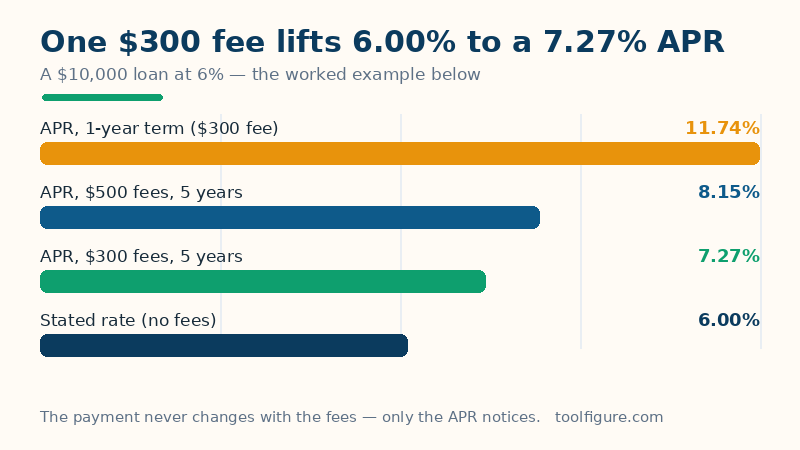
Read it in words. The first line is ordinary amortisation: each month you owe interest on the shrinking balance, and the payment is the level amount that clears the loan in exactly n months. The second line runs the same machinery backwards. There is no tidy closed-form answer for j — the equation cannot be rearranged into one — so the calculator solves it the honest numerical way: it tries monthly rates, finds the one whose payment on the net amount (loan minus fees) matches your real payment to within a hair, and multiplies that monthly rate by 12. Set the fees to zero and the second line collapses onto the first: the APR comes out exactly equal to the stated rate, which is the built-in proof that nothing extra has been smuggled in. Fees are also why the total cost of credit at the bottom of the result is simply interest + fees — every dollar the credit costs beyond repaying what you borrowed.
Worked example: $10,000 at 6% for five years, with $300 of fees
The defaults above enter a loan of $10,000, a stated rate of 6%, a term of 5 years (60 payments) and $300 of upfront fees. The payment formula gives $10,000 × 0.005 ÷ (1 − 1.005^−60) = $193.33 a month, a total of $11,599.68, and therefore $1,599.68 of interest. But the $300 fee means only $9,700 was ever received. Solving the second formula for the rate at which $9,700 produces $193.33 a month for 60 months gives a monthly rate of about 0.6062% — an APR of 7.27%. The fee has quietly added 1.27 percentage points to the cost of the loan, and the true total cost of the credit is $1,599.68 + $300 = $1,899.68. A rival loan at 6.5% with no fees would beat this one, despite the higher headline rate — that is the comparison the APR exists to make.
How the APR moves: fees, term and size
| Case | Payment | Interest | APR |
|---|---|---|---|
| Worked example — $10,000, 6%, 5 years, $300 fees | $193.33 | $1,599.68 | 7.27% |
| Same loan, no fees | $193.33 | $1,599.68 | 6.00% |
| Same loan, $500 fees | $193.33 | $1,599.68 | 8.15% |
| Same loan and fees, 1-year term | $860.66 | $327.97 | 11.74% |
| Same loan and fees, 10-year term | $111.02 | $3,322.46 | 6.68% |
| $20,000 at 5%, 5 years, $500 fees | $377.42 | $2,645.48 | 6.05% |
| $5,000 at 12%, 3 years, $200 fees | $166.07 | $978.58 | 14.86% |
| $300,000 mortgage at 6.5%, 30 years, $3,000 fees | $1,896.20 | $382,633.47 | 6.60% |
Three patterns are worth learning from that table. The payment never moves when the fees do — the first three rows pay the same $193.33 — because fees change what you received, not what you repay; only the APR notices. A short term concentrates a fee: the same $300 spread over 12 payments instead of 60 lifts the APR to 11.74%, nearly double the stated rate, while stretching it over ten years dilutes it to 6.68% (at the price of far more interest, as the $3,322.46 row shows — a lower APR gap is not the same as a cheaper loan). And size dilutes a fee: $3,000 of fees on a $300,000 mortgage moves the APR by only a tenth of a point, where $200 on a small $5,000 loan adds nearly three points. Small, short loans are exactly where fee-loading hides, and exactly where this check matters most. The chart near the top draws the fee effect for the worked example as bars.
Reading an APR honestly — the limits
Four cautions belong with any figure here. This tool counts the fees you enter, once, at the start. Official APR calculations follow local rules about which charges count — some include broker fees, closing costs and even ongoing insurance, others exclude some of them — so a lender's regulated APR quote can differ slightly from the figure here even on identical inputs. The method, though, is the same, and for comparing two offers entered the same way the difference is what matters. It assumes a fixed rate and on-time payments throughout: a variable-rate loan's true APR depends on rates nobody knows yet, and late fees are not in any APR. The payment is rounded for display; a real loan adjusts the final payment by a few cents so the payments sum exactly, which does not move the APR at two decimal places. And the APR is a rate, not a bill: the ten-year row above has the gentler APR gap and the larger interest total. Compare loans of the same term by APR; compare different terms by the total cost of credit as well. If a deal is stated as interest-free, the APY calculator covers the mirror-image question for savings — what a deposit rate is really worth once compounding is counted.
Frequently asked questions
What is APR, in plain words?
The annual rate that describes the whole deal, fees included. This page works it out by asking: at what rate would the amount you actually received — the loan minus its upfront fees — produce exactly the payments you make? On the worked example ($10,000 at 6% with $300 of fees) the answer is 7.27%: the payments are those of a 6% loan, but on only $9,700 received, which is a 7.27% deal.
Why is the APR higher than the stated rate?
Because the stated rate prices the payment, while the APR also prices the fees. The fee is taken before you receive the money, so you repay the full loan from a smaller starting amount — the same payments bought with less cash, which is a higher rate. With no fees the two are identical: the calculator returns exactly 6.00% on the worked example with the fee set to zero.
Does a shorter term really change the APR that much?
Yes — the table above is the proof. The same $10,000 loan at 6% with the same $300 fee has an APR of 11.74% over one year, 7.27% over five years and 6.68% over ten. The fee is a fixed sum; squeezed into fewer payments it is a much bigger slice of each one. This is why short payday-style loans with modest-looking fees carry very large APRs.
Can a 0% loan have an APR above zero?
Yes, whenever it carries fees. Enter $15,000 at 0% over 3 years with a $300 fee and this calculator returns an APR of 1.32% — the payment is $416.67, the interest is genuinely $0.00, and the $300 fee is the whole cost, which the APR honestly converts into a rate. Interest-free with a fee is not cost-free, and the APR is the number that says so.
Should I always choose the loan with the lowest APR?
Between loans of the same amount and the same term, yes — the lowest APR is the cheapest credit on a like-for-like basis. Across different terms, read the total cost of credit too: a longer term usually lowers both the payment and the APR gap while raising the total interest paid (the ten-year row pays $3,322.46 of interest against $1,599.68 over five years). APR for the rate, total cost for the bill — decide on both.