What a sum becomes when time and interest work on it
Future value is the forward-looking half of the time value of money: the question is not what a sum is worth, but what it becomes. Two engines do the becoming. A lump sum already in place grows by compounding — interest earning interest on itself — and a stream of regular payments grows payment by payment, the early ones compounding for longer than the late ones. This page runs both engines together and reports the parts separately, because the split is the useful part: it shows how much of the final figure you supplied yourself and how much the rate and the calendar supplied for you. It is the exact mirror of the present value calculator, which runs the same arithmetic backwards, and the close cousin of the compound interest calculator, which fixes the compounding at monthly and walks the balance year by year.
The future value formulas, with every term defined
Future value = PV × (1 + r)n + PMT × (((1 + r)n − 1) ÷ r)r = annual rate ÷ periods per year · n = years × periods per year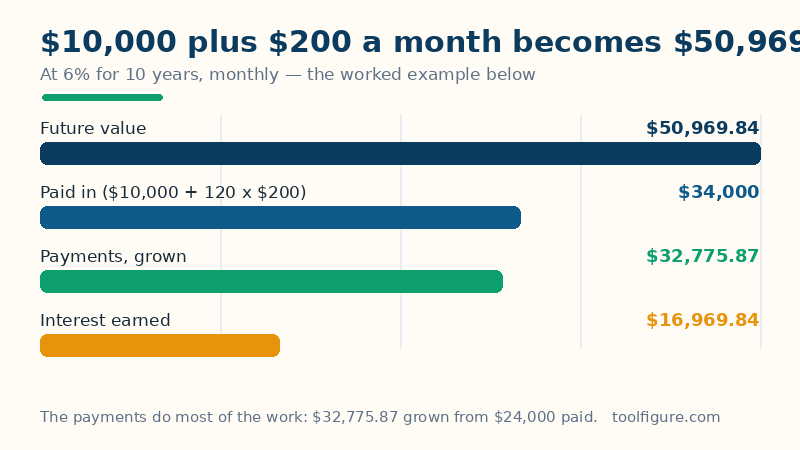
Read it in words. PV is the present value — the starting amount in place on day one. PMT is the payment made at the end of every period. r is the rate per period: the annual rate divided by how many periods a year contains, so 6% compounded monthly is 0.5% per period, not 6%. n is the total number of periods. The first term grows the lump sum: (1 + r)n is the growth factor, the multiple the starting money is carried by. The second term grows the payments: each payment compounds for the periods remaining after it lands, and the bracket ((1 + r)n − 1) ÷ r is the tidy sum of all those separate growths — the first payment grows for n − 1 periods, the last for none. One case needs no bracket at all: at a rate of exactly 0% there is no growth, and the future value is simply PV + PMT × n, everything paid in and not a cent more, which is the check every projection should pass before it is trusted.
Worked example: $10,000 plus $200 a month for 10 years at 6%
The defaults above enter a $10,000 starting amount, a $200 payment, a 6% annual rate, 10 years and monthly compounding. The period rate is 6 ÷ 12 = 0.5000% and the period count is 10 × 12 = 120, so the growth factor is 1.005120 = 1.81939673 (the breakdown above shows it rounded to 1.8194). The lump sum grows to $10,000 × 1.81939673 = $18,193.97. The payments grow by the bracket ((1.81939673 − 1) ÷ 0.005) = 163.879346, times $200, to $32,775.87 — noticeably more than the $24,000 actually paid, because the average payment sits invested for about half the decade. Added together, the future value is $18,193.97 + $32,775.87 = $50,969.84. Against it stands everything you supplied: $10,000 + (120 × $200) = $34,000.00 paid in. The difference, $50,969.84 − $34,000.00 = $16,969.84, is interest — 33.3% of the final figure, earned by neither the lump nor the payments alone but by the two compounding together, as the bar under the result and the chart near the top both draw.
The same plan, changed one piece at a time
| Plan (monthly, end-of-period payments) | Future value | Paid in | Interest |
|---|---|---|---|
| $10,000 + $200/mo, 6%, 10 years — worked example | $50,969.84 | $34,000.00 | $16,969.84 |
| The $10,000 lump alone, no payments | $18,193.97 | $10,000.00 | $8,193.97 |
| Same plan, 5 years | $27,442.51 | $22,000.00 | $5,442.51 |
| Same plan, 20 years | $125,510.22 | $58,000.00 | $67,510.22 |
| Smaller start: $5,000 + $100/mo, 5%, 5 years | $13,217.40 | $11,000.00 | $2,217.40 |
| Same plan at a 0% rate | $34,000.00 | $34,000.00 | $0.00 |
Read the table by what changes. Time is the strongest lever: doubling the wait from 10 years to 20 a bit more than doubles the future value, and the interest column overtakes everything paid in — $67,510.22 of interest on $58,000.00 of payments — because compounding is exponential, not proportional. The payments do the heavy lifting early: in the worked example the grown payments ($32,775.87) beat the grown lump ($18,193.97), even though the lump had a ten-year head start on every single payment. Frequency is a weaker lever than either: the $10,000 lump alone at 6% for 10 years grows to $17,908.48 compounded annually, $18,140.18 quarterly, $18,193.97 monthly and $18,220.29 daily — the whole annual-to-daily climb is worth about $312, real money but small next to one extra year of time. The annuity calculator values the payment stream on its own, in both directions at once; this page's job is the combined plan, lump and stream together.
Reading a future value honestly — the limits
Four cautions belong with any figure here. The rate is held constant, and real rates are not: a savings rate moves, an investment return arrives in lumps and losses, and a single average rate smooths a bumpy road into a straight one — the further out the projection, the wider the honest range around it. Payments land at the end of each period: a payment made at the start of each period compounds for one extra period, which lifts the payments part by one period's rate — the worked example becomes $51,133.72 instead of $50,969.84 (the annuity-due adjustment, worked through in the questions below). Inflation is not deducted: $50,969.84 in ten years buys what $37,926.35 buys today if prices rise 3% a year — run the inflation calculator on any long projection before celebrating it. And nothing here is a quote or a prediction: taxes, fees, contribution limits and product terms all move a real plan's outcome, so treat the result as the arithmetic of the assumptions you entered — exact for those assumptions, and only as good as they are.
Frequently asked questions
What is future value, in plain words?
What money left to compound becomes by a chosen date. The worked example's $10,000 starting amount and $200 monthly payments — $34,000.00 paid in over 10 years — become $50,969.84 at 6%, because every dollar in place earns interest, and the interest itself starts earning interest too. The $16,969.84 gap between the two figures is the whole point of the concept: it is what time plus a rate add to money that is simply left alone.
What changes if my payments land at the start of each period?
Each payment compounds for one extra period, so the payments part is multiplied by (1 + r). In the worked example that lifts the grown payments from $32,775.87 to $32,939.75 and the future value from $50,969.84 to $51,133.72 — a difference of exactly one month's interest on the payment stream. Rent, leases and some insurance premiums are start-of-period (annuity-due) payments; savings deposits and loan-free projections are usually modelled end-of-period, as this page does, and the page states which pattern it uses rather than hiding it.
How is this different from the compound interest calculator?
The compound interest calculator fixes compounding at monthly and walks the balance year by year, which suits watching one savings account grow. This page lets the compounding and payment frequency move together — annual, semi-annual, quarterly, monthly or daily — and splits the final figure into the grown lump sum and the grown payments, the split a settlement projection, a course-fee fund or a savings-goal plan usually needs. The two pages agree wherever their settings overlap: set both to $10,000 at 6% over 10 years with monthly compounding and the lump-sum growth is the same $18,193.97 before payments are counted (the compound page displays its totals rounded to whole dollars).
What does a 0% rate do — and why does the page allow it?
It reduces the formula to simple addition: future value = starting amount + payment × number of periods. The worked example at 0% returns exactly $34,000.00 — everything paid in, no interest — which is the correct answer for cash kept outside any account, and a useful honesty check on the tool itself: a calculator that cannot return the paid-in total at a zero rate has a bug in its growth maths, not a feature.
How can I check a future value by hand?
Rebuild it from the growth factor. For the worked example: the period rate is 6% ÷ 12 = 0.5%, the periods are 120, and 1.005 to the power of 120 is 1.81939673. Multiply the lump sum by the factor — $10,000 × 1.81939673 = $18,193.97. Then divide what is left of the factor by the period rate for the payments — (1.81939673 − 1) ÷ 0.005 = 163.879346 — and multiply by the payment: $200 × 163.879346 = $32,775.87. The two parts add to $50,969.84, and subtracting the $34,000.00 paid in leaves the $16,969.84 of interest. If a projection cannot be rebuilt this way from its own stated rate and periods, its assumptions are hidden somewhere — ask where.