A CD is compound interest with the doors locked
A certificate of deposit is the simplest savings product a bank sells: one amount goes in, a fixed rate is promised, and the money stays untouched until the term ends. That simplicity is also why it deserves its own page. The compound interest calculator models money you keep adding to; the APY calculator converts a rate on any account. A CD is neither — it is a single deposit, compounded on the bank's schedule, answered at one date: maturity. This calculator keeps the deposit and the interest as separate rows throughout, because on a CD the interest is the whole product — it is the only thing the rate buys you.
The method, with every term defined
Maturity value = deposit × ( 1 + rate ÷ periods per year ) ^ ( periods per year × years )Interest earned = maturity value − deposit · APY = ( 1 + rate ÷ periods per year ) ^ periods per year − 1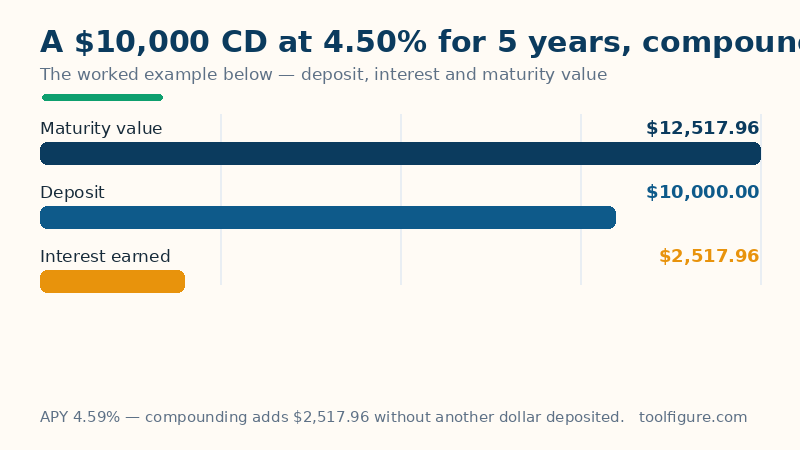
The deposit is the single amount paid in at the start — CDs do not take top-ups, so there is deliberately no monthly-contribution box. The rate is the annual rate the bank quotes, before compounding. Each period the balance is multiplied by one plus the rate divided by the periods per year — monthly compounding at 4.50% means 0.3750% twelve times a year, not 4.50% once. The APY (annual percentage yield) folds that compounding back into a single yearly figure: it is always at or above the quoted rate, and it is the only fair basis for comparing a monthly-compounded CD against a quarterly one. Continuous compounding is the limiting case, where the periods shrink to nothing and the growth factor becomes e to the power of rate × years — included so the ceiling on what frequency can do is visible, not because most banks offer it.
Worked example: $10,000 at 4.50% for 5 years, monthly
The defaults above are a $10,000 deposit at 4.50% for 5 years, compounding monthly. Each month the balance grows by 4.50 ÷ 12 = 0.3750%, and there are 12 × 5 = 60 periods, so the maturity value is $10,000 × 1.0037560 = $12,517.96. The interest earned is $12,517.96 − $10,000 = $2,517.96 — deposit and interest sum back to the maturity value exactly, as the result table shows. The APY is 1.0037512 − 1 = 4.59%: the quoted 4.50% understates the true yearly yield by about nine hundredths of a point, which is precisely the gap APY exists to disclose. After just one year the same CD holds $10,459.40 — the first year's interest is $459.40, and every later year earns slightly more because the interest itself starts earning.
The same deposit, stretched and repriced
| Change one thing | Maturity value | Interest |
|---|---|---|
| Term 1 year (4.50%, monthly) | $10,459.40 | $459.40 |
| Term 2 years | $10,939.90 | $939.90 |
| Term 3 years | $11,442.48 | $1,442.48 |
| Term 5 years — worked example | $12,517.96 | $2,517.96 |
| Term 10 years | $15,669.93 | $5,669.93 |
| Rate 3.00% instead (5 years) | $11,616.17 | $1,616.17 |
| Rate 5.00% instead (5 years) | $12,833.59 | $2,833.59 |
Time outearns rate-shopping at these scales: doubling the term from 5 to 10 years more than doubles the interest ($2,517.96 to $5,669.93), because the second five years compound on a balance that already includes the first five years' interest. A full extra point of rate over 5 years, by contrast, adds about $316. Compounding frequency matters least of all — the same deposit at 4.50% for 5 years matures at $12,461.82 compounded annually, $12,507.51 quarterly, $12,517.96 monthly and $12,523.23 continuously: the entire annual-to-continuous spread is about $61 on $10,000. Frequency is worth knowing, never worth choosing a worse rate for. A second shape to recognise: $5,000 at 5.00% for 3 years compounded quarterly matures at $5,803.77 (interest $803.77, APY 5.09%).
How to read your result — and its limits
Compare CDs on the APY and the maturity value together: APY makes different compounding schedules comparable, and the maturity value is the cheque you actually receive. Four limits belong with the page. Early withdrawal is not priced here: taking money out before maturity typically costs several months of interest as a penalty — sometimes more than the interest earned to date — and that penalty is a property of the contract, not of the arithmetic, so no honest calculator can fold in a penalty it has not been given. Tax is not deducted: CD interest is usually taxed as income in the year it is credited, even though you cannot spend it until maturity. The rate is fixed because the product is: unlike a savings account, a CD's rate cannot fall mid-term — the flip side is that it cannot rise either, which is the real cost of a long term in a rising-rate market. And the deposit is assumed to arrive whole on day one: a term entered as 5 years means five full years of compounding. What this page guarantees is narrower and checkable: given the deposit, the quoted rate, the term and the schedule, every maturity, interest and APY figure follows exactly as written above.
Frequently asked questions
How is a CD's interest calculated?
By compounding a single deposit: maturity value = deposit × (1 + rate ÷ periods per year) raised to (periods per year × years), and the interest is the maturity value minus the deposit. Monthly compounding at 4.50% applies 0.3750% sixty times over five years, turning $10,000 into $12,517.96 — $2,517.96 of interest. There are no further deposits to add: that single-deposit structure is what makes a CD different from a savings plan, and it is why this page has no monthly-contribution box.
What is the difference between a CD's rate and its APY?
The rate is the quoted annual figure before compounding; the APY is what the money actually yields in a year once each period's interest starts earning interest itself. At 4.50% compounded monthly the APY is 4.59%; compounded annually it would be exactly 4.50%, because nothing compounds inside the year. Two CDs can only be compared fairly on APY — a 4.50% monthly CD quietly beats a 4.50% annual one — which is why banks are required to disclose it and why this page prints it on every result.
How much interest does $25,000 earn in a CD?
It depends on the rate and term, and this page exists to run your pair — but at 4.00% for 2 years compounded monthly, $25,000 matures at $27,078.57, which is $2,078.57 of interest. Scale is honest in both directions: the same rate and term on $10,000 would earn exactly two-fifths as much, because a CD's interest is strictly proportional to the deposit. What is not proportional is time — doubling the term more than doubles the interest, as the table on this page shows.
Does compounding frequency matter much?
Less than people expect. On $10,000 at 4.50% for 5 years: annual compounding matures at $12,461.82, quarterly at $12,507.51, monthly at $12,517.96, daily at $12,523.05 and continuous compounding — the mathematical ceiling — at $12,523.23. The whole spread from worst to best is about $61. A tenth of a point of rate is worth more than any frequency upgrade, so choose the CD on its rate, term and penalty terms, and let frequency be the tiebreaker it deserves to be.