Lumber is sold by volume, not by the piece
Walk into a lumber yard for hardwood or rough-sawn stock and the price tag is not per board — it is per board foot, a unit of volume. Two boards with the same name can hold very different amounts of wood, and a quote in board feet is meaningless until you can turn your cut list back into the same unit. This calculator does that conversion in the open: the volume of one piece, the exact total for the job, and the larger order quantity once a waste allowance is added — the same discipline this category applies to concrete, gravel and every other material that is easy to under-order. If your project starts from a room rather than a cut list, measure it first with the square footage calculator.
The method, with every term defined
Board feet per piece = thickness (in) × width (in) × length (ft) ÷ 12Exact total = board feet per piece × number of piecesOrder quantity = exact total × ( 1 + waste % ÷ 100 ) · Cost = order quantity × price per board foot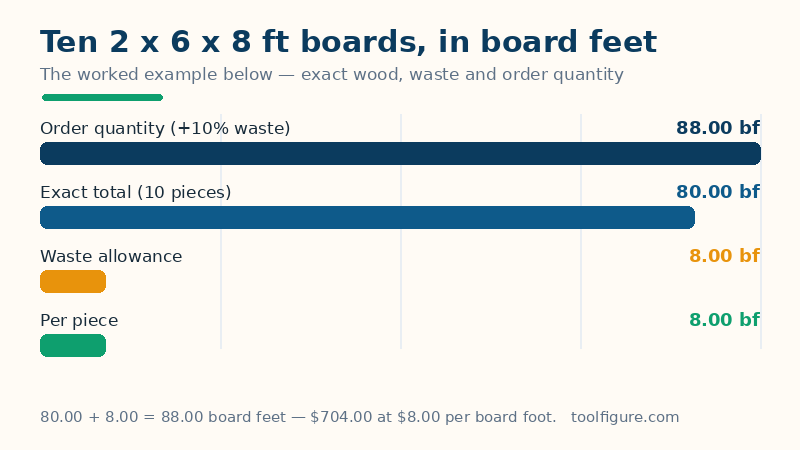
A board foot is the volume of a board 1 inch thick, 12 inches wide and 1 foot long — 144 cubic inches of wood. The formula mixes inches and feet on purpose: thickness and width are measured in inches because that is how boards are sized, length in feet because that is how they are sold, and dividing by 12 reconciles the two. The same volume through cubic inches must agree: thickness × width × length in inches, divided by 144, gives the identical figure — this page shows both on every result so one checks the other. Waste is the share of the order that will end as offcuts, trimmed defects and the board you cut twice: it is added on top of the exact total and shown as its own row, never folded silently into a per-piece figure.
Worked example: ten boards, 2 × 6 × 8 ft
The defaults above are ten boards, each 2 inches thick, 6 inches wide and 8 feet long, with a 10% waste allowance and a price of $8.00 per board foot. One piece holds 2 × 6 × 8 ÷ 12 = 8.00 board feet — check it the other way: 2 × 6 × 96 inches = 1,152 cubic inches, and 1,152 ÷ 144 = 8.00 exactly. Ten pieces hold 80.00 board feet. The waste allowance adds 10% of 80 = 8.00, so the order quantity is 88.00 board feet, and at $8.00 per board foot the order costs $704.00. The breakdown sums the way the yard will bill it: exact wood plus allowance equals the order, and the order times the price equals the bill.
Common board sizes, worked the same way
| Board (thickness × width × length) | Board feet per piece |
|---|---|
| 1 in × 6 in × 8 ft | 4.00 bf |
| 2 in × 4 in × 8 ft | 5.33 bf |
| 2 in × 6 in × 8 ft — worked example | 8.00 bf |
| 1 in × 12 in × 6 ft | 6.00 bf |
| 4 in × 4 in × 8 ft | 10.67 bf |
| 2 in × 8 in × 10 ft | 13.33 bf |
Read the 2 × 4 row carefully: at its full named size it holds 5.33 board feet, but a finished 2 × 4 is really about 1.5 × 3.5 inches, which is 1.5 × 3.5 × 8 ÷ 12 = 3.50 board feet — barely two-thirds as much wood. Which figure a yard uses depends on the stock: rough hardwood is commonly billed on its rough or nominal measure, while the volume in your finished project is the actual measure. That gap is the single biggest reason board-foot estimates and invoices disagree, and it is a question to settle with the yard before the order, not after it.
How to read your result — and its limits
Order the order quantity, not the exact total: the exact total assumes every cut is perfect, every board is sound along its whole length, and nothing is measured twice. Four limits belong with the page. Nominal is not actual: enter the dimensions you will really receive — for dressed construction lumber that means the smaller actual sizes, as the 2 × 4 example above shows. Waste is a judgement, not a constant: 10% suits straight cuts in sound stock; figured grain you are matching, short pieces cut from long boards, or a first project all argue for 15–20%, and this page refuses allowances over 50% because at that point the cut list itself needs rethinking. Yards round and grade differently: some round each board's volume, some bill in fractions, and lower grades carry more unusable sections — confirm the yard's convention when you order. And price follows the order quantity here: if your yard instead bills exact measure plus a separate cull allowance, use the exact-total row with their price. What this page guarantees is the volume arithmetic: given the actual dimensions, every board-foot figure follows exactly as written above.
Frequently asked questions
How many board feet are in a 2 × 6 × 8 board?
8.00 board feet at its full named size: 2 × 6 × 8 ÷ 12 = 8. The same answer comes from cubic inches — 2 × 6 × 96 in = 1,152 in³, and 1,152 ÷ 144 = 8.00. One caution: a dressed 2 × 6 is really about 1.5 × 5.5 inches, which holds noticeably less wood, so enter the actual dimensions of the stock you are buying and see the limits note on this page.
What is a board foot, in plain terms?
The volume of a board 1 inch thick, 12 inches wide and 1 foot long — 144 cubic inches of wood. It is a volume unit, not a length and not an area: a 2-inch-thick board holds two board feet for every foot of its length at 12 inches wide, which is why thickness must be in the formula and why two boards of the same length can hold very different amounts of wood.
Why does my lumber yard's total differ from my estimate?
Usually one of three reasons, all covered on this page. The yard may bill nominal dimensions while you calculated actual ones (a named 2 × 4 at 5.33 board feet per 8 ft against 3.50 at its dressed size). It may round each board's volume before totalling. Or your lists may differ on waste: this page shows the exact total and the waste as separate rows precisely so you can compare line by line and find where the difference sits.
How much waste should I allow when ordering lumber?
Ten percent is the common starting point for straight cuts in sound stock, and it is this page's default. Allow 15 to 20 percent when you are matching grain, cutting short pieces from long boards (the offcuts cannot be reused), working with a lower grade that carries defects to cut around, or doing a job for the first time. Long, straight, repetitive cuts in clean stock can honestly run under 10 percent — the allowance is yours to set, and this page shows it as its own row so its cost is never hidden.