Duration arithmetic is carrying, done honestly
Adding two lengths of time looks like ordinary addition until the columns overflow: seconds stop at 60, minutes stop at 60, hours stop at 24, and every overflow has to be carried into the next column before the answer means anything. That carrying is where pencil answers quietly go wrong — 45 minutes plus 30 minutes is not 75 minutes in any finished answer, it is 1 hour 15. This calculator removes the carrying problem by refusing to work in mixed units at all: both durations are converted to a single count of seconds, added or subtracted once, and the result is then normalised back into days, hours, minutes and seconds by dividing down. It is a deliberately different job from the hours calculator, which reads clock-in and clock-out times off a working day; this page adds and subtracts the durations themselves — editing timelines, exercise splits, cooking stages, travel legs, project phases — wherever they came from.
The method, with every term defined
Total seconds = days × 86,400 + hours × 3,600 + minutes × 60 + secondsAdd or subtract the two totals — one operation, in one unitNormalise back: days = total ÷ 86,400 (whole part); hours = remainder ÷ 3,600; minutes = remainder ÷ 60; seconds = what is left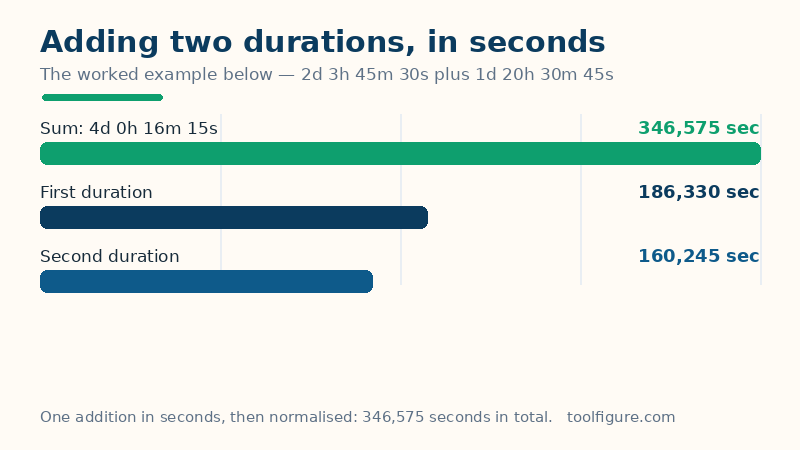
The constants are definitions, not approximations: a minute is exactly 60 seconds, an hour exactly 60 minutes (3,600 seconds), and a day, for duration work, exactly 24 hours (86,400 seconds). Normalising means rewriting a total so that no unit overflows — 346,575 seconds becomes 4 days, 0 hours, 16 minutes and 15 seconds, because 4 whole days account for 345,600 of those seconds and only 975 remain. Because the conversion happens before the operation, fields are allowed to overflow on the way in: typing 90 in a minutes field is fine, and the answer treats it as the hour and a half it is. Fractional seconds are kept through the working and shown to four decimal places in the totals where they arise.
Worked example: 2 days 3:45:30 plus 1 day 20:30:45
The defaults above add a first duration of 2 days, 3 hours, 45 minutes, 30 seconds to a second of 1 day, 20 hours, 30 minutes, 45 seconds. In seconds, the first is 172,800 + 10,800 + 2,700 + 30 = 186,330 seconds, and the second is 86,400 + 72,000 + 1,800 + 45 = 160,245 seconds. One addition: 186,330 + 160,245 = 346,575 seconds. Normalised, that is 4 days, 0 hours, 16 minutes, 15 seconds — and the column-by-column view shows why the carries cascade: 30 + 45 seconds = 75, which is 1 minute carried and 15 left; 45 + 30 + 1 minutes = 76, which is 1 hour carried and 16 left; 3 + 20 + 1 hours = 24, which is 1 day carried and 0 left; 2 + 1 + 1 days = 4. The same total stated other ways: 5,776.25 minutes, 96.2708 hours, 4.0113 days — the figures in the table, and the three bars in the chart.
More sums, including a subtraction
| Calculation | Result | In seconds |
|---|---|---|
| Worked example: (2d 3h 45m 30s) + (1d 20h 30m 45s) | 4d 0h 16m 15s | 346,575 |
| Worked example, subtracted: (2d 3h 45m 30s) − (1d 20h 30m 45s) | 0d 7h 14m 45s | 26,085 |
| 5h 30m + 2h 45m | 8h 15m 0s | 29,700 |
| 1 day + 12 hours | 1d 12h 0m 0s | 129,600 |
| 90 minutes + 90 seconds (fields over their usual limits) | 1h 31m 30s | 5,490 |
| 3 days − 1 day 12 hours | 1d 12h 0m 0s | 129,600 |
| 7 days + 1 second | 7d 0h 0m 1s | 604,801 |
Two rows deserve a second look. The 90-minutes row is the normaliser earning its keep: nothing about the input was wrong, it was simply written in the wrong unit, and converting through seconds makes the answer (1 hour 31 minutes 30 seconds) automatic. And the subtraction row shows the method's symmetry — 3 days minus a day and a half lands on exactly the same 129,600 seconds as 1 day plus 12 hours, because both are the same length of time described from opposite directions.
How to read your result — and its limits
The headline is the normalised breakdown, and the table underneath shows the working: both inputs in seconds, then the total restated as seconds, minutes, hours and days, so any figure can be checked with one division. Three limits belong with the page. A day here is always 24 hours: duration arithmetic knows nothing about calendars, daylight saving or time zones, so a span that crosses a clock change may be an hour longer or shorter on the wall clock than it is as a duration — for dates themselves, the date calculator is the right tool. Subtraction stops at zero: a result below zero is a negative duration, which this page will not dress up as an answer — it tells you the second duration is the longer one and by how many seconds, so you can swap them knowingly. And the totals are exact conversions, not new information: 96.2708 hours and 4.0113 days are the same 346,575 seconds wearing different units, rounded at the fourth decimal — the seconds figure is the one to quote when precision matters.
Frequently asked questions
How is this different from the hours calculator?
The hours calculator starts from clock times — a 09:00 start, a 17:30 finish, a break — and works out how long a shift lasted. This calculator starts from durations that already exist, in days, hours, minutes and seconds, and adds them together or subtracts one from another. Timing a video edit from its segment lengths, totalling exercise intervals, or finding what is left of a budget of hours are this page's jobs.
Why can I type 90 into the minutes field?
Because a duration does not stop being valid when it is written in the wrong unit. The calculator converts everything to seconds before it operates, so 90 minutes is simply read as 5,400 seconds and normalised to 1 hour 30 in the answer. It is the same tolerance a spreadsheet applies when it stores times as fractions of a day — the unit you type in is a description, not a rule.
Why does subtraction refuse to go below zero?
Because a negative duration has no everyday meaning — a task cannot take minus three hours. When the second duration is longer, the page says so and states both totals in seconds, which is the information you actually need: swap the durations to get the positive difference, or reconsider which span was supposed to contain the other.
How many seconds are in a day, exactly?
86,400 — 24 hours of 3,600 seconds each — and that is the day this calculator uses, because it works with durations, not calendar dates. A calendar day on a clock can occasionally run to 23 or 25 hours when daylight saving changes, and very rarely a leap second is added to a day; neither affects a length of time measured in hours and minutes, which is what this page adds and subtracts.
Are the totals in minutes, hours and days rounded?
The seconds figure is exact. The other totals are that same figure divided by 60, 3,600 or 86,400 and shown to four decimal places, so 346,575 seconds reads as 5,776.25 minutes exactly, 96.2708 hours and 4.0113 days — the last two rounded at the fourth decimal. If you are chaining the result into another calculation, carry the seconds figure, not a rounded total.