Two equations run every simple circuit
Ohm's law is the relationship Georg Ohm published in 1827 between the three quantities in a simple electric circuit: the voltage pushing charge around it, the current that flows, and the resistance opposing the flow. Add the power law — how fast the circuit turns electricity into heat, light or motion — and any two known values determine the other two completely. That is the whole design of this calculator: you enter whichever two of the four you know (a battery's voltage and a resistor's value, a device's wattage and its supply voltage), and it derives the pair you do not, showing the exact substitution for each one and finishing with two check rows that rebuild the entered quantities from the solved ones. It is the arithmetic behind fuse choices, resistor sizing, heater ratings and every "will this supply run that device?" question — the same square-root and square work the exponent calculator practises, put to work.
The formulas, with every term defined
Ohm's law: V = I × R — and rearranged, I = V ÷ R and R = V ÷ IPower law: P = V × I — which combines with Ohm's law into P = I² × R and P = V² ÷ RFrom resistance and power alone: V = √(P × R) and I = √(P ÷ R)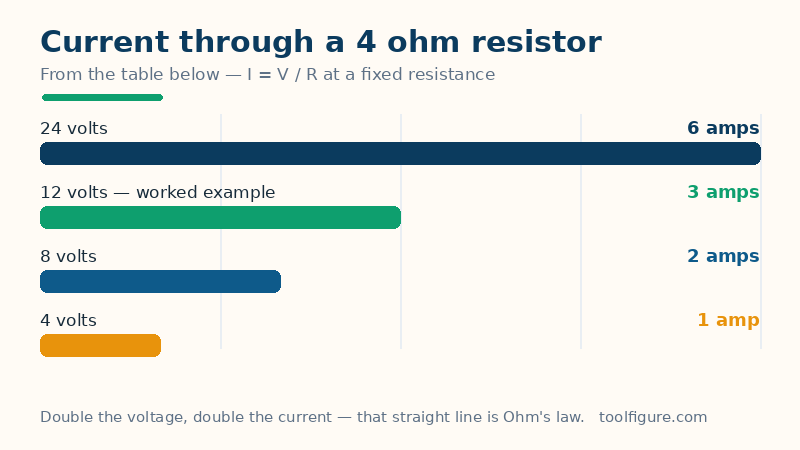
The four quantities, pinned down. Voltage (V), measured in volts, is the electrical push between two points — the battery or supply rating. Current (I), in amps (amperes), is the rate of flow of charge — the figure fuses and wire gauges are rated by. Resistance (R), in ohms (Ω), is how strongly a component opposes the flow — the value printed or colour-coded on a resistor, or the effective resistance of a whole device. Power (P), in watts, is the rate at which electrical energy is converted — the headline rating on heaters, bulbs and power supplies. The triangle mnemonic covers the first law: cover the quantity you want, and what remains shows the operation — V over I × R, I under V ÷ R, R under V ÷ I. The power law then ties P to any pair, which is why knowing any two of the four is always enough.
Worked example: 12 volts across a 4 ohm resistor
The defaults above enter the two values a bench worker actually knows: a 12 volt supply and a 4 ohm resistor. Current first: I = V ÷ R = 12 ÷ 4 = 3 amps. Power two ways, which must agree: P = V × I = 12 × 3 = 36 watts, and P = I² × R = 9 × 4 = 36 watts again — that agreement is exactly what the check rows at the foot of the table verify on every calculation, along with I × R rebuilding the 12 volts entered. Read the result physically: 3 amps is a substantial current (a phone charger delivers a fraction of it), and 36 watts dissipated in a small resistor is a great deal of heat — which is why real resistors carry a power rating as well as a resistance, and why this pair of answers, not either one alone, is what a circuit decision needs.
The same laws from every starting pair
| Given | Voltage | Current | Resistance | Power |
|---|---|---|---|---|
| 12 V and 4 Ω — worked example | 12 V | 3 A | 4 Ω | 36 W |
| 9 V and 3 Ω | 9 V | 3 A | 3 Ω | 27 W |
| 2 A and 10 Ω | 20 V | 2 A | 10 Ω | 40 W |
| 120 V and 0.5 A | 120 V | 0.5 A | 240 Ω | 60 W |
| 5 A and 100 W | 20 V | 5 A | 4 Ω | 100 W |
| 8 Ω and 200 W | 40 V | 5 A | 8 Ω | 200 W |
| 24 V and 48 W | 24 V | 2 A | 12 Ω | 48 W |
The last-but-two row is the one worth studying: from resistance and power alone, the voltage arrives by a square root — V = √(200 × 8) = √1,600 = 40 volts — and the current by its twin, √(200 ÷ 8) = √25 = 5 amps. Roots appear because power depends on the square of current and voltage, so recovering either one means undoing a square. The 120-volt row is a household bulb in disguise: a 60 watt bulb on a 120 volt supply draws half an amp and presents 240 ohms when hot. And the chart near the top holds resistance fixed at the worked example's 4 ohms and varies only the voltage — 4, 8, 12, 24 volts drawing 1, 2, 3, 6 amps — the straight line that is Ohm's law itself: at fixed resistance, current is simply proportional to voltage.
How to read your result — and its limits
The solved pair is the headline; the table shows all four quantities with the entered two marked, the substitution that produced each solved value, and the two check rows — if V × I does not rebuild P, or I × R does not rebuild V, nothing on the page can be trusted, and both are printed so you can confirm they do. The limits are real ones. These are DC, steady-state relationships: they describe resistive loads exactly, and AC circuits only approximately — motors, transformers and anything with coils or large capacitors shift voltage and current out of step, and real AC power needs the power factor this page deliberately does not model. Resistance is treated as constant: a cold bulb filament measures a fraction of its hot resistance, which is why the 240 ohms in the table is its working value, not what a meter reads on a cold bulb. Units must be the base units: milliamps, kilohms and milliwatts must be converted before entry — 500 mA is 0.5 in the current field, and the unit converter will not do electrical prefixes, so divide by 1,000 by hand. And a calculated fuse or wire size is a starting point, not an installation: real electrical work is governed by codes, ratings and safety margins that a two-equation calculator does not replace — anything beyond a bench circuit belongs with a qualified electrician.
Frequently asked questions
Why do I have to enter exactly two values?
Because two is what the maths needs and all it can honestly use. With one value, infinitely many circuits fit — a 12 volt supply says nothing about current until something about the load is known. With three or four, the values will almost always contradict each other slightly (real ratings are rounded), and the calculator would have to choose which of your figures to disbelieve. Enter the two you trust, and the solved pair — plus the check rows — shows what they commit you to.
How do I size a resistor for an LED?
An LED holds roughly its rated forward voltage across itself, so the resistor takes the rest of the supply and sets the current: R = (supply voltage − LED voltage) ÷ desired current. For a 9 volt supply, a 2 volt LED and the usual 20 mA (0.02 amps) working current, that is (9 − 2) ÷ 0.02 = 350 ohms — and the nearest standard value above it is the one to fit. Enter 7 volts and 0.02 amps in this calculator and it returns the same 350 ohms, with the resistor's small power — 0.14 watts — beside it.
What is the difference between amps and watts?
Amps measure flow — how much charge passes per second — while watts measure the rate of energy conversion, which is flow multiplied by push: P = V × I. The distinction decides real purchases. A cable or fuse cares about amps alone, whatever the voltage; a 12 volt circuit carrying 10 amps and a 240 volt circuit carrying 10 amps need the same thickness of wire, but the second delivers twenty times the power — 2,400 watts against 120.
Why does a square root appear when I enter resistance and power?
Because power grows with the square of both voltage and current — P = V² ÷ R and P = I² × R — so recovering V or I from P means undoing a square. In the table's 8 ohm, 200 watt row, V = √(200 × 8) = √1,600 = 40. It is also why doubling the voltage on a fixed resistor quadruples its power, the single most destructive surprise in hobby electronics.
Does Ohm's law work for household AC?
Approximately, for purely resistive loads — heaters, kettles, incandescent bulbs — where the resistance rows in the table behave as calculated. For motors, LED lighting, chargers and anything electronic or magnetic, the current and voltage fall out of step and the simple product V × I overstates the real power; electricians apply a power factor the calculator does not model. Treat AC answers here as estimates for resistive loads, and never as the basis for wiring decisions, which belong to codes and qualified electricians.