Volume is area, given depth
The square footage calculator answers how much floor a shape covers; this page answers the next question — how much it holds. A tank, a planter, a storage box, a ball: each is a solid with a volume, and the volume is always some version of base area multiplied by depth, which is why the circle's area formula from the circle calculator (π × r²) reappears inside the cylinder, the sphere and the cone below. Six shapes cover most of what people actually measure, and because a volume in cubic centimetres is a number nobody can picture, every result is also stated in litres, US gallons and cubic metres — the units containers are sold, labelled and filled in. One unit selector applies to every measurement you enter, so a tank measured in inches is never silently treated as centimetres.
The formulas, with every term defined
Cube: V = s³ Box: V = l × w × h Cylinder: V = π × r² × hSphere: V = (4/3) × π × r³ Cone: V = (1/3) × π × r² × h Square pyramid: V = (1/3) × s² × h1 litre = 1,000 cm³ exactly · 1 US gallon = 3.785411784 litres exactly · 1 m³ = 1,000 litres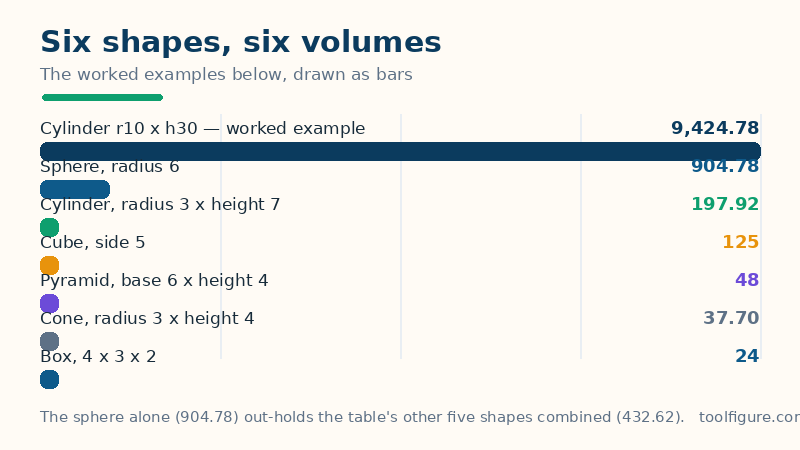
s is a side length — the cube's edge, or the side of the pyramid's square base. l, w, h are a box's length, width and height. r is a radius: half the diameter, measured from the centre of a circle to its edge — not across it. h for the cone and pyramid is the vertical height, from base to tip measured straight down, never the slanted edge; the slant height is a different line, used only in their surface areas, and the calculator reports it separately so the two are never confused. The thirds in the cone and pyramid formulas are real geometry, not fudge factors: a pointed solid on a given base holds exactly one third of the straight-sided solid on the same base and height, which the table below demonstrates with matching numbers. Surface area, shown with every result, counts the solid's whole outside — for the cylinder that includes both circular ends, so an open tank's true material area is one end less.
Worked example: a cylindrical tank, radius 10 cm, height 30 cm
The defaults above enter a cylinder of radius 10 cm and height 30 cm — a small tank or a large saucepan. Follow the formula in order: r² is 10 × 10 = 100; × the height gives 100 × 30 = 3,000; × π gives 9,424.78 cm³. Restated in units a person can use, that is 9.42 litres, 2.49 US gallons, or 0.009425 m³ — a tank of roughly nine and a half litre-bottles, which is the picture the raw cubic figure never gives. Its surface area is 2 × π × 10 × (10 + 30) = 2,513.27 cm², counting both ends. Change only the unit selector and the same tank measured in inches would need its dimensions re-entered in inches — the selector declares what your numbers mean; it does not convert the numbers themselves, which keeps a unit mix-up visible instead of silent.
Six shapes, worked through
| Shape and dimensions | Volume | Surface area |
|---|---|---|
| Cylinder, radius 10 × height 30 — worked example | 9,424.78 | 2,513.27 |
| Sphere, radius 6 | 904.78 | 452.39 |
| Cylinder, radius 3 × height 7 | 197.92 | 188.50 |
| Cube, side 5 | 125.00 | 150.00 |
| Square pyramid, base side 6 × height 4 | 48.00 | 96.00 |
| Cone, radius 3 × height 4 (slant 5) | 37.70 | 75.40 |
| Rectangular box, 4 × 3 × 2 | 24.00 | 52.00 |
| Sphere, radius 1 | 4.19 | 12.57 |
All volumes above are in cubic units of whichever unit the dimensions were in. Read the table for its two structural lessons. First, the thirds check: the cone of radius 3 and height 4 holds 37.70, and a cylinder on that same base and height would hold exactly three times as much — π × 9 × 4 = 113.10 — so the cone's third is visible in the numbers, not just asserted. Second, the sphere's bulk: at 904.78 it holds more than the table's cylinder, cube, pyramid, cone and box combined (432.62 between them), because its radius is cubed and it bulges in every direction at once. That cubing is also why size changes deceive: doubling a sphere's radius multiplies its volume by exactly eight — a radius-3 sphere holds 113.10, the radius-6 sphere in the table 904.78. The same table in real units: the 4 × 3 × 2 box measured in feet holds 24 cubic feet, which is 679.60 litres — a serious container — while a cube of side 1 metre holds exactly 1,000.00 litres, the conversion anchor worth remembering. For pours rather than perfect solids, the concrete calculator applies the same base-times-depth idea with waste allowances added.
Reading a volume honestly — the limits
Four cautions belong with any figure from this page. Real objects are not perfect solids. A bucket tapers (it is a frustum, between a cylinder and a cone), a tank's corners are rounded, and a ball is rarely a true sphere; the answer is exact for the shape you chose and approximate for the object you measured, so pick the nearest shape and treat the last digit with suspicion. Inside and outside measurements differ. Capacity depends on the inside dimensions — measure a thick-walled tank from the outside and the wall thickness is counted twice in every direction, inflating the volume noticeably on small containers. Volume is not fill level. A tank's brim volume is its geometric volume; its usable capacity is less, by the headspace every container needs, and a cylinder lying on its side fills by a different, messier rule that this page does not attempt. And volume is not weight: 9.42 litres of water weighs about 9.42 kg, but the same volume of oil, fuel or honey weighs something else entirely — convert volume to weight only with the density of the actual substance, or use the cooking converter, which carries densities for kitchen ingredients.
Frequently asked questions
How do I work out the volume of a cylinder?
Multiply the area of its circular base by its height: V = π × r² × h. For the worked example — radius 10 cm, height 30 cm — that is π × 100 × 30 = 9,424.78 cm³, which is 9.42 litres. The two mistakes to avoid are entering the diameter instead of the radius (it quadruples the answer, because the radius is squared) and mixing units, such as a radius in centimetres with a height in inches.
What happens if I enter the diameter where the radius belongs?
The volume inflates by the square or cube of two. A cylinder's volume follows r², so doubling the 'radius' multiplies the volume by 4; a sphere's follows r³, so the same slip multiplies its volume by 8. It is the single most common volume error, which is why the radius fields on this page are labelled 'half the diameter'. If a result looks implausibly large for the object in front of you, this is the first thing to check.
How many litres are in a cubic metre, and in a cubic foot?
A cubic metre is exactly 1,000 litres — a cube one metre on each side holds a thousand litre bottles, which is why water bills are priced per cubic metre. A cubic foot is 28.32 litres (28.3168… exactly, from the inch's definition as 2.54 cm). The worked example runs the same conversion at small scale: 9,424.78 cm³ is 9.42 litres because a litre is exactly 1,000 cm³.
Why is a cone exactly one third of its cylinder?
It is a theorem, not an approximation: a cone and a cylinder on the same base with the same height always stand in the ratio 1 to 3, and the same holds for a pyramid against its box. The table on this page shows it numerically — the cone of radius 3 and height 4 holds 37.70, and the matching cylinder (π × 9 × 4) holds 113.10, exactly three times as much. Intuitively, the cone's slices shrink from full width at the base to nothing at the tip, and the shrinking averages out to a third.
Is volume the same as capacity or weight?
No — three related but different ideas. Volume is the space a solid occupies or encloses, in cubic units. Capacity is the volume a container can usefully hold, which is its inside volume minus the headspace it needs — always a little less. Weight is something else again: it needs the density of what fills the space. Water is the convenient special case (1 litre ≈ 1 kg, so the worked example's 9.42 litres of water weighs about 9.42 kg); almost every other substance breaks the equality.