A period prediction is cycle counting, done carefully
A menstrual cycle is counted from the first day of one period to the first day of the next — not from the end of one bleed to the start of another, which is the single most common counting mistake and throws every prediction out by the length of the bleed. This calculator works on that standard rule: you give it the first day of your last period, the cycle length you usually run, and how many days your period usually lasts, and it counts forward in whole cycles — the next period start, the day it should end, the two starts after that, which day of the current cycle a chosen date falls on, and how many days remain until the next start. If the count-from date sits more than one cycle after the last period you entered, the tool first rolls forward whole cycles to find the cycle you are actually in, so an old start date still gives a sensible answer instead of a countdown into the past. It is deliberately a different job from the ovulation calculator, which estimates fertile days inside one cycle: this page predicts period dates, across the next three cycles, and nothing more.
The counting rule, with every term defined
Next period start = last period start + cycle length (in days)Following starts: keep adding the same cycle length — start + 2 cycles, start + 3 cyclesPeriod end = period start + (period length − 1) days, because the start day itself is day 1Cycle day of a date = days since the current cycle began + 1, so the start date is day 1, never day 0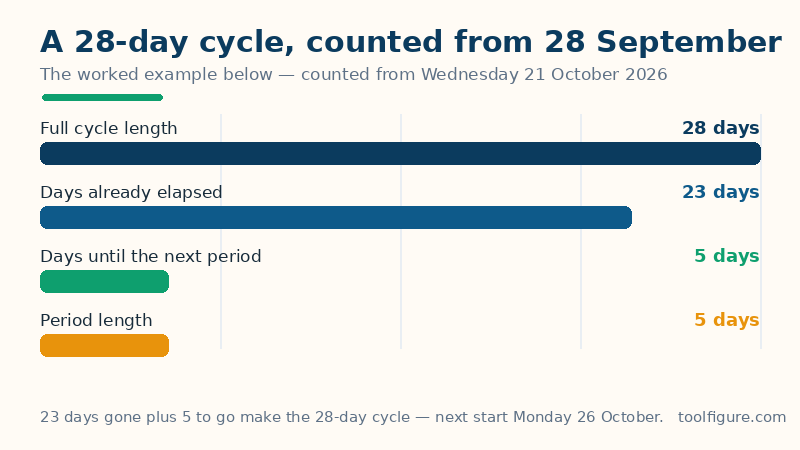
The terms, in plain words. The cycle length is the number of days from one period's first day to the next period's first day — 28 in the worked example, and the figure to average across your last few cycles if yours varies. The period length is how many days the bleeding itself lasts — 5 in the example — and it affects only the predicted end date, never the start dates. The cycle day numbers where you are inside the current cycle, counting the start date as day 1. And a prediction here means exactly what the arithmetic says: the date the next period starts if this cycle runs to your usual length. Real cycles vary — the limitations below are part of the tool, not fine print.
Worked example: a 28-day cycle from 28 September 2026
The defaults above enter a last period that began on Monday 28 September 2026, a cycle length of 28 days, a period length of 5 days, and a count-from date of Wednesday 21 October 2026. The next start is one whole cycle on: 28 September + 28 days = Monday 26 October 2026, and at 5 days long it runs to Friday 30 October 2026 (26, 27, 28, 29, 30 — the start day counts as day 1, which is why the end is start + 4, not start + 5). The two starts after that add the same 28 days each time: Monday 23 November 2026 and Monday 21 December 2026 — all Mondays, because 28 is a whole number of weeks, so a 28-day cycle always lands on the same weekday. The count-from date, 21 October, is 23 days after the last start, which makes it day 24 of the current cycle (23 days later, counting the start as day 1), with 5 days left until the predicted start: 23 days gone plus 5 to come makes the 28-day cycle — the split drawn in the chart near the top.
How the cycle length moves the answer
| From a last period starting Mon 28 Sep 2026 | Next period starts |
|---|---|
| Cycle length 24 days | Thursday 22 October 2026 |
| Cycle length 26 days | Saturday 24 October 2026 |
| Cycle length 28 days — worked example | Monday 26 October 2026 |
| Cycle length 30 days | Wednesday 28 October 2026 |
| Cycle length 35 days | Monday 2 November 2026 |
| Second example: last period Mon 2 Mar 2026, 30-day cycle, 6-day period, counted from Fri 20 Mar 2026 | Next start Wed 1 April 2026 — day 19 of the cycle, 12 days away, ending Mon 6 April 2026 |
The table carries the practical lesson: the prediction is only ever as good as the cycle length inside it. A two-day error in the length you enter moves every predicted date by two days, and the error repeats into the second and third forecast. If your cycles vary — say between 26 and 30 days — the honest way to use this page is to run it at your shortest and longest recent lengths as well as your average, and treat the answer as the window between those dates. The second example shows the same arithmetic on a different rhythm: a 30-day cycle from Monday 2 March 2026 puts the next start on Wednesday 1 April, and a 6-day period runs to Monday 6 April; counted from Friday 20 March, that is day 19 of the cycle with 12 days to go.
How to read your result — and its limits
The large figure is the predicted next start; the table underneath gives the working — the current cycle's start, your cycle day, the countdown and the following two starts — so any date can be rebuilt by hand from the last start plus whole cycles. The limits matter more on this page than on most. This is an estimate, not a schedule your body has agreed to: stress, illness, travel, weight change, new medication and the natural variation between cycles all move real periods, sometimes by a week or more, and no calculator can see them coming. A late period is information, not a verdict: if a period is notably late and pregnancy is a possibility, a pregnancy test answers that question far more reliably than any date arithmetic — and the due date calculator takes over from there. Patterns deserve a clinician, not a webpage: cycles that are persistently very short, very long, absent, or accompanied by severe pain or very heavy bleeding are worth raising with a doctor or gynaecologist, who can look for causes a calculator cannot. And this page predicts periods only: it makes no claim about ovulation or fertile days and must never be used as contraception — that is a different calculation with far less forgiving stakes, covered, with the same caution, by the ovulation calculator it sits beside.
Frequently asked questions
How accurate is a period calculator?
It is exactly as accurate as the cycle length you feed it, and no more. For someone whose cycles genuinely run 28 days every time, the prediction typically lands on the day or within a day or two. For someone whose cycles swing between 26 and 32 days, the same tool can only offer the middle of a window — run it at your shortest and longest recent cycle lengths to see that window honestly, and expect the real date to fall inside it rather than on any single predicted day.
What cycle length should I enter if mine varies?
Your average over the last three to six cycles, counting each one from first day to first day. Add the lengths together and divide by how many cycles you counted. If the variation is wide, also run the calculator at your shortest and longest lengths: the three predicted starts are your realistic window. Entering the length of just your last cycle — especially if it was an unusual one — is the commonest way to get a prediction that was never likely to land.
Why does the next period land on the same weekday?
Only in the worked example, and only because 28 days is exactly four weeks. Any cycle length that is a whole number of weeks (28, 35) repeats its weekday; every other length shifts it — a 30-day cycle moves each start two weekdays later, which is why the 30-day row in the table lands on a Wednesday from a Monday start. It is a quick sanity check on the arithmetic, nothing more.
What if my period does not come on the predicted date?
First, treat it as normal variation until it is not: a few days either way is common, and stress, illness, travel and disrupted sleep are frequent causes. If the delay stretches towards a week or more and pregnancy is possible, take a pregnancy test rather than re-running calculators. If periods keep arriving far outside your usual pattern, stop arriving, or come with severe pain or very heavy bleeding, that pattern is worth a clinician's attention — those are questions about causes, and causes are not something date arithmetic can assess.
Is the data I enter private?
Yes, completely. Your dates are read by code running in your own browser and are never sent to, or stored on, ToolFigure's servers — the page works offline once it has loaded. The result text the copy button uses is generated on your device as well. Nothing about your cycle is tracked, logged or shared by this page.