A calorie target is not yet a plate of food
The calorie calculator answers how much energy a day should carry. It does not answer what that energy should be made of — and two days of exactly the same calories can be built very differently: one heavy on carbohydrate, one heavy on fat, with different effects on hunger, training and blood sugar. Splitting a calorie target into macronutrients — protein, carbohydrate and fat, the three parts of food that carry energy — is the step between a number and a meal plan. This calculator does that split for four widely used patterns and shows the calories inside each macro as it goes, so the parts visibly add back to the whole. It pairs naturally with the strength side of the same log, the one rep max calculator: percentages load the bar, macros fuel the work.
The method, with every term defined
Calories for a macro = daily target × that macro's share of caloriesGrams of protein = its calories ÷ 4 · Grams of carbohydrate = its calories ÷ 4 · Grams of fat = its calories ÷ 9Per-meal grams = daily grams ÷ meals per day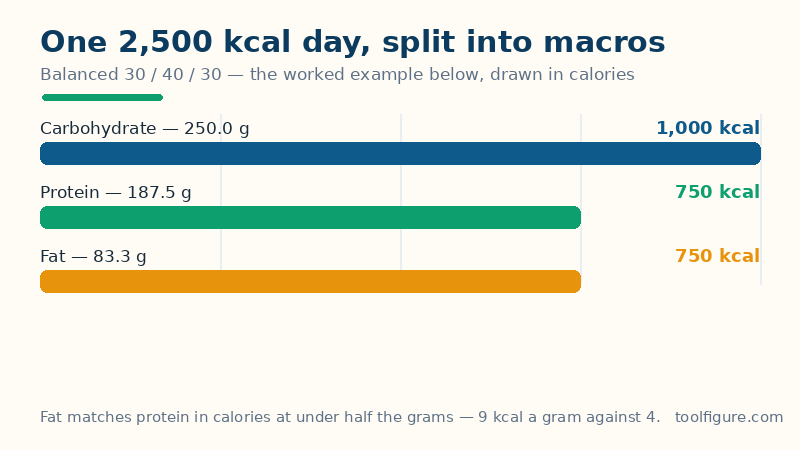
The shares are shares of energy, not of weight — the single most common macro mistake. Protein and carbohydrate each carry about 4 kcal per gram; fat carries about 9 kcal per gram, more than twice as much, which is why a split that looks even in percentages is never even in grams. A balanced split (30% protein, 40% carbohydrate, 30% fat) is the general-purpose pattern most guidelines cluster near. High-protein (40/30/30) suits muscle gain and satiety while dieting. Low-carb (30/20/50) moves energy from carbohydrate to fat without going to extremes, and keto (20/5/75) restricts carbohydrate hard enough — 5% of calories — to aim at ketosis. The energy densities 4, 4 and 9 are the standard Atwater factors printed on food labels; alcohol, at 7 kcal per gram, is a fourth energy source this page deliberately leaves out, and any day that includes it comes in over these figures.
Worked example: 2,500 kcal on the balanced split
The defaults above take a 2,500 kcal day on the balanced split, eaten as 3 meals. Protein takes 30% of 2,500 = 750 kcal, which at 4 kcal per gram is 187.5 g. Carbohydrate takes 40% = 1,000 kcal, which is 250.0 g. Fat takes 30% = 750 kcal, but at 9 kcal per gram that is only 83.3 g — the same calories as the protein in well under half the weight, the density difference made visible. The parts add back exactly: 750 + 1,000 + 750 = 2,500 kcal. Per meal, the day divides into 62.5 g protein, 83.3 g carbohydrate and 27.8 g fat. Those are the three bars in the chart — drawn in calories, because in grams the fat bar would mislead the eye into thinking fat is a minor part of the day.
The same 2,500 kcal, four different days
| Split (P / C / F) | Protein | Carbohydrate | Fat |
|---|---|---|---|
| Balanced 30 / 40 / 30 — worked example | 187.5 g | 250.0 g | 83.3 g |
| High-protein 40 / 30 / 30 | 250.0 g | 187.5 g | 83.3 g |
| Low-carb 30 / 20 / 50 | 187.5 g | 125.0 g | 138.9 g |
| Keto 20 / 5 / 75 | 125.0 g | 31.3 g | 208.3 g |
Read the keto row as the arithmetic of restriction: 5% of 2,500 kcal is 125 kcal of carbohydrate, and 125 ÷ 4 is 31.3 g — roughly one modest portion of rice or bread carries the whole day's allowance, which is why keto meal planning is a weighing exercise and not a rough guess. Read the balanced calorie ladder the same way: at 1,800 kcal the balanced split gives 135.0 g protein, 180.0 g carbohydrate and 60.0 g fat; at 2,000 kcal it gives 150.0 / 200.0 / 66.7 g; at 3,000 kcal, 225.0 / 300.0 / 100.0 g. Every gram figure on this page is one multiplication and one division from the target — nothing here needs to be taken on trust.
How to read your result — and its limits
Treat the grams as daily totals to plan around, not per-meal commandments: the per-meal row simply divides the day evenly, and real eating is lumpier than that — a lighter breakfast and a larger dinner that together hit the same totals serve the goal just as well. Four limits belong with the page. The split is a pattern, not a prescription: diabetes, kidney conditions, pregnancy, endurance training and eating-disorder history all change what an appropriate split is, and a clinician or dietitian who knows your case outranks any preset here — this page is general educational information, not medical or dietary advice. Labels round too: packaged foods state macros in whole grams and calories to the nearest ten, so a tracked day that lands within a few percent of these targets is a hit, not a miss. Fibre sits inside carbohydrate on most labels while carrying less usable energy than 4 kcal per gram, so very high-fibre days read slightly high. And the target rules everything: perfect ratios on the wrong calorie total still gain or lose weight at the wrong rate — if the target itself is stale, redo it on the calorie calculator first and split the new number. What this page guarantees is narrower and checkable: given the target and the split, every calorie share and every gram is worked exactly as written above.
Frequently asked questions
How many grams of protein do I need on 2,500 calories?
On the balanced split used as this page's worked example, 187.5 g — 30% of 2,500 kcal is 750 kcal of protein, and at 4 kcal per gram that is 187.5 g. The answer moves with the split, not just the calories: the high-protein pattern at the same 2,500 kcal gives 250.0 g, and keto gives 125.0 g. As a cross-check in body-weight terms, 187.5 g is about 2.3 g per kilogram for an 80 kg person — above the general-population minimum and inside the range strength athletes commonly aim for.
Why is the fat gram figure so much lower than the carbohydrate figure?
Because fat is more than twice as energy-dense. On the balanced worked example, fat and protein take identical calories — 750 kcal each — yet protein comes out at 187.5 g and fat at only 83.3 g, because a gram of fat carries 9 kcal against protein's 4. Any split stated in percentages is a split of calories; converting to the grams you actually weigh out is where the density difference appears, and it is the whole reason this calculator exists.
What is the difference between this and the calorie calculator?
The calorie calculator finds the size of the day: your maintenance calories from your body, age and activity, and the targets for losing or gaining. This calculator assumes that target already exists and decides its composition — how much of it is protein, carbohydrate and fat under a chosen pattern. Use them in that order: size first, split second. The calorie page itself prints one fixed 30/40/30 split of its maintenance figure; this page exists for everyone who needs a different pattern, a goal target rather than maintenance, or a per-meal division.
Do I have to hit these grams exactly every day?
No — and treating them as exact is the fastest way to abandon the plan. Food labels themselves are rounded, home weighing has error, and the body responds to averages over weeks, not to a single day's tenth of a gram. A practical standard is to land within about 5 to 10 percent of each target across the day, keep protein the most consistent of the three (it drives satiety and muscle retention), and judge the pattern over a week. This page shows tenths so the arithmetic can be checked, not because the tenths matter.
Why does the calculator refuse targets under 800 kcal?
Because below roughly that level a day cannot reliably carry essential fats, minimum protein and micronutrient needs from ordinary food, and planning such days is a clinical matter — very-low-calorie diets exist, but they are medically supervised and often use formulated products. A general calculator quietly splitting a 600 kcal target into macros would be pretending a safety it cannot offer. Set the target from your maintenance figure instead, keep any deficit moderate, and involve a clinician in anything aggressive.