Mulch is bought by volume and judged by depth
A mulch job is specified in two different languages at once: the bed is measured in feet, the depth is wanted in inches, and the yard sells by the cubic yard while the garden centre sells by the bag. This calculator translates between all of them in the open — the exact volume your measurements make, and the larger order quantity once a settling allowance is added, because fresh mulch compacts and a bed spread at exactly the calculated volume finishes visibly thinner within weeks. It is the same discipline this category applies to gravel, its heavier stone cousin: gravel is priced by weight, mulch by volume, and confusing the two units is how orders go wrong. If you do not know the bed's area yet, measure it first with the square footage calculator.
The method, with every term defined
Bed area = length (ft) × width (ft)Exact volume (ft³) = area × depth (in) ÷ 12 · Exact volume (yd³) = cubic feet ÷ 27Order quantity = exact volume × ( 1 + settling % ÷ 100 ) · Bags = order cubic feet ÷ 2, rounded up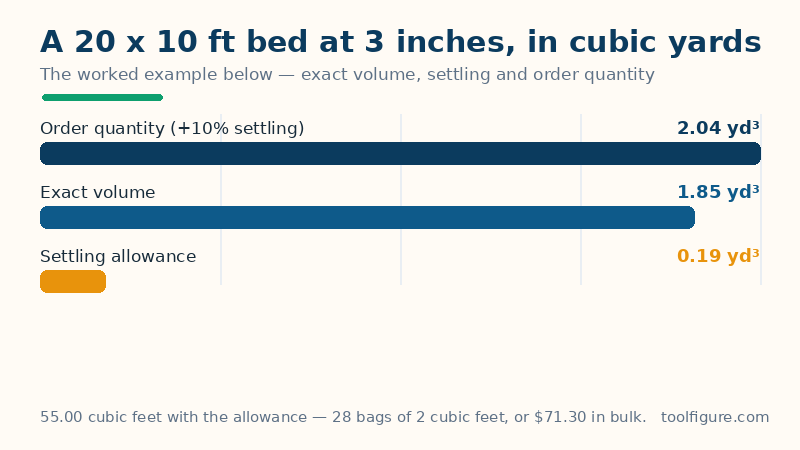
The depth is divided by 12 because it arrives in inches and everything else is in feet: 3 inches is a quarter of a foot, and area times a quarter-foot is the volume. A cubic yard is 27 cubic feet — a cube three feet on each side — and it is the unit bulk yards load and price by. The settling allowance covers what happens after spreading: loose mulch is full of air, rain and foot traffic compact it, and the fibres begin to break down, so a bed laid to an exact 3 inches can sit at 2½ within a season. The allowance is added on top of the exact volume and shown as its own row, never folded silently into a depth figure. Bags are counted at the standard 2 cubic feet per bag and always rounded up, because a part-bag cannot be bought.
Worked example: a 20 × 10 ft bed at 3 inches
The defaults above are a 20 ft by 10 ft bed, mulched 3 inches deep, with a 10% settling allowance and a bulk price of $35.00 per cubic yard. The area is 20 × 10 = 200 square feet. The exact volume is 200 × 3 ÷ 12 = 50.00 cubic feet, and 50 ÷ 27 = 1.85 cubic yards. The allowance adds 10% of 1.85 = 0.19, so the order quantity is 55.00 cubic feet = 2.04 cubic yards, which at $35.00 a yard costs $71.30. Bought bagged instead, the exact volume takes 25 bags of 2 cubic feet and the order quantity takes 28 bags — three extra bags is the whole price of the settling allowance, which is why it is worth seeing as its own row. One cross-check worth memorising: a cubic yard at 3 inches deep covers 27 ÷ 0.25 = 108 square feet, and 200 ÷ 108 = 1.85 — the same exact volume by a completely different route.
Common beds, worked the same way
| Bed (length × width × depth) | Cubic feet | Cubic yards | Bags (2 ft³, exact) |
|---|---|---|---|
| 10 ft × 10 ft × 2 in | 16.67 | 0.62 | 9 |
| 10 ft × 10 ft × 3 in | 25.00 | 0.93 | 13 |
| 10 ft × 10 ft × 4 in | 33.33 | 1.23 | 17 |
| 20 ft × 10 ft × 3 in — worked example | 50.00 | 1.85 | 25 |
| 20 ft × 20 ft × 3 in | 100.00 | 3.70 | 50 |
| 30 ft × 20 ft × 4 in | 200.00 | 7.41 | 100 |
Depth is the lever in this table: on the same 100-square-foot bed, moving from 2 inches to 4 doubles the order from 0.62 to 1.23 cubic yards. That is why the depth decision comes first and the volume second. Two inches is a cosmetic refresh over existing mulch; 3 inches is the working depth that suppresses most weed germination and holds moisture; 4 inches suits a new bed over bare soil. Beyond that, extra depth buys little and can keep crowns and trunks too wet — the answer to a bed that keeps looking thin is usually topping up yearly, not one very deep layer.
How to read your result — and its limits
Order the order quantity, not the exact volume: the exact figure assumes the bed is a perfect rectangle measured perfectly, the mulch never compacts, and nothing spills on the path. Four limits belong with the page. Beds are rarely rectangles: for a curved or angled bed, break it into rough rectangles, run each one, and add the volumes — or measure the longest length and widest width and accept that the corners overstate it slightly; the square footage calculator handles circles and triangles directly. Existing mulch counts: if an inch of old mulch is staying, you need only the depth above it — enter the top-up depth, not the full finished depth. Bag sizes vary: the counts here use the standard 2-cubic-foot bag; larger 3-cubic-foot bags exist, and the honest conversion is order cubic feet divided by the size printed on your bag, rounded up. And bulk yards round too: many load in half-yard steps, so a 2.04-yard order may arrive — and be billed — as 2 or 2.5 yards; confirm the yard's step when you order. What this page guarantees is the volume arithmetic: given the area and the finished depth, every cubic-foot, cubic-yard and bag figure follows exactly as written above.
Frequently asked questions
How much mulch do I need for 200 square feet?
At the usual 3-inch depth, 1.85 cubic yards exactly — 50.00 cubic feet — and 2.04 cubic yards once a 10% settling allowance is added, which is the quantity to order. The quick check: one cubic yard at 3 inches covers 108 square feet, and 200 ÷ 108 = 1.85. Bought in standard 2-cubic-foot bags, the order quantity is 28 bags. Depth changes everything: the same 200 square feet at 2 inches needs only 1.23 cubic yards, and at 4 inches it needs 2.47.
How many bags of mulch are in a cubic yard?
Thirteen and a half — so 14 bags, rounded up. A cubic yard is 27 cubic feet and a standard bag holds 2 cubic feet: 27 ÷ 2 = 13.5. That is also the comparison that decides bulk versus bagged: once a job passes about a cubic yard, a bulk delivery is usually cheaper and far less carrying than 14 bags, while under half a yard — 7 bags — bags win on convenience. This page shows both counts on every result so the comparison is made with your real volume, not a guess.
How deep should mulch be?
Three inches is the working depth for most beds: deep enough to suppress most weed germination and slow evaporation, shallow enough to let air and water reach the soil. Two inches is a refresh layer over mulch that is already there. Four inches suits a brand-new bed over bare, weedy soil. Keep any depth pulled a few inches back from trunks and stems — mulch piled against bark holds moisture where it rots rather than where it helps — and expect to top up about an inch a year as the layer below breaks down into the soil.
Why does my mulch look thinner a month after spreading?
Settling. Fresh mulch is loosely packed with air between the pieces; rain, watering and its own weight compact it, and the bottom layer starts decomposing into the soil — which is good for the soil and bad for the finished depth. A bed spread at an exact calculated 3 inches commonly sits nearer 2½ inches within a season. That is why this calculator adds a settling allowance — 10% by default — on top of the exact volume and shows it as its own row: you are buying the depth you will have in a month, not the depth on the day.