A wattage is not a cost until hours and a rate meet it
Every appliance carries a number in watts, and almost nobody can say what that number costs them. The missing pieces are time and price: watts say how fast an appliance uses energy while it runs, hours say how long it runs, and the price per kilowatt-hour on your bill says what that energy costs. This calculator joins the three in the open and answers at the three horizons a household budget actually uses — a day, an average month and a year — because the same appliance can look trivial per day and serious per year. It sits on the money side of a question the BTU calculator answers on the sizing side, and its electrical terms come from the same family as the Ohm's law calculator: power is the rate, energy is the rate multiplied by time.
The method, with every term defined
Energy per day (kWh) = power (W) ÷ 1,000 × hours per dayCost per day = energy per day × price per kWhCost per year = cost per day × 365 · Cost per average month = cost per year ÷ 12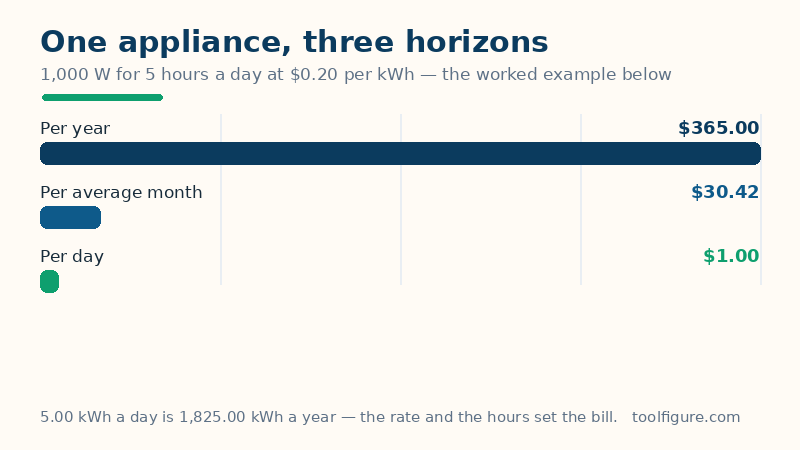
A watt is a rate of using energy — a 1,000-watt appliance draws energy at the rate of one kilowatt for as long as it runs. A kilowatt-hour (kWh) is an amount of energy: one kilowatt sustained for one hour, and it is the unit your bill charges for. Dividing watts by 1,000 converts the rate to kilowatts; multiplying by the hours converts the rate into the amount. The price per kWh should be the all-in rate from your own bill — the bill's total divided by the kWh it charged for — because the headline unit rate on a tariff page usually leaves out standing charges and taxes that are very much part of what you pay. An average month on this page is 365 ÷ 12 = 30.42 days, chosen so that twelve average months rebuild the year exactly instead of drifting by five days.
Worked example: 1,000 watts, 5 hours a day, $0.20 per kWh
The defaults above are a 1,000-watt appliance — a small heater, a powerful microwave or a gaming PC under load — run for 5 hours a day at $0.20 per kWh. The energy per day is 1,000 ÷ 1,000 × 5 = 5.00 kWh, costing 5.00 × $0.20 = $1.00 a day. An average month uses 5.00 × 365 ÷ 12 = 152.08 kWh and costs $30.42. A year uses 5.00 × 365 = 1,825.00 kWh and costs $365.00 — the dollar-a-day figure and the yearly figure are the same habit stated twice, which is exactly why the yearly column exists: $1.00 sounds like nothing and $365.00 is a bill worth planning around. The parts check each other: the daily energy times 365 is the yearly energy, and the average month is the year divided by 12, before rounding.
Common appliances at the same $0.20 rate, worked the same way
| Appliance (power × hours a day) | kWh per day | Cost per day | Cost per year |
|---|---|---|---|
| LED bulb — 10 W × 5 h | 0.05 | $0.01 | $3.65 |
| Television — 100 W × 4 h | 0.40 | $0.08 | $29.20 |
| Desktop computer — 300 W × 8 h | 2.40 | $0.48 | $175.20 |
| Worked example — 1,000 W × 5 h | 5.00 | $1.00 | $365.00 |
| Space heater — 1,500 W × 5 h | 7.50 | $1.50 | $547.50 |
| Air conditioner — 1,500 W × 8 h | 12.00 | $2.40 | $876.00 |
Read the table by its two levers. Power dominates: the heater and the air conditioner draw the same 1,500 watts, and both dwarf everything else on the list. Hours are the quieter lever — the television is on for half the computer's day at a third of its power and lands at a sixth of its yearly cost. And the bulb row carries the standby lesson in reverse: at 5 watts left on around the clock — a charger, a set-top box asleep — the same arithmetic gives 0.12 kWh a day and $8.76 a year for a device that is doing nothing at all. Small is not free; it is just slow.
How to read your result — and its limits
Compare appliances on the yearly column: it is the only horizon on which a heater, a bulb and a standby draw can be weighed fairly against each other and against the rest of a budget. Four limits belong with the page. Nameplate watts are a maximum, not a promise: many appliances cycle — a fridge's compressor, an air conditioner's thermostat, a heater's dial — so the label states the draw while running, and the honest hours to enter are the hours it is actually drawing, which a cheap plug-in meter measures in a day. Rates are rarely flat: time-of-use tariffs charge more at peak hours and some bills step the rate after a usage threshold; a single all-in rate is a fair average, and a peak-hour appliance deserves a run at the peak rate too. Your rate moves the answer proportionally: at $0.30 instead of $0.20, every cost on this page rises by exactly half — rerun with your own bill's figure before acting on any number here. And this page prices energy, not ownership: purchase price, filters, repairs and standby draws outside the hours entered are separate costs, handled the way the limits note handles everything — stated, not hidden. What it guarantees is narrower and checkable: given the watts, the hours and the rate, every energy and cost figure follows exactly as written above.
Frequently asked questions
How do I work out what an appliance costs to run?
Three steps, all shown on this page. Convert its watts to kilowatts (divide by 1,000). Multiply by the hours it runs each day to get kilowatt-hours per day. Multiply that by your price per kWh — the all-in rate, your bill's total divided by the kWh it charged for. A 1,000-watt appliance run 5 hours a day at $0.20 per kWh uses 5.00 kWh a day and costs $1.00 a day, $30.42 an average month and $365.00 a year.
What is the difference between a watt and a kilowatt-hour?
A watt is a rate — how fast energy is being used right now. A kilowatt-hour is an amount — that rate sustained over time. A 100-watt bulb burning for 10 hours uses exactly the same energy, 1 kWh, as a 1,000-watt heater running for 1 hour, and your bill charges for the amount, not the rate. Confusing the two is the most common reason running-cost estimates land ten times too high or too low, which is why this page shows the energy column beside every cost.
How much does it cost to run a 1,500-watt heater?
At $0.20 per kWh, $0.30 an hour: 1,500 watts is 1.5 kW, and 1.5 × $0.20 = $0.30. Run 5 hours a day, that is 7.50 kWh and $1.50 a day, $547.50 across a year of daily use — or across a 120-day heating season, $180.00. The same arithmetic at your own rate is one input change on this page: at $0.30 per kWh the yearly figure becomes $821.25, because every cost here scales in direct proportion to the rate.
Is leaving things on standby really costing me money?
Yes — slowly, which is the point. A device drawing 5 watts around the clock uses 0.12 kWh a day, which at $0.20 per kWh is $8.76 a year for one device doing nothing. Ten such devices — chargers, boxes, consoles, a microwave clock — approach $90 a year. The honest way to find yours is a plug-in meter: standby draw is printed almost nowhere, and this page can only price the watts you give it, so measure first and then run the number.