What electric field strength is
Electric field strength is the force a unit positive test charge would feel at a point in space — the push, per coulomb, that a charge, a voltage or a charged plate exerts on anything charged nearby. It is the quantity behind every high-voltage rating, every capacitor gap and every "keep clear" sign on a transmission line, and it is measured in volts per metre, which is exactly the same quantity as newtons per coulomb: a field of 1 V/m pushes a 1 C charge with 1 N of force. Textbooks, though, quote it in kilovolts per metre, lab notes in volts per centimetre, and old CGS tables in statvolts per centimetre, so the same field arrives under half a dozen labels. This page restates any electric field strength in all eleven units at once, worked through volts per metre with every factor defined, and answers the question the conversion alone cannot: on a test charge you enter, how much force does this field actually exert?
The formula
answer = volts per metre ÷ (V/m in one "to" unit)
force = volts per metre × microcoulombs × 0.000001
Three terms, all visible on the page. value is the number you enter. V/m in one "from" unit is the definition of the unit you are converting from: 1 for the volt per metre itself and for the newton per coulomb, 1,000 for the kilovolt per metre, 0.001 for the millivolt per metre, 0.000001 for the microvolt per metre, 100 for the volt per centimetre, 1,000 for the volt per millimetre, 1,000,000 for the megavolt per metre, 39.3700787 for the volt per inch, 3.2808399 for the volt per foot, and 29,979.2458 for the statvolt per centimetre. answer is the result in the unit you asked for. microcoulombs is the test charge you enter, and the force line multiplies the field by it, with 0.000001 coulombs in a microcoulomb, so the newtons a real charge would feel fall out of the field on the datasheet.
Worked example
Convert 12,000 volts per metre to kilovolts per metre — the field near a high-voltage test rig — the way the tool does it.
Step 1 — get to volts per metre. The input is already in volts per metre, so the base value is 12,000 V/m itself.
Step 2 — divide by the target factor. One kilovolt per metre is 1,000 V/m, so 12,000 ÷ 1,000 = 12.
Step 3 — read the display. The headline reads 12 kV/m, and the detail line shows the working: 12,000 V/m = 12 kV/m — worked through volts per metre: 12,000 V/m ÷ the Kilovolt per metre factor. The full table for this example reads: 12,000 V/m, 12 kV/m, 12,000,000 mV/m, 12,000,000,000 µV/m, 120 V/cm, 12 V/mm, 0.012 MV/m, 304.8 V/in, 3,657.6 V/ft, 12,000 N/C and 0.4003 statV/cm. The force line, at the default test charge of 2 µC, reads 0.024 N: 12,000 × 2 × 0.000001 = 0.024 N.
Check it. Multiplying back, 12 kV/m × 1,000 = 12,000 V/m exactly, and 120 V/cm × 100 = 12,000 V/m exactly — no rounding shadow anywhere, because every factor here is an exact definition. The force line checks the same way: 0.024 N ÷ 2 µC, with the microcoulomb factor, is 0.024 ÷ 0.000002 = 12,000 V/m, the field we started from.
Conversion table
The conversions textbooks, datasheets and lab notes reach for most, each one the same two steps as the example:
| From | To |
|---|---|
| 1,000 V/m | 1 kV/m |
| 1,000 V/m | 10 V/cm |
| 1 kV/m | 1,000 V/m |
| 1 V/cm | 100 V/m |
| 100 V/m | 100,000 mV/m |
| 1,000 V/m | 25.4 V/in |
| 1,000 V/m | 304.8 V/ft |
| 500 V/m | 500 N/C |
| 1 V/mm | 1,000 V/m |
| 1 MV/m | 1,000,000 V/m |
| 1 statV/cm | 29,979.25 V/m |
| 29,979.2458 V/m | 1 statV/cm |
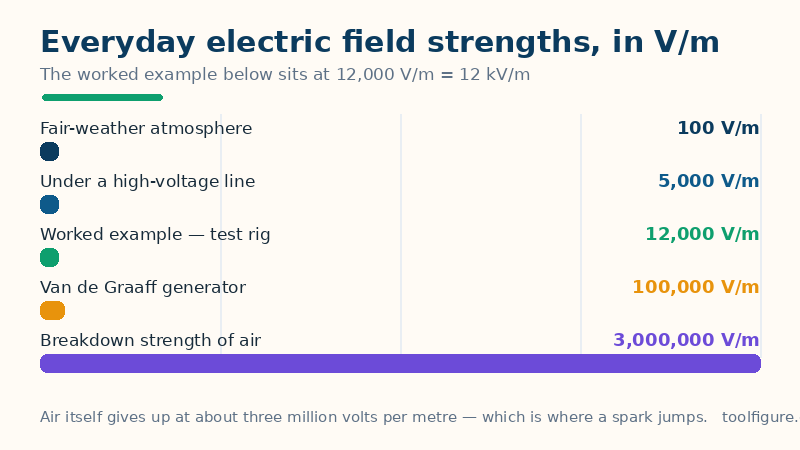
Three everyday cross-checks for the scale, each one the same two steps: the fair-weather atmospheric field near the ground, about 100 V/m, is 0.1 kV/m and 1 V/cm; a parallel-plate setup with 200 V across a 0.5 m gap gives 400 V/m, the voltage divided by the gap; and air itself breaks down at roughly 3,000,000 V/m, which is 3 MV/m and 30,000 V/cm, the field at which a spark jumps.
Reading the result, and its limits
Four distinctions keep this page honest. First, field strength is not voltage: volts per metre is a voltage divided by a distance, and a 12,000 V/m field across a 1 mm gap is only 12 V, while across a 1 m gap it is 12,000 V — the gap matters as much as the field. Second, V/m and N/C are the same quantity, not two quantities: a field quoted in N/C converts to V/m by doing nothing, because the volt is defined as a joule per coulomb and a joule is a newton-metre. Third, the statvolt figure is a CGS survivor, not a second SI unit: 1 statV/cm is 29,979.2458 V/m exactly through the speed of light, and old tables that round it to 30,000 V/m are off by about 0.07% — small, but visible at laboratory precision. Fourth, the force line is a magnitude for a point test charge: a real charge distorts the field it sits in, and a charge inside a conductor feels no field at all — the line is the idealised force on a small test charge, not a measurement inside a material.
Related tools: Electric Charge Converter — Coulombs to milliamp-hours, ampere-hours, faradays and more — every answer in all ten units; Electric Current Converter — Amps to milliamps, microamps and more — every answer in all eight units, plus the watts at your voltage; Magnetic Field Converter — Tesla to gauss, millitesla, microtesla and more — every answer in all eight units.
Frequently asked questions
How do I convert V/m to kV/m?
Divide by 1,000. A field of 12,000 V/m is 12,000 ÷ 1,000 = 12 kV/m, the worked example on this page. To go the other way, multiply kV/m by 1,000 to get V/m.
Is N/C the same as V/m?
Yes, exactly. One newton per coulomb equals one volt per metre, because a volt is a joule per coulomb and a joule is a newton-metre, so the metres cancel. A field of 500 N/C and a field of 500 V/m are the same field, and this page converts between the two labels by doing nothing.
What is a statvolt per centimetre?
A CGS unit from before SI, still found in old tables: one statvolt is 299.792458 volts, and one centimetre is 0.01 metres, so 1 statV/cm = 29,979.2458 V/m. This page uses that exact figure rather than the common 30,000 V/m rounding, which is off by about 0.07%.
How do I find the force on a charge in a field?
Multiply the field by the charge: F = E × q. In this page's units, a 2 µC test charge in a 12,000 V/m field feels 12,000 × 0.000002 = 0.024 N. Enter any test charge in microcoulombs and the force line does that multiplication for you.
