Two families, running in opposite directions
Fuel economy is measured two ways that refuse to agree with each other. The US and UK count distance per fuel — miles per gallon, where bigger is better. Most of the rest of the world counts fuel per distance — litres per 100 km, where smaller is better — and much of Asia counts kilometres per litre, back in the distance-per-fuel family. They are reciprocals of the same fact, which makes conversion a division rather than a multiplication, and it makes the units' "better" directions point opposite ways. This converter carries all four — US MPG, UK MPG, L/100km and km/L — works through L/100km as the common scale with exact published definitions, and answers in all four at once.
The formulas, with every variable defined
US: L/100 km = 235.214583 ÷ US mpgUK: L/100 km = 282.480936 ÷ UK mpgkm/L = 100 ÷ L/100 km (and back: L/100 km = 100 ÷ km/L)US mpg = 235.214583 ÷ L/100 km · UK mpg = 282.480936 ÷ L/100 km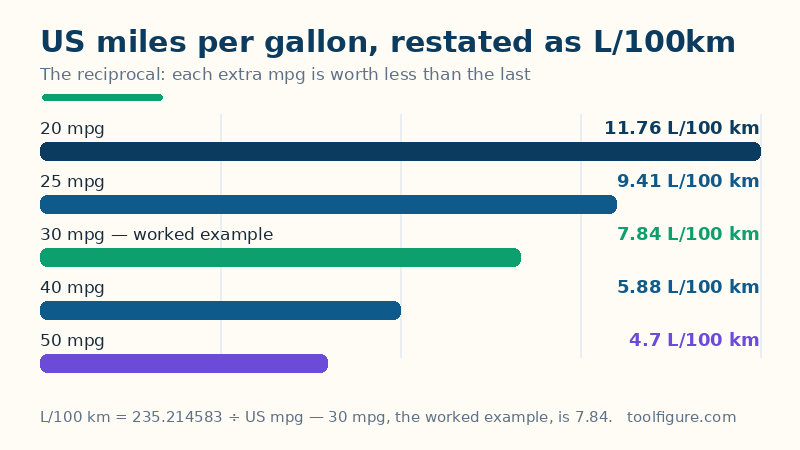
The constants are not magic: they are 100 × litres-per-gallon ÷ kilometres-per-mile. For the US gallon — exactly 3.785411784 litres — that is 100 × 3.785411784 ÷ 1.609344 = 235.214583. For the imperial gallon — exactly 4.54609 litres — it is 100 × 4.54609 ÷ 1.609344 = 282.480936. The mile is exactly 1.609344 km by the 1959 international definition. Because the two families are reciprocals, the same division runs backwards: swapping the constant with the result converts the other way.
Worked example, done step by step
Convert 30 US MPG to L/100km. Step 1: the common scale. L/100 km = 235.214583 ÷ 30 = 7.840486. Step 2: that is already the target, so the answer is 7.84 L/100km — the figure a European spec sheet would print for the same car. The every-unit table adds the rest: 100 ÷ 7.840486 = 12.75 km/L, and 282.480936 ÷ 7.840486 = 36.03 UK MPG — the same car looks better in Britain because the imperial gallon is the bigger jug.
The reverse — 7.84 L/100km to US MPG. US mpg = 235.214583 ÷ 7.84 = 30.00. The round trip lands exactly back where it started, which is the check to run on any conversion that passes through a reciprocal.
Common economies side by side
| US MPG | L/100km | UK MPG | km/L |
|---|---|---|---|
| 20 | 11.76 | 24.02 | 8.50 |
| 25 | 9.41 | 30.02 | 10.63 |
| 30 (worked example) | 7.84 | 36.03 | 12.75 |
| 35 | 6.72 | 42.03 | 14.88 |
| 40 | 5.88 | 48.04 | 17.01 |
| 50 | 4.70 | 60.05 | 21.26 |
Read the L/100km column from top to bottom: the steps shrink as MPG climbs, because each extra mile per gallon is worth less than the last. That is the reciprocal at work, and it is the most useful thing this table teaches.
The reciprocal trap
Improving a thirsty car saves far more fuel than improving an efficient one by the same MPG. Moving from 15 to 20 US MPG cuts consumption from 15.68 to 11.76 L/100km — 3.92 litres saved per 100 km. Moving from 40 to 50 MPG cuts it from 5.88 to 4.70 — only 1.18 litres saved, a third as much for a bigger MPG gain. MPG rewards the headline; L/100km tells the truth about the fuel bill. Anyone comparing two cars should compare the L/100km column, not the MPG gap.
Reading the result, and its limits
Three honest notes. First, a conversion is not a prediction: it restates one economy figure in another unit, it does not say what your car will actually do. Official test-cycle figures are measured in laboratories and real driving — traffic, hills, air conditioning, a cold engine — uses more; treat any single figure as a comparison between cars, not a promise. Second, check the gallon: US reviews use the 3.785-litre gallon and UK reviews the 4.546-litre one, so a "40 MPG" car in a British review is a 33.3 MPG car in American terms (40 ÷ 1.20095) — always convert before comparing across the Atlantic. Third, direction matters: lower L/100km is better, higher MPG or km/L is better — the table above keeps all three visible so the "better" direction is never guessed. To work out what a car actually drinks from real fill-ups rather than a brochure figure, the MPG calculator does the tank-to-tank arithmetic.
Frequently asked questions
How do I convert MPG to L/100km?
Divide the constant by your MPG figure. For US MPG: L/100km = 235.215 ÷ MPG, so 30 US MPG = 235.215 ÷ 30 = 7.84 L/100km. For UK (imperial) MPG the gallon is bigger, so use 282.481 instead: 40 UK MPG = 282.481 ÷ 40 = 7.06 L/100km. The same division runs backwards: MPG = 235.215 ÷ L/100km.
What is the difference between US MPG and UK MPG?
The gallons are different sizes: a US gallon is exactly 3.785411784 litres while a UK imperial gallon is exactly 4.54609 litres — about 20% larger. So UK MPG figures are always roughly 20% higher than US MPG for the same car: 30 US MPG equals 36.03 UK MPG. Never compare a British review's MPG with an American one without converting first.
Why is lower better for L/100km but higher better for MPG?
They are reciprocals — two ways of stating the same fact. MPG counts distance per unit of fuel, so more distance is better. L/100km counts fuel per unit of distance, so less fuel is better. The converter shows both side by side, and the reciprocal relationship is also why each extra MPG saves less fuel than the last.
Is 30 MPG good fuel economy?
It depends on the vehicle. For a petrol family car, 30 US MPG (7.84 L/100km) is respectable; for a small hatchback it is average; for a large SUV or pickup it is good. Hybrids commonly beat 45 MPG and the thirstiest trucks sit under 20. Compare within the same class, and compare the L/100km figures — the reciprocal maths means equal MPG gaps are not equal fuel savings.