The conversion that is not a multiplication
Every other converter on this site works by multiplying — a mile is always 1,609.344 metres, whatever the weather. Temperature refuses to behave that way, because its scales disagree about two things at once: how big a degree is and where zero sits. That is why 0 °C is 32 °F rather than 0 °F, and why forgetting the offset is the single most common conversion error in kitchens, classrooms and workshops. This converter handles the five scales you will actually meet — Celsius, Fahrenheit, Kelvin, Rankine and Réaumur — works through Celsius as the common scale, and answers in all five at once, so the figure a recipe, thermostat or spec sheet uses is already on the page.
The formulas, with every variable defined
°F = °C × 9/5 + 32 — multiply the Celsius value by nine-fifths (1.8), then add 32°C = (°F − 32) × 5/9 — subtract 32 from the Fahrenheit value, then multiply by five-ninthsK = °C + 273.15 — Kelvin shares the Celsius degree and starts at absolute zero°R = (°C + 273.15) × 9/5 — Rankine is the Fahrenheit-sized twin of Kelvin, used in some engineering work°Ré = °C × 4/5 — Réaumur survives in old European texts; 80 °Ré is boiling water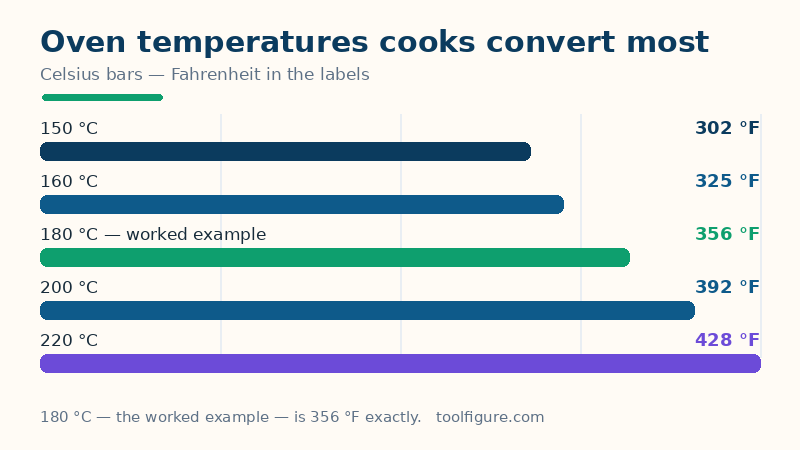
The 9/5 is the degree-size ratio — a Fahrenheit degree is smaller than a Celsius degree — and the 32 is the zero offset between the two scales. Kelvin needs no ratio because its degrees are Celsius-sized; it only moves the zero down to absolute zero. Rankine does the same job for Fahrenheit-sized degrees, which is why it appears on some thermodynamics paperwork and almost nowhere else.
Worked example, done step by step
Convert 25 °C to Fahrenheit. Step 1: 25 °C is already Celsius, the common scale, so nothing happens. Step 2: apply °F = °C × 9/5 + 32. Multiply first: 25 × 9/5 = 45. Then add the offset: 45 + 32 = 77 °F. The same 25 °C is 298.15 K (25 + 273.15), 536.67 °R ((25 + 273.15) × 9/5) and 20 °Ré (25 × 4/5) — all four sit in the every-scale table above the moment you type.
The reverse — 180 °C, the oven example. Many recipes are written for American ovens in Fahrenheit while European and Australian ovens dial in Celsius. For 180 °C: 180 × 9/5 = 324, plus 32 gives 356 °F. That is the standard moderate oven, and the chart below plots the oven settings cooks convert most often.
Everyday temperatures on all five scales
| Reference point | °C | °F | K | °R | °Ré |
|---|---|---|---|---|---|
| Absolute zero | −273.15 | −459.67 | 0 | 0 | −218.52 |
| Water freezes | 0 | 32 | 273.15 | 491.67 | 0 |
| Room temperature | 21 | 69.8 | 294.15 | 529.47 | 16.8 |
| Human body | 37 | 98.6 | 310.15 | 558.27 | 29.6 |
| Water boils | 100 | 212 | 373.15 | 671.67 | 80 |
| Moderate oven (worked example) | 180 | 356 | 453.15 | 815.67 | 144 |
The −40 ° coincidence is worth knowing: −40 °C and −40 °F are the same temperature, the only point where the two scales agree. It is a handy sanity check — convert −40 either way and you should get −40 back.
Where you will actually meet each scale
Celsius runs weather forecasts, cooking and daily life almost everywhere except the United States. Fahrenheit still runs American weather, ovens and thermostats. Kelvin belongs to science and engineering, where starting at absolute zero keeps the maths honest. Rankine turns up in some US thermodynamics and aerospace paperwork as the Fahrenheit-sized absolute scale. Réaumur is effectively retired, but it haunts old European cheese-making and confectionery texts — 80 °Ré on a 19th-century recipe is boiling water, not a furnace.
Reading the result, and its limits
Two honest notes. First, the formulas convert absolute temperatures. A temperature difference converts differently: a rise of 10 °C is a rise of 18 °F — the +32 offset cancels out, so do not add it. Mixing the two is the classic error behind wrongly converted climate and engineering figures. Second, real thermometers are not this precise: a kitchen thermometer is typically ±1 °C, so quoting 176.67 °C from a 350 °F recipe is false precision — round to the nearest 5 °C your oven dial actually offers. For the other everyday conversions, the unit converter covers length, weight and volume, and the cooking converter handles cups, grams and spoon measures.
Frequently asked questions
What is the formula to convert Celsius to Fahrenheit?
Multiply the Celsius value by 9/5 (1.8) and add 32: °F = °C × 9/5 + 32. So 25 °C × 9/5 = 45, plus 32 gives 77 °F. To go the other way, subtract 32 first and multiply by 5/9: 77 °F becomes (77 − 32) × 5/9 = 25 °C.
Why can't I just multiply to convert temperature?
Because the scales start at different zeros as well as using different degree sizes. Length converters multiply because a metre is always the same multiple of a foot; with temperature you must also shift the zero — the +32 in the Celsius–Fahrenheit formula. Forget the offset and 100 °C comes out as 180 °F instead of 212 °F.
What is absolute zero?
The coldest anything can be: −273.15 °C, which is −459.67 °F, 0 Kelvin and 0 Rankine. Kelvin and Rankine are built on it — their zero is absolute zero. This converter refuses any value below it, because no such temperature exists.
My recipe says 350 °F but my oven dial is in Celsius — what do I set?
Convert it: (350 − 32) × 5/9 = 176.67 °C. In practice set 175–180 °C — oven dials move in 5–10 °C steps and thermostats are rarely more accurate than that, so the decimal is false precision.