One speed, six languages
A rental car in France shows 130 on the sign, your American instincts think in miles, the pilot overhead thinks in knots and the physics textbook thinks in metres per second — and they are all describing motion the same way: distance covered per unit of time. This converter translates between the six units you will actually meet — mph, km/h, m/s, ft/s, knots and Mach — working through metres per second with exact published factors, and answers in all six at once, so the number on the foreign road sign, the sailing forecast or the flight tracker is already translated.
The factors, with every variable defined
Step 1 — into metres per second: m/s = value × the from-unit's factorStep 2 — out to the target: target = m/s ÷ the to-unit's factorFactors (one unit in m/s): mph 0.44704 · km/h 0.277777… (exactly 1/3.6) · m/s 1 · ft/s 0.3048 · knot 0.514444… (exactly 1,852/3,600) · Mach 340.29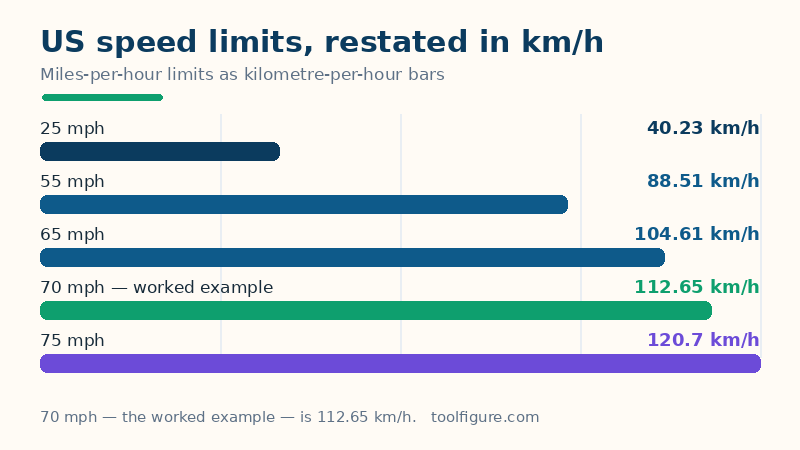
These are definitions, not measurements. The mile has been defined as exactly 1,609.344 metres since 1959, so one mile per hour is exactly 1,609.344 metres per 3,600 seconds — 0.44704 m/s, no rounding involved. The knot is defined as one nautical mile per hour, and the nautical mile is defined as exactly 1,852 metres. Mach is the honest exception on the page: the speed of sound genuinely changes with air temperature and altitude, so this tool uses the standard sea-level 15 °C value, 340.29 m/s, and says so on every answer that touches it.
Worked example, done step by step
Convert 70 mph to km/h — the classic American-highway question. Step 1: into metres per second. 70 × 0.44704 = 31.2928 m/s. Step 2: out to kilometres per hour. 31.2928 ÷ 0.277777… = 112.65 km/h (dividing by 1/3.6 is the same as multiplying by 3.6). So an American doing 70 on the interstate is doing the equivalent of about 113 km/h — right in the 110–130 km/h band of European motorway limits.
The reverse — 100 km/h to mph. Step 1: 100 × 0.277777… = 27.7778 m/s. Step 2: 27.7778 ÷ 0.44704 = 62.14 mph. That is why the 100 km/h limit feels so slow to an American driver: it is barely over 60 mph.
Speeds you actually meet, in every unit
| What | mph | km/h | m/s | knots |
|---|---|---|---|---|
| Brisk walk | 3 | 4.83 | 1.34 | 2.61 |
| City cycling | 12 | 19.31 | 5.36 | 10.43 |
| City speed limit | 30 | 48.28 | 13.41 | 26.07 |
| US highway (worked example) | 70 | 112.65 | 31.29 | 60.83 |
| High-speed train | 186 | 299.34 | 83.15 | 161.63 |
| Cruising jet | 575 | 925.37 | 257.05 | 499.66 |
Two landmarks for orientation: the speed of sound at sea level is about 1,225 km/h (761 mph) — that is Mach 1 in this tool's standard conditions — and the speed of light is 299,792,458 m/s, which no physical object can reach. If your conversion ever crosses that line, the tool will tell you.
Where you will actually meet each unit
mph rules road signs and dashboards in the United States and the United Kingdom. km/h rules them almost everywhere else — which is exactly why the rental-car moment needs this page. m/s is the scientist's and the sprinter's unit: athletics times and physics problems live here. ft/s turns up in American engineering and ballistics. Knots belong to ships and aircraft — a knot is one nautical mile per hour, and navigation charts are drawn in nautical miles, so speeds at sea stay in knots. Mach is aviation shorthand for fractions of the speed of sound.
Reading the result, and its limits
Two honest notes. First, converting a speed does not convert the speed limit: limits are set per country and do not translate, so 70 mph equalling 112.65 km/h does not make 112 km/h legal where the limit is 100. Second, Mach is the only approximate unit on the page — 340.29 m/s is the sea-level 15 °C value, but at cruising altitude the speed of sound is lower, so a jet's Mach number and its km/h figure drift apart with altitude. For pace-style running figures (minutes per kilometre), the pace calculator is the right tool; for fuel use on the same journey, the MPG calculator covers it.
Frequently asked questions
How do I convert mph to km/h?
Multiply by 1.609344 — exactly, because the mile is defined as 1,609.344 metres. So 70 mph × 1.609344 = 112.65 km/h. To go the other way, multiply km/h by 0.621371: 100 km/h × 0.621371 = 62.14 mph.
What is a knot, and how fast is it in mph?
A knot is one nautical mile per hour — the speed unit of ships and aircraft, because navigation charts are drawn in nautical miles. One knot is 1.852 km/h, which is 1.15078 mph, so 25 knots is 28.77 mph.
How do I convert km/h to m/s?
Divide by 3.6 — exactly. A kilometre is 1,000 metres and an hour is 3,600 seconds, so the factor is exact: 36 km/h ÷ 3.6 = 10 m/s. Multiply by 3.6 to go from m/s back to km/h.
How fast is Mach 1 in km/h?
About 1,225 km/h at sea level and 15 °C — this tool uses 340.29 m/s as the standard speed of sound, giving 1,225.04 km/h (761.21 mph). The real figure falls as the air gets colder, so at cruising altitude Mach 1 is noticeably slower in km/h.