One subtraction that summarises a whole financial life
Net worth is the simplest honest summary in personal finance: everything you own, at today's value, minus everything you owe, at today's balance. Income does not appear in it at all — a high earner who owes more than they own has a negative net worth, and a modest earner who owns a home outright can be well ahead. This page does the weighing in the open: each side is broken into its five lines with every line's share of its side shown, so the total can be rebuilt by hand, and it reports the two figures people most often confuse with net worth itself — home equity, which is only the home's slice, and cash, which is only the part reachable without selling anything. It belongs with the forward-looking pages here — the retirement calculator projects where the investments line is heading, and the debt payoff calculator works the debts side down month by month — but this page is the snapshot they both move.
The method, with every term defined
Net worth = total assets − total debts · Home equity = home value − mortgage still owedDebt share of assets = total debts ÷ total assets × 100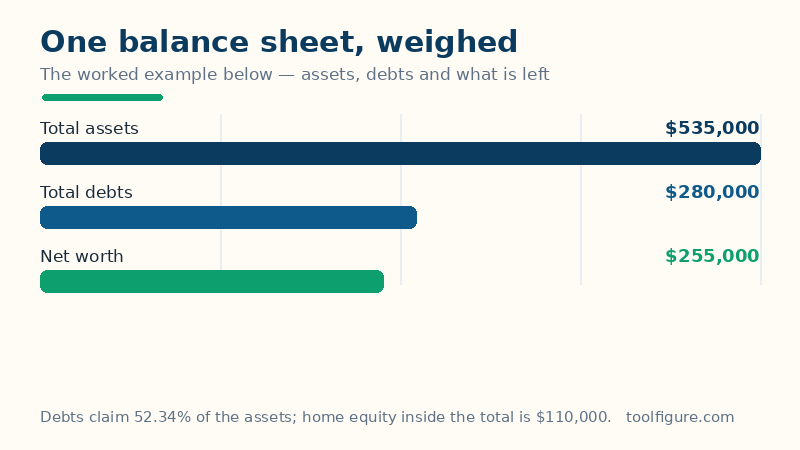
An asset here is anything with a resale value today: the home at what it would sell for now, cash and savings at their balances, investments and retirement accounts at their current values, vehicles at a realistic resale figure, and anything else saleable in the other-assets line. A debt is a balance still owed today — the mortgage remaining, not the amount originally borrowed. The debt share of assets states how much of everything you own is claimed by lenders: at 0% nothing is claimed, at 100% the debts exactly consume the assets, and above 100% the net worth is negative whatever the assets are worth. Note what is deliberately not an asset: future earnings, however likely. A salary is income, not property, and counting it would flatter every young worker's balance sheet into meaninglessness.
Worked example: a homeowner with a mortgage and four smaller debts
The defaults above are a household that owns a home worth $350,000, holds $25,000 in cash and savings, $120,000 in investments and retirement accounts, vehicles worth $30,000 and $10,000 of other assets. The assets add to $535,000 — the home is 65.42% of them, investments 22.43%, vehicles 5.61%, savings 4.67% and other assets 1.87%, shares that sum to exactly 100.00%. Against that stand a mortgage of $240,000, car loans of $18,000, credit cards of $6,500, student loans of $12,000 and $3,500 of other debts: $280,000 owed in total, of which the mortgage alone is 85.71%. The net worth is $535,000 − $280,000 = $255,000. The debts claim 52.34% of the assets, the home equity is $350,000 − $240,000 = $110,000, and only the $25,000 of savings is liquid — three very different numbers that casual talk merges into one vague "worth", kept separate here on purpose.
Four households, from first savings to owing more than everything
| Household | Total assets | Total debts | Net worth | Debts / assets |
|---|---|---|---|---|
| Starting out — renting, small savings, one loan | $22,000.00 | $9,000.00 | $13,000.00 | 40.91% |
| Homeowner — worked example | $535,000.00 | $280,000.00 | $255,000.00 | 52.34% |
| Debt-free homeowner | $610,000.00 | $0.00 | $610,000.00 | 0.00% |
| Owing more than everything is worth | $45,000.00 | $78,000.00 | -$33,000.00 | 173.33% |
Two lessons in the table. The starting-out household is less indebted relative to what it owns (40.91%) than the established homeowner (52.34%) — a mortgage is a large, deliberate claim, and the ratio alone does not say whether the position is healthy; the direction of travel matters more, which is why this snapshot is worth retaking once or twice a year rather than judged once. And the last row is not a rounding error: when debts pass assets the net worth goes honestly negative, and the ratio passing 100% (173.33% there) is the same fact stated the other way — every dollar owned has $1.73 of claims against the household.
How to read your result — and its limits
Use net worth as a trend, not a grade: the same household measured yearly shows whether debts are shrinking and assets growing faster than life spends them, and a single figure cannot show that. Four limits belong with the page. Values are estimates: a home is worth what a buyer pays on the day, vehicles and other assets are worth less than optimism suggests, and investment balances move daily — enter resale values you could defend, not prices you hope for. Selling costs and taxes are not deducted: realising an asset usually costs fees and may trigger tax, so the spendable figure is somewhat below the paper figure, most of all for retirement accounts with withdrawal penalties. Joint and separate property differ: decide whose balance sheet this is — one person's or a household's — and put every line on the same basis, or debts shared and assets halved will quietly corrupt the subtraction. And liquidity is not worth: a household can be worth $255,000 and still miss a $600 emergency, because almost none of that worth is cash; the savings line in the table is the figure that answers emergencies, and it deserves its own attention beside the headline. What this page guarantees is the weighing itself: given the values and the balances, every total, share and the final subtraction follow exactly as written above.
Frequently asked questions
How do you calculate net worth?
Add everything you own at today's value — home, savings, investments, vehicles, other saleable assets — and subtract everything you still owe. This page's worked example: $535,000 of assets minus $280,000 of debts gives a net worth of $255,000. The two rules that keep the figure honest are to use current values on both sides (what the home would sell for now, the mortgage balance remaining now) and never to count future income, which is earnings, not property.
Is home equity the same as net worth?
No — home equity is one slice of it. Equity is the home's value minus the mortgage still owed on it: $350,000 − $240,000 = $110,000 in the worked example. Net worth, $255,000 there, counts every other asset and every other debt as well. A household can have large home equity and a small or negative net worth if other debts are heavy, and a renter with no equity at all can have a solid net worth in savings and investments.
Can net worth be negative?
Yes, and early in working life it often is: a graduate whose student loans exceed their savings and car value owes more than they own. The fourth household in the table on this page owns $45,000 and owes $78,000, for a net worth of -$33,000 and a debt share of 173.33% of assets. A negative figure is a starting point to track, not a verdict — what matters is that each retake of the snapshot moves it upward as debts fall and assets build.
How often should I calculate my net worth?
Once or twice a year is the rhythm most planners suggest: often enough to see the trend clearly, rarely enough that market wiggles and the seasons of spending do not dominate it. Retake it on the same basis each time — same lines, same valuation habits — because the change between two honestly comparable snapshots is the useful number. Big events justify an extra reading: buying or selling a home, clearing a debt, or a job change all move the figure in one step.