A wall is an area; a brick is a smaller area with a joint around it
Counting bricks is division, not guesswork — but only once the mortar joint is counted as part of each brick. A brick laid alone covers its own face; a brick laid in a wall covers its face plus one joint's width and one joint's height, because the joints tile the wall along with the bricks. That is the whole method on this page, and it is why the joint is an input rather than a fudge factor: change it and the count genuinely changes. Brick belongs with the other quantity pages on this site — the concrete calculator volumes a slab, the board foot calculator volumes lumber — but a wall is counted in pieces, and pieces must be rounded up, never down: a wall that takes 548.57 bricks cannot be built with 548.
The method, with every term defined
Face per brick = ( brick length + joint ) × ( brick height + joint )Bricks needed = wall length × wall height × 144 ÷ face per brick · Order = exact count × ( 1 + waste % ), rounded up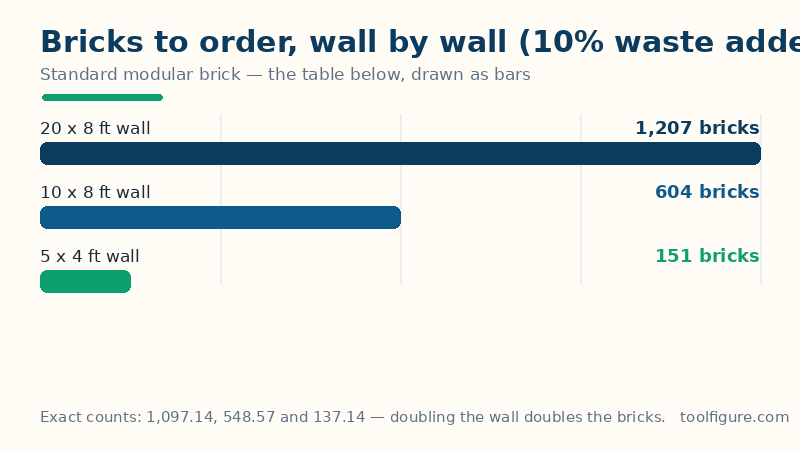
The wall area is length times height, in square feet; the 144 converts it to square inches so it can be divided by a face measured in inches. The face per brick adds one joint to the length and one to the height — one, not two, because each joint is shared between the two bricks it separates, so across a whole wall each brick effectively carries half a joint on each side, which sums to one. The waste allowance covers cut bricks at the ends of courses, breakage in transit and the odd dropped brick; 10% is the usual planning figure for a plain rectangular wall, and it is added openly here as its own step so you can see the count before and after. The mortar volume is worked geometrically: the wall's volume (area times the brick's depth) minus the solid volume of the bricks themselves is the space left for mortar. It is a volume, not a bag count — bag yields are printed per product and differ, so convert with the yield on the bag you actually buy.
Worked example: a 10 by 8 foot wall in standard modular brick
The defaults above are a 10 × 8 ft wall — 80.00 square feet — built from standard US modular bricks, 7.625 × 2.25 in on the face and 3.625 in deep, with a 0.375 in joint. Each brick covers (7.625 + 0.375) × (2.25 + 0.375) = 8 × 2.625 = 21.00 square inches of wall, which is 144 ÷ 21 = 6.86 bricks per square foot. The wall therefore takes 80 × 6.8571 = 548.57 bricks exactly. Adding the 10% allowance gives 603.43, which rounds up to 604 bricks to order — at $0.65 a brick, $392.60. The mortar check: the wall's volume is 80 × (3.625 ÷ 12) = 24.17 cubic feet, the bricks themselves occupy 19.74, so the joints hold about 4.42 cubic feet of mortar.
The same brick, different walls — and a bigger brick
| Wall (same brick and joint, 10% waste) | Area | Exact bricks | To order |
|---|---|---|---|
| 5 × 4 ft garden wall | 20.00 sq ft | 137.14 | 151 |
| 10 × 8 ft — worked example | 80.00 sq ft | 548.57 | 604 |
| 12 × 10 ft wall | 120.00 sq ft | 822.86 | 906 |
| 20 × 8 ft wall | 160.00 sq ft | 1,097.14 | 1,207 |
Two checks on the table's honesty: doubling the wall doubles the exact count (548.57 becomes 1,097.14), and every order figure is the exact count times 1.1 rounded up — nothing else is hidden in them. Brick size moves the count harder than wall size surprises people: a larger face brick of 11.625 × 3.625 in with the same joint covers (12 × 4) = 48.00 square inches, so the same 80-square-foot wall takes exactly 240.00 bricks, 264 to order. And openings come straight off the area: the worked wall with a 3 × 7 ft door removed is 80 − 21 = 59.00 square feet, which takes 404.57 bricks exactly — 446 to order. At scale the per-square-foot figure is the one to carry: 100 square feet of this brickwork is 685.71 bricks exactly, 755 to order with the same allowance.
How to read your result — and its limits
Order on the rounded-up count, and treat the exact count as the audit figure: if a supplier's quote is far from the exact count for your area and brick, one of you is using a different brick or a different joint, and the face-per-brick row shows which. Four limits belong with the page. One wythe only: this counts a wall one brick thick; a double-wythe (two-brick) wall takes twice the count, and cavity walls take the count once per leaf. Corners and bonds change cuts, not area: a stretcher bond is assumed; decorative bonds, soldier courses and arches waste more than 10%, so raise the allowance rather than expecting the base figure to absorb them. Nominal and actual sizes differ: bricks are often named by their nominal size — the size including a joint — so enter the actual measured dimensions of the brick in hand, as the board foot calculator also warns for lumber. And measure the net wall: large openings should be subtracted before you start, as the door example above shows; small ones are usually absorbed by the waste allowance. What this page guarantees is the area arithmetic itself: given the wall, the brick and the joint, every count follows exactly as written above.
Frequently asked questions
How many bricks do I need for a wall?
Divide the wall's area by the face each brick covers including one mortar joint. A standard US modular brick (7.625 by 2.25 in) with a 3/8 in joint covers 21.00 square inches — 6.86 bricks per square foot — so a 10 by 8 foot wall (80 square feet) takes 548.57 bricks exactly, and 604 to order once a 10% waste allowance is added and the result rounded up. This page runs that division for your own wall and brick, with the allowance shown as its own step.
How many bricks are in 100 square feet?
With the standard modular brick and a 3/8 in joint used on this page, 100 square feet takes 685.71 bricks exactly — 100 times the 6.86 bricks per square foot — and 755 to order with a 10% allowance for cuts and breakage. The figure is only as portable as the brick: a larger face brick covering 48.00 square inches needs just 300 bricks for the same 100 square feet, which is why any per-square-foot rule of thumb is meaningless until the brick and joint are named.
Why does the mortar joint change the brick count?
Because the joints are part of the wall's area. Each brick in the wall effectively covers its own face plus one joint's width and one joint's height — the joints on its other two sides belong to its neighbours. With a 3/8 in joint, a modular brick's covered face grows from 17.16 to 21.00 square inches, about 22% larger, so the wall needs about 22% fewer bricks than the bare brick face suggests. Ignoring the joint is the commonest reason hand counts come out high.
How much mortar does a brick wall need?
The joints hold the difference between the wall's volume and the bricks' own volume. For the worked example on this page — an 80-square-foot wall, one modular brick (3.625 in) thick — the wall is 24.17 cubic feet, the bricks occupy 19.74, and the mortar is about 4.42 cubic feet. Treat that as the volume to cover, then convert it with the yield printed on the mortar product you buy: bag yields differ between brands and types, so this page reports the geometry honestly rather than inventing a bag count.