Fuel economy is one division — the discipline is in the measuring
Miles per gallon is the simplest ratio on this site: the miles a tank carried you, divided by the gallons that replaced what you burned. The arithmetic is trivial; the measurement is where honesty lives. A dashboard estimate is the car's own guess, averaged over a window it chooses. The fill-to-fill method — full tank, trip meter zeroed, drive, refill, divide — measures what actually left the tank, which is why this page is built around a fill, not a guess. It sits in Finance rather than with the car-loan pages for a reason: the auto loan calculator prices the purchase, but fuel is the running cost that repeats every week, and at the worked example's economy it is worth $1,400 a year on an ordinary mileage — the same household-budget family as the electricity cost calculator, priced per mile instead of per hour.
The method, with every term defined
MPG = miles driven ÷ gallons used · Fuel cost per mile = price per gallon ÷ MPGLitres per 100 km = 235.214583 ÷ MPG · Fuel for a distance = distance ÷ MPG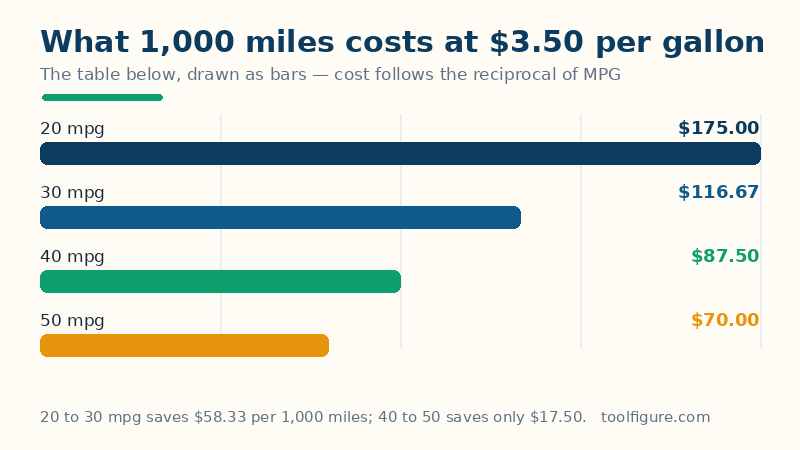
The miles and gallons must cover the same driving — that is the whole fill-to-fill rule — and the gallons are US gallons (3.785 litres); the UK imperial gallon is about a fifth larger, and mixing them is the classic error this page's FAQ untangles. Cost per mile divides the price by the economy rather than multiplying anything, which is why it falls as MPG rises: at a fixed price, each mile's fuel is a gallon sliced into MPG pieces. The litres-per-100-km figure is the same economy in the measure most of the world uses, and it runs backwards — lower is better — because it counts consumption instead of distance. Its constant, 235.214583, is not a fudge: it is 100 km in miles (62.1371) divided by a US gallon in litres (3.785412), times 100 in the arrangement the formula needs, and this page prints it in full so the conversion can be checked rather than trusted. Kilometres per litre (MPG × 0.4251437) is the third statement of the same fact, kept because some markets quote it.
Worked example: 300 miles on 10 gallons at $3.50
The defaults above are a 300-mile stretch of driving that took exactly 10.00 gallons to refill, at $3.50 per gallon. The economy is 300 ÷ 10 = 30.00 mpg. In consumption terms that is 235.214583 ÷ 30 = 7.84 litres per 100 km, or 30 × 0.4251437 = 12.75 km per litre. The fill cost 10 × $3.50 = $35.00, and each mile cost $3.50 ÷ 30 = $0.1167 in fuel. Held steady, that economy uses 3.33 gallons ($11.67) per 100 miles, 16.67 gallons ($58.33) per 500, and 33.33 gallons ($116.67) per 1,000 miles — the three distance rows in the result, each one just the distance divided by 30, so they scale exactly with the miles and can be audited at a glance.
What economy is worth, at one fixed price
| Economy (at $3.50 per gallon) | L/100 km | Cost per mile | Gallons per 1,000 miles | Cost per 1,000 miles |
|---|---|---|---|---|
| 20.00 mpg | 11.76 | $0.1750 | 50.00 | $175.00 |
| 25.00 mpg | 9.41 | $0.1400 | 40.00 | $140.00 |
| 30.00 mpg — worked example | 7.84 | $0.1167 | 33.33 | $116.67 |
| 40.00 mpg | 5.88 | $0.0875 | 25.00 | $87.50 |
| 50.00 mpg | 4.70 | $0.0700 | 20.00 | $70.00 |
Read the table by its gaps, not its levels: the step from 20 to 30 mpg saves $58.33 per 1,000 miles, while the same ten-point step from 40 to 50 saves only $17.50 — because cost follows the reciprocal of MPG, early improvements are worth far more than late ones. A second fill makes the method concrete: 412 miles on 12.50 gallons is 412 ÷ 12.5 = 32.96 mpg (7.14 L/100 km); at $3.80 a gallon that fill cost $47.50, or $0.1153 a mile. And economy compounds across a year of driving: 12,000 miles at 25 mpg burns 480.00 gallons ($1,680.00 at $3.50), while the same miles at 35 mpg burn 342.86 gallons ($1,200.00) — a $480.00 difference from ten points of MPG, which is the honest scale to judge a more efficient car, or a lighter right foot, against.
How to read your result — and its limits
Judge a car on the cost per mile and the per-1,000-miles cost, not the MPG alone: MPG's reciprocal shape makes two cars 5 points apart look similar at the efficient end and very different at the thirsty end, while the money rows never hide that. Four limits belong with the page. One fill is a sample, not a verdict: pump cut-off variation, a headwind week, roof loads and cold starts all move a single fill by a point or two — average three or four fills before concluding anything, ideally with the unit converter keeping any litre-measured fills straight. The method assumes the tank was equally full both times: that is what the pump's cut-off roughly delivers, and it is why topping off past the click breaks the comparison. Fuel is not the whole cost of a mile: tyres, servicing, insurance and depreciation are real per-mile costs this page deliberately does not invent figures for — it prices the fuel slice exactly and leaves the rest to your own records. And a rating is not a road: official test-cycle figures are measured on a standard cycle, so a gap between the brochure number and your fill-to-fill number is information about your driving pattern, not necessarily about the car. What this page guarantees is the ratio itself: given the miles, the gallons and the price, every economy and cost figure follows exactly as written above.
Frequently asked questions
How do I calculate miles per gallon?
Fill the tank, reset the trip meter, drive as usual, then divide the miles on the trip meter by the gallons the next fill takes. Driving 300 miles and refilling with 10.00 gallons is 300 divided by 10 — 30.00 mpg. The two numbers must cover exactly the same driving, which the fill-to-fill method guarantees and a dashboard estimate does not. For a figure you can trust, average the result over three or four fills rather than trusting one.
Is 30 mpg good?
At $3.50 per gallon it costs $0.1167 of fuel per mile — $116.67 per 1,000 miles — which the table on this page puts in the middle of the common range: a 20 mpg vehicle costs $175.00 per 1,000 miles and a 50 mpg vehicle $70.00. Whether 30 is good depends on the vehicle class, but the money rows are the fair judge, because MPG differences shrink in value as economy rises: 20 to 30 mpg saves $58.33 per 1,000 miles, while 40 to 50 saves only $17.50.
Why is my UK mpg different from US mpg?
Because the gallons differ. A UK (imperial) gallon is 4.54609 litres; a US gallon is 3.78541 litres — about 20% smaller. The same car therefore posts a higher number in the UK: multiply US mpg by 1.20095 to get the UK figure, so this page's 30.00 US mpg is 36.03 UK mpg. Neither is wrong, but they must never be compared directly, and a fuel quantity measured in UK gallons must not be typed into a US-gallon calculator like this one.
How much fuel will a 500-mile trip use?
Divide the distance by your economy: at the worked example's 30.00 mpg, 500 miles takes 16.67 gallons, which at $3.50 per gallon costs $58.33. The result table on this page shows the 100, 500 and 1,000 mile rows for whatever economy you measured, and they scale exactly — double the distance doubles the fuel at a steady economy. Add a margin for detours and a different driving mix rather than planning a trip to the last tenth of a gallon.