A week of clock times, turned into money
A paper timesheet hides exactly one operation: turn every day's clock-in and clock-out into hours, take off the unpaid break, add the days, and split the total at 40 hours for overtime. This page does that arithmetic in the open, with every day listed separately so a wrong entry can be spotted at a glance — the day that looks wrong usually is. It belongs to the working-time family here: the hours calculator works a single span of time in depth, the overtime pay calculator starts from hours you already know and prices them, and the paycheck calculator takes gross pay on to what lands in the bank — this page is the bridge between clock times and that gross pay.
The method, with every term defined
Day's hours = ( clock-out − clock-in − unpaid break ) ÷ 60Regular hours = min( weekly total, 40 ) · Overtime hours = weekly total − 40 ( when the total is over 40 )Gross pay = regular hours × rate + overtime hours × rate × 1.5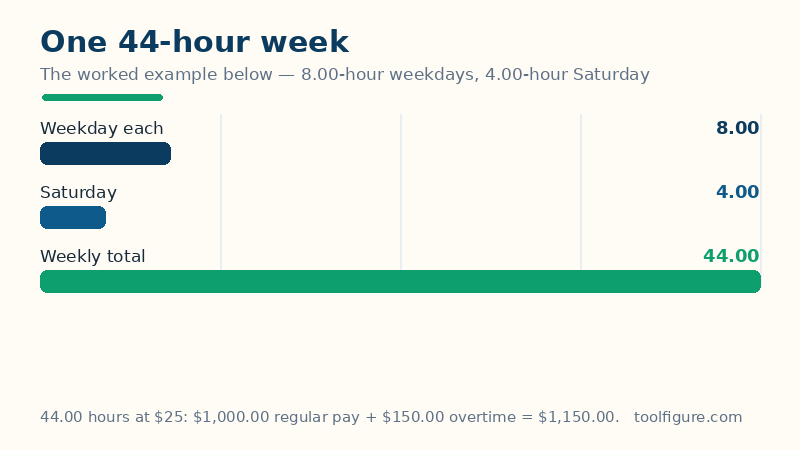
Each day is counted in minutes first — 9:00 to 17:30 is 510 minutes, minus a 30-minute break is 480, divided by 60 is 8.00 hours — because minute arithmetic never loses the fractions that decimal hours hide. A day left entirely blank is skipped; a day with a clock-in but no clock-out is an error, not a guess, and the page says so. The overtime split is the common US rule: the first 40 hours of the week at the plain rate, everything after at time-and-a-half. That rule is stated as an assumption, not a law — the limits below say when it does not apply.
Worked example: five full days and a Saturday morning
The defaults above are a week at $25 an hour: Monday to Friday clocked 9:00 to 17:30 with a 30-minute unpaid break, Saturday 9:00 to 13:00 with no break, Sunday off. Each weekday is (510 − 30) ÷ 60 = 8.00 hours, five of them make 40.00; Saturday is 240 ÷ 60 = 4.00 hours. The week's total is 44.00 hours: the first 40.00 are regular time and 4.00 are overtime. The regular pay is 40.00 × $25 = $1,000.00, the overtime pay is 4.00 × $37.50 = $150.00, and the gross pay for the week is $1,150.00 — the two parts added, as the result table shows.
Three more weeks, checked the same way
| Week | Total hours | Overtime | Gross pay at $25 |
|---|---|---|---|
| Defaults — 5 × 8.00 + Sat 4.00, worked example | 44.00 | 4.00 | $1,150.00 |
| 5 × (9:00–17:00, 60-min break) | 35.00 | 0.00 | $875.00 |
| 5 × (8:00–18:00, 30-min break) | 47.50 | 7.50 | $1,281.25 |
| 4 × (7:00–18:00, 60-min break) | 40.00 | 0.00 | $1,000.00 |
Read the rows for the two lessons in them. First, the break matters: the second row's hour-long breaks make a 9:00–17:00 week only 35.00 counted hours — a worker who "did 40 hours" by the clock did 35 by the timesheet, which is why the break column exists. Second, watch 40.00 on the last row: four ten-hour days land exactly on the overtime line, so the pay is a clean $1,000.00 with no 1.5× applied — the week that looks busiest can be the one the rule leaves alone.
How to read your result — and its limits
Check the per-day list first, then the total. The most common timesheet error is not arithmetic but a mis-typed entry — one 17:30 typed as 7:30 turns a day negative-proof into a complaint, so the page refuses out-before-in rather than guessing. Four limits belong with the result. Overnight shifts are not covered: if clock-out is not after clock-in the page stops — split the shift across midnight into two rows instead of fighting it. Breaks are unpaid here: a paid break should be entered as 0 minutes, because the tool subtracts whatever break you give it. The 1.5× rule is the common US one, not a universal law: daily-overtime states, union contracts, salaried posts and non-US rules all differ — confirm yours before relying on the pay figure. Gross is not net: the pay shown is before every tax and deduction; the paycheck calculator takes it from here. What the page guarantees is the counting: given the times and the stated assumptions, every hour and every dollar follows exactly as written above.
Frequently asked questions
How is a day's hours worked out from clock-in and clock-out?
In minutes, with the break taken off first. Monday in the worked example: 9:00 to 17:30 is 510 minutes, minus the 30-minute unpaid break is 480 minutes, divided by 60 is 8.00 hours. The page lists every day separately so a wrong entry — the usual real-world error — can be spotted before the total is trusted. A break left blank counts as zero; a day left entirely blank is skipped as a day off.
When does the time card calculator apply overtime?
Whenever the week's total passes 40 hours. The worked example's 44.00 hours split into 40.00 regular and 4.00 overtime; at $25 an hour that is $1,000.00 of regular pay plus 4.00 times $37.50 of overtime pay, $150.00, for a gross of $1,150.00. A week at exactly 40.00 — like the four ten-hour days in the table — earns no overtime at all, even though the days are long.
Why does the calculator refuse a clock-out before the clock-in?
Because guessing is how timesheet errors become pay disputes. A clock-out earlier than the clock-in usually means a 24-hour entry was meant (7:30 instead of 17:30), or the shift crossed midnight — and overnight shifts are a stated limit of this page, which counts each day as one continuous span. Split a midnight-crossing shift into two day rows instead, and the arithmetic works.
Is the gross pay the amount I will receive?
No — gross is the starting point, before every tax, deduction and benefit taken from it. In the worked example the $1,150.00 is 40.00 hours at $25 plus 4.00 overtime hours at $37.50, added openly in the result table; nothing has been taken off yet. The paycheck calculator takes this page's gross pay on to the take-home figure, and the salary to hourly calculator works the reverse direction for comparing offers.