Military time is the day counted 00 to 23
A standard clock counts to 12 twice and leaves you to work out which half of the day you mean. The 24-hour clock — called military time in the US and railway time in much of Europe — counts the whole day once: 0000 is midnight, 1200 is noon, and 2359 is the last minute before midnight comes round again. The minutes never change; only the hour and the AM/PM label move. It exists for one reason: removing the ambiguity that has caused real scheduling failures in hospitals, aviation and the armed forces, when a 7:00 turned out to be the wrong 7:00.
The conversion rules, with every case named
Military → standard: hour 00 → 12 AM · hours 01–11 → same hour, AM · hour 12 → 12 PM · hours 13–23 → hour − 12, PM (minutes never change)Standard → military: 12:xx AM → 00:xx · 1:xx–11:xx AM → same hour, padded to two digits · 12:xx PM → 12:xx · 1:xx–11:xx PM → hour + 12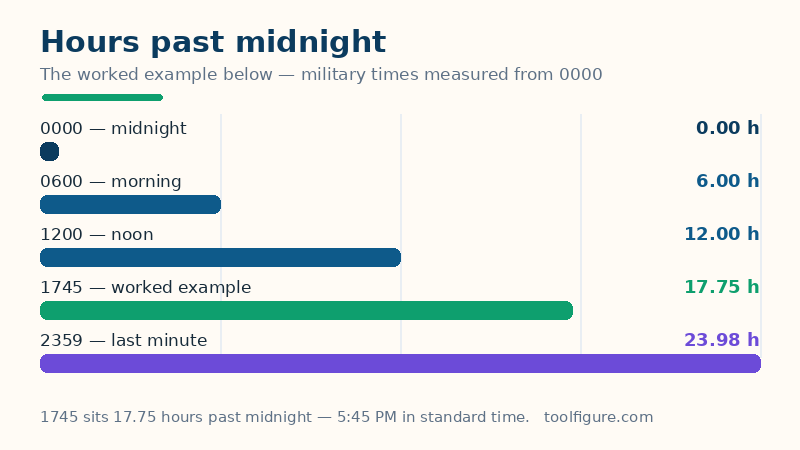
The two traps that catch everyone are named in the rules above, but they deserve saying plainly: midnight is 0000, never "1200 AM" — that notation does not exist in 24-hour time — and noon is 1200, which becomes 12 PM rather than 12 AM. Get those two right and the rest is arithmetic you can do in your head.
Worked examples, done step by step
Military to standard — 1745. Split into hour and minutes: 17 and 45. The hour is above 12, so subtract: 17 − 12 = 5, and the label is PM. The minutes stay 45. The answer is 5:45 PM, spoken "seventeen forty-five".
Standard to military — 12:30 AM. This is the midnight trap. 12 AM is the start of the day, so the hour becomes 00, not 12. The minutes stay 30. The answer is 0030, spoken "zero thirty".
The noon trap — 1200. Hour 12 stays 12 and takes the PM label. The answer is 12:00 PM — noon, not midnight.
The full conversion chart
| Military | Standard | Spoken |
|---|---|---|
| 0000 | 12:00 AM (midnight) | Zero hundred hours |
| 0100 | 1:00 AM | Zero one hundred hours |
| 0200 | 2:00 AM | Zero two hundred hours |
| 0300 | 3:00 AM | Zero three hundred hours |
| 0400 | 4:00 AM | Zero four hundred hours |
| 0500 | 5:00 AM | Zero five hundred hours |
| 0600 | 6:00 AM | Zero six hundred hours |
| 0700 | 7:00 AM | Zero seven hundred hours |
| 0800 | 8:00 AM | Zero eight hundred hours |
| 0900 | 9:00 AM | Zero nine hundred hours |
| 1000 | 10:00 AM | Ten hundred hours |
| 1100 | 11:00 AM | Eleven hundred hours |
| 1200 | 12:00 PM (noon) | Twelve hundred hours |
| 1300 | 1:00 PM | Thirteen hundred hours |
| 1400 | 2:00 PM | Fourteen hundred hours |
| 1500 | 3:00 PM | Fifteen hundred hours |
| 1600 | 4:00 PM | Sixteen hundred hours |
| 1700 | 5:00 PM | Seventeen hundred hours |
| 1800 | 6:00 PM | Eighteen hundred hours |
| 1900 | 7:00 PM | Nineteen hundred hours |
| 2000 | 8:00 PM | Twenty hundred hours |
| 2100 | 9:00 PM | Twenty-one hundred hours |
| 2200 | 10:00 PM | Twenty-two hundred hours |
| 2300 | 11:00 PM | Twenty-three hundred hours |
Where you will actually meet military time
Hospital shift boards, flight and rail timetables, emergency-services logs, shipping schedules, and the 24-hour clock option on your phone — alongside the 1430-style timestamps inside server logs and spreadsheets. The reverse direction matters most when a form demands military time: shift schedules, airline crew rosters and some government applications ask for it, and writing 2:30 PM as 1430 is the expected answer. Learn the four rules above and the converter becomes the checker rather than the crutch.
Reading the result, and its limits
Two honest notes. First, some timetables write midnight at the end of a day as 2400 — the last minute of Monday is 2359, then Monday 2400 is the same instant as Tuesday 0000. This converter accepts 0000–2359 only and treats 2400 as invalid, because outside a timetable it is ambiguous; if you meet it, read it as that day's midnight. Second, the spoken forms follow the common convention — "seventeen hundred hours" on the hour, "seventeen forty-five" otherwise — which is a pronunciation guide, not a regulation; services differ slightly in the details. Leading zeros are part of the format: 0700 is correct military time and 700 is not, which is why this converter always writes the full four digits. For shifting a moment between cities rather than between formats, use the time zone converter; for durations inside one working day, the hours calculator is the right tool.
Frequently asked questions
What is 1745 in standard time?
5:45 PM. Split 1745 into hour 17 and minutes 45; the hour is above 12, so subtract — 17 − 12 = 5 — the label is PM, and the minutes stay 45. Spoken, it is "seventeen forty-five".
Why is midnight 0000 and not 1200 AM?
Because the 24-hour clock has no AM/PM labels at all — the day simply starts at hour zero. Writing 1200 AM mixes two systems: in 24-hour time, 1200 is noon, full stop. The confusion is the whole reason the 24-hour clock was adopted.
How do I convert military time to regular time?
Keep the minutes and work on the hour: 00 becomes 12 AM, 01–11 keep their number with AM, 12 keeps its number with PM, and 13–23 subtract 12 and take PM. So 1930 is 7:30 PM and 0830 is 8:30 AM.
What is 2400 in military time?
End-of-day midnight — the same instant as 0000 of the next day. Some timetables print 2400 for a service arriving at the close of the day's schedule. This converter uses 0000–2359 and rejects 2400, because outside a timetable it is ambiguous.