One table, three levels
The bodyboard guides that are worth trusting do not give a single height rule, because height alone does not float a rider — weight decides how much board is under them, and level decides whether they want float or control. The table below is the published height, weight and level table the tool looks up, with every row stated in full so the lookup can be checked by hand. Read it by row: find your height band, check your weight sits in the same row's weight band, then take the column for your level.
Bodyboard size = the range in your height row and level column — beginners take the longer end, experts the shorter, and the board should reach navel to sternum when stood upright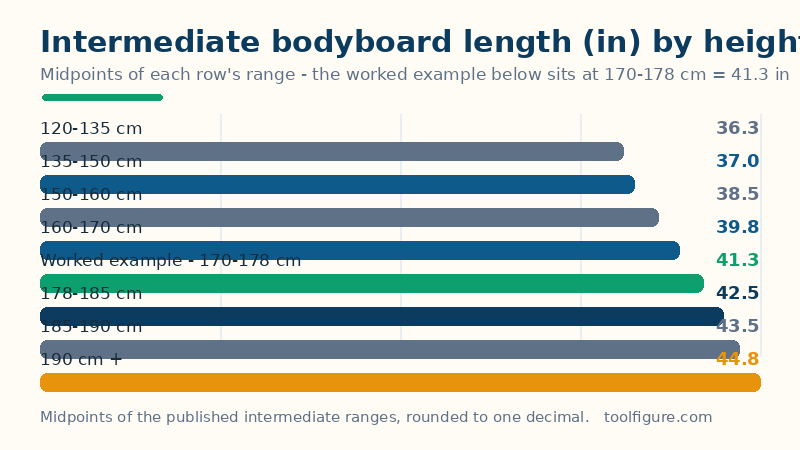
| Height | Weight | Beginner | Intermediate | Expert |
|---|---|---|---|---|
| 120–135 cm | 25–35 kg | 36–37 in | 36–36.5 in | 34–36 in |
| 135–150 cm | 35–45 kg | 37–38 in | 36.5–37.5 in | 36–37 in |
| 150–160 cm | 45–55 kg | 38–39.5 in | 38–39 in | 37–38.5 in |
| 160–170 cm | 55–65 kg | 39.5–41 in | 39–40.5 in | 38.5–40 in |
| 170–178 cm | 65–75 kg | 41–42.5 in | 40.5–42 in | 40–41.5 in |
| 178–185 cm | 75–85 kg | 42.5–43.5 in | 42–43 in | 41.5–42.5 in |
| 185–190 cm | 85–95 kg | 43.5–45 in | 43–44 in | 42.5–43.5 in |
| 190 cm + | 95 kg + | 45–46 in | 44–45.5 in | 43.5–45 in |
Centimetres come from inches × 2.54 exactly: 36 in is 91.4 cm, 42 in is 106.7 cm and 46 in is 116.8 cm, so the whole table spans roughly 86–117 cm. The pattern to notice is the level shift: at every height, beginners ride about 1 in longer than intermediates, and experts about 1 in shorter — float for the beginner, control for the expert, with the intermediate column in the middle.
Worked example: 175 cm, 70 kg, intermediate
A rider 175 cm tall (68.9 in, about 5 ft 9 in) weighing 70 kg (154 lb) at intermediate level takes a 40.5–42 in bodyboard (102.9–106.7 cm). The working: 175 cm falls in the 170–178 cm row, whose weight band is 65–75 kg — and 70 kg sits inside it, so no weight adjustment is needed — and the intermediate column of that row reads 40.5–42 in; converted, 40.5 × 2.54 = 102.9 cm and 42 × 2.54 = 106.7 cm. Two more spot checks from the same table: a 150 cm, 50 kg beginner takes 38–39.5 in (96.5–100.3 cm) — 150 cm opens the 150–160 cm row, 50 kg sits in its 45–55 kg band, and the beginner column reads 38–39.5 in; and a 185 cm, 90 kg expert takes 42.5–43.5 in (108.0–110.5 cm) — 185 cm opens the 185–190 cm row, 90 kg sits in its 85–95 kg band, and the expert column reads 42.5–43.5 in.
How to read your result, and its limits
Three checks before buying. First, the standing fit check overrules the table: stand the board upright in front of you, tail on the ground — a board that fits comes up to somewhere between your navel and the bottom of your sternum. The guides state this check in several forms (chin-to-knee is another), and they agree on the point: the table narrows the choice, the body settles it. Second, weight outside your row's band is a real signal, not an error: a heavier build at a given height should take the longer end of the range or look at a high-volume board, which is wider and thicker and floats more at a shorter length — the tool says so when it happens instead of quietly moving you to another row. Third, special cases bend the table openly: drop-knee riders usually take a longer board than prone riders at the same height, hollow waves reward a shorter board with more control, and a growing child should be bought for their current height — a board bought big to grow into is a board that does not fit now, when the learning happens.
Common mistakes
- Sizing by height alone. Two riders at 175 cm weighing 60 kg and 85 kg do not float the same board — weight is half the table, and ignoring it is how a board ends up sinking at the nose.
- Buying big for a growing child. A board that reaches the chest instead of the navel is harder to control and slower to learn on; buy the size that fits now.
- Treating the range as a single size. The table gives ranges because bodies and waves vary — beginners should take the longer end for wave catching, experts the shorter end for control, not the middle by default.
- Skipping the standing check. Proportions differ between riders of the same height; the navel-to-sternum check catches the mismatch the table cannot see.
Related tools: Surfboard Size Calculator — Your surfboard size from weight and skill: target volume, board type and length range; Wakeboard Size Calculator — The right wakeboard length from your weight and ability: the published weight-band chart as a calculator, with the pick inside each band shown; Paddleboard Size Calculator — The right stand-up paddleboard from your weight, use and skill: minimum volume, length range and width from one published rule, shown openly.
Frequently asked questions
What size bodyboard do I need?
Find your height row in the table, check your weight sits in the same row's band, and take your level's column: a 175 cm, 70 kg intermediate rider takes 40.5–42 in (102.9–106.7 cm). Then check the fit by standing the board upright — it should reach between your navel and the bottom of your sternum.
How do I check bodyboard fit without a chart?
Stand the board upright in front of you with the tail on the ground: a board that fits comes up to somewhere between your navel and the bottom of your sternum. That standing check overrules any table when the two disagree.
Does weight matter more than height for bodyboard size?
Neither alone: the table cross-references both, and your level shifts the answer by about an inch either way. If your weight sits outside your height row's band, take the longer end of the range (heavier build) or the shorter end (lighter build), or look at a high-volume board.
What size bodyboard for drop-knee riding, or for a growing child?
Drop-knee riders usually take a longer board than prone riders at the same height, because the stance needs more rail. A growing child should be bought for their current height — a board bought big to grow into does not fit now, when the learning happens.
