Three steps: watts, hours a night, nights a week
The whole calculation is three multiplications, and the heating duty is the one people get wrong. Watts divided by 1,000 is kilowatts; kilowatts times the hours a night times the heating duty is the energy of one night; the night's energy times the nights a week times 52 weeks is the year's energy; the year's energy times the price is the year's money. The month is the year divided by 12, not the night times 30 — the two differ by a few cents, and the year-divided-by-12 figure is the one this page uses, so it agrees with the yearly total exactly:
energy per night (kWh) = watts ÷ 1,000 × hours a night × heating duty ÷ 100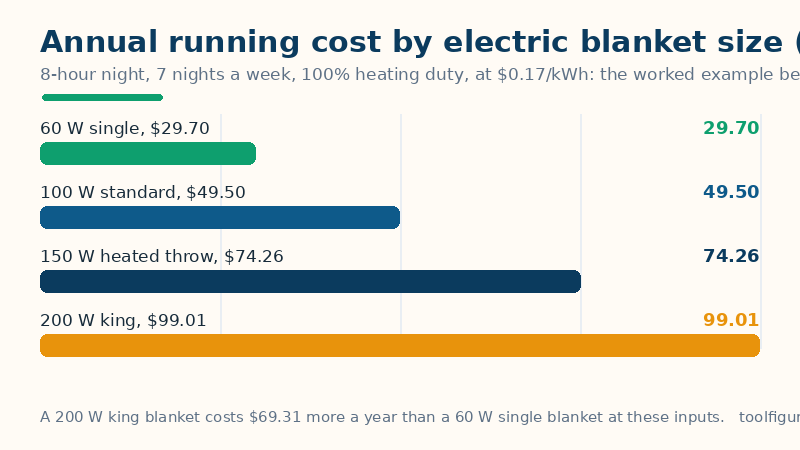
energy per year (kWh) = energy per night × nights a week × 52annual cost ($) = energy per year × electricity priceThe watts on the label are the blanket's maximum draw, and the blanket does not draw them all night. Most electric blankets draw between 40 W and 150 W, according to EDF Energy, while Electrical Safety First lists a typical band of 80–120 W — a single blanket is about 60 W, a standard or double blanket about 100 W, a heated throw about 150 W and a king blanket about 200 W. What matters is the heating duty: a blanket heats at full power, then the thermostat cycles it off and on to hold the temperature, so a blanket left on all night typically averages 50 to 70% of its label watts. The nights a week matter just as much: a blanket used three nights a week costs less than half the every-night figure, and a blanket is a seasonal appliance — the yearly figure assumes all 52 weeks, so a blanket used for the four cold months costs about a third of it.
Worked example: 100 W, 8 hours a night, 7 nights a week, 100% heating duty, $0.17/kWh
A 100 W electric blanket at 8 hours a night and full heating duty uses 0.1 × 8 = 0.800 kWh a night, costing 13.6¢. A week is 0.800 × 7 = 5.6 kWh, costing $0.95. A month is 291.2 ÷ 12 = 24.3 kWh, costing $4.13. A year is 0.800 × 7 × 52 = 291.2 kWh, costing $49.50. The table above shows the same maths for the other blanket sizes at 8 hours a night: a 60 W single blanket costs 8.2¢ a night and $29.70 a year, a 150 W heated throw costs 20.4¢ a night and $74.26 a year, and a 200 W king blanket costs 27.2¢ a night and $99.01 a year. One hour at these settings uses 0.10 kWh and costs 1.7¢, and ten years of warm nights at this pace costs $495.04. Running 6 hours a night costs $37.13 a year and 4 hours a night $24.75; fifteen minutes of pre-heating at full power costs 0.4¢. Five published cross-checks reproduce exactly: wattcostcalc's 100 W electric blanket at 6 hours a night and 17.5 cents costs $0.105 a night and $38.33 a year — this page reproduces them at $0.175: the same 0.600 kWh a night and 10.5¢, and $38.22 a year on the week-times-52 year against their $38.33 day-times-365 year, with the month $3.19 on the year-divided-by-12 month against their $3.15 day-times-30 month. Their single blanket at 60 W, 6 hours a night and 60% heating duty costs $0.038 a night and $13.80 a year — this page gives the same 0.216 kWh a night and 3.8¢, and $13.76 a year on the week-times-52 year against their $13.80 day-times-365 year. Their king-size blanket at 200 W, 6 hours a night and 60% heating duty costs $0.126 a night and $45.99 a year — this page gives the same 0.720 kWh a night and 12.6¢, and $45.86 a year on the week-times-52 year against their $45.99 day-times-365 year. Electricity Bill Calculator's 100 W blanket for 8 hours at the Ofgem price-cap rate of 26.32p costs 21p a night — this page gives the same 0.800 kWh a night and 21.1p. Shaws' 100 W blanket for 8 hours at €0.23 costs about 18 cents a night — this page gives the same 0.800 kWh a night and 18.4¢. And Vonhaus's table at 26.32p gives a 50 W blanket about 11p a night and £3.30 a month, a 100 W blanket 21p a night and £6.30 a month, and a 150 W blanket 32p a night and £9.60 a month — this page gives the same 0.400, 0.800 and 1.200 kWh a night and 10.5p, 21.1p and 31.6p, with the months $3.19, $6.39 and $9.58 on the year-divided-by-12 month against their £3.30, £6.30 and £9.60 day-times-30 months.
How to read your result, and its limits
Four cautions keep the number honest. First, heating duty is the average: the label watts are the ceiling, and a blanket left on all night cycles, so 100% duty is the cautious ceiling and 50–70% is the realistic overnight figure — a 100 W blanket at 60% duty costs $29.70 a year, not $49.50, so set the duty to match how you actually use it. Second, the nights a week and the season: the yearly figure assumes the blanket runs every week of all 52 weeks, but a blanket used for the four cold months costs about a third of the yearly figure — $16.50 of the worked example's $49.50 — so count the nights you actually use it. Third, the blanket warms you, not the room: a 1,500 W space heater for 8 hours a day costs $744.60 a year at the same rate, fifteen times the blanket, which is why a blanket plus a turned-down thermostat is the saving — the blanket is the cheap half of that pair, not a replacement for heating the house. Fourth, the electricity price is the all-in rate: the total on the bill divided by the kilowatt-hours on the bill, including delivery charges. For the cost of running anything else in the house, the electricity cost calculator prices any appliance by watts and hours.
Common mistakes
- Pricing one hour and stopping. A 100 W blanket for one hour is 0.10 kWh and 1.7¢, but it runs 8 hours a night: 0.800 kWh and 13.6¢ a night, $49.50 a year. Price the hours a night, not one hour.
- Using the label watts at every setting. The label watts are the maximum at the highest setting. A 100 W blanket cycling at 60% duty costs $29.70 a year, not $49.50 — set the heating duty to match how you actually use it.
- Multiplying the night by 30 for the month. A night is 13.6¢, but the month is $4.13, not $4.08: the year divided by 12 is the month this page uses, and the night-times-30 month is a few cents short. Count the year, then divide by 12.
- Pricing the whole year for a seasonal blanket. The $49.50 year assumes every night of all 52 weeks; a blanket used for the four cold months costs about $16.50. Count the nights you actually use it.
- Adding the standing charge to every hour. The daily supply charge is payable whether the blanket runs or not. Only the per-kWh rate belongs in the per-night maths — the fixed charge is a separate line on the bill.
Related tools: Dehumidifier Cost Calculator — What does your dehumidifier really cost to run? Price the damp by watts, hours and humidistat — per hour, day, month and year.
Frequently asked questions
How much does it cost to run an electric blanket all night?
A 100 W electric blanket for 8 hours a night costs 13.6¢ a night, $0.95 a week, $4.13 a month and $49.50 a year at $0.17 per kWh — 291.2 kWh a year. A 60 W single blanket costs $29.70 a year and a 200 W king blanket $99.01 at the same hours.
How many watts does an electric blanket use?
Most electric blankets draw 40 to 150 W: Electrical Safety First lists a typical band of 80–120 W, while EDF Energy gives 40–150 W. A single blanket is about 60 W, a standard or double about 100 W, a heated throw about 150 W and a king about 200 W — and the thermostat cycles below the label watts once the bed is warm, so the heating duty on this page is what turns the label watts into the watts actually used.
Is an electric blanket cheaper to run than a space heater?
Yes, by a wide margin: a 100 W blanket for 8 hours a night costs $49.50 a year, while a 1,500 W space heater for the same 8 hours a day costs $744.60 a year at $0.17 per kWh — fifteen times as much — because the blanket warms you directly instead of heating the whole room.
Does an electric blanket use power all night at full watts?
No: the label watts are the maximum, and the thermostat cycles the blanket off and on to hold the temperature, so a blanket left on all night typically averages 50 to 70% of its label watts. Set the heating duty on this page to 60% for a blanket left on all night, or 100% for the cautious ceiling — a pre-heat or a blanket on its highest setting.