Two measurements, one size
Published harness guides size a harness from the waist belt and the leg loops together, and the general men's chart they agree on runs like this. Waist: S 27–30 in (69–76 cm), M 30–33 in (76–84 cm), L 33–36 in (84–91 cm), XL 36–39 in (91–99 cm). Leg: S 19–21 in (48–53 cm), M 21–23 in (53–58 cm), L 23–25 in (58–64 cm), XL 25–27 in (64–69 cm). The waist belt is the measurement that matters most — it is what keeps you in the harness — so when the two disagree, this page recommends the larger of the two sizes and says so openly, rather than quietly averaging them into a size neither measurement supports. Measure the waist where the belt will actually sit, over your hips, not at your trouser waist, and measure the leg around the upper thigh where the loop sits, standing relaxed rather than flexing.
Waist band: S 27–30 in · M 30–33 in · L 33–36 in · XL 36–39 in — Leg band: S 19–21 in · M 21–23 in · L 23–25 in · XL 25–27 in — Size = the larger of the two bands when they disagree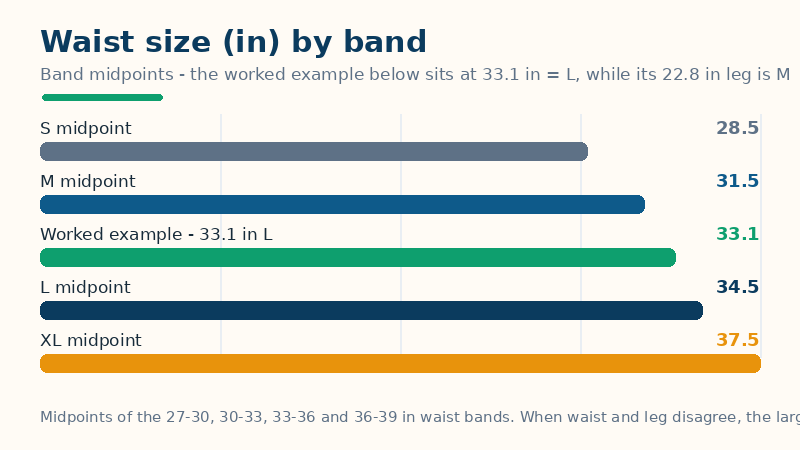
A measurement exactly on a boundary belongs to the larger size: a waist of exactly 30 in reads as M, not S, and a leg of exactly 23 in reads as L, not M. That is the safer side of the boundary for a harness — a belt that is slightly roomy can be tightened, while a belt that will not close cannot be used at all — but the fit checks below, not the boundary rule, are the final word.
Worked example: 84 cm waist, 58 cm leg
A climber with an 84 cm waist and a 58 cm leg measurement should try size L first. The working: 84 cm ÷ 2.54 = 33.1 in, which falls in the L waist band, 33–36 in; 58 cm ÷ 2.54 = 22.8 in, which falls in the M leg band, 21–23 in. The two disagree, so the larger size, L, is the recommendation — the waist belt must close and sit snugly over the hips, and a leg loop one step roomy is far easier to live with than a waist belt that will not fasten. The same arithmetic at other measurements shows both rules in action:
| Waist | Leg | Working | Size |
|---|---|---|---|
| 76 cm | 53 cm | 29.9 in (S) · 20.9 in (S) | S — both agree |
| 91 cm | 63 cm | 35.8 in (L) · 24.8 in (L) | L — both agree |
| 70 cm | 50 cm | 27.6 in (S) · 19.7 in (S) | S — both agree |
| 97 cm | 66 cm | 38.2 in (XL) · 26.0 in (XL) | XL — both agree |
Notice the worked example against the second row: the 91 cm / 63 cm climber agrees on L from both measurements, while the worked-example climber reaches L from the waist alone — the same headline size, arrived at for different reasons, which is why the page always shows both bands instead of just the answer.
How to read your result, and its limits
Three checks before trusting the size. First, the waist-belt check overrules the chart: the belt must sit over your hips and be snug enough that you cannot pull it down over them, with the buckle adjustment about halfway through its range rather than maxed out at either end — a belt at the very end of its adjustment has no room left for layers or for settling. Second, the leg-loop check: the loops should be comfortable, not tight — you should be able to place a flat hand between your leg and the loop — and if your harness has adjustable leg loops, a one-step disagreement between waist and leg is much less of a problem than on fixed loops, which is one reason adjustable loops suit ice climbing and mountaineering, where layers change. Third, the maker's chart outranks this page for the harness you buy: brands cut differently around this general chart, women's charts run on their own bands, and youth sizes sit below it — always compare both measurements against the label of the actual harness, and try it on, hanging in it if the shop allows, before trusting it on a wall. This page also does not choose the harness type — gym, sport, trad and ice harnesses differ in gear loops and padding — it only sizes the harness once the type is chosen.
Common mistakes
- Using your trouser waist. The belt sits over your hips, lower than a trouser waistband — measure where the belt will sit, or the size will come out small.
- Sizing from the waist alone. A waist-only size can leave leg loops painfully tight or flapping loose — both measurements go into the answer, and a disagreement is reported, not hidden.
- Measuring over a T-shirt for winter climbing. A harness sized over summer clothing may not close over layers — measure over what you will actually climb in.
- Trusting the chart over the fit. If the belt pulls down over your hips or the buckle sits at the end of its range, the size is wrong whatever the chart said — try the next size.
Related tools: Climbing Shoe Size Calculator — Your climbing shoe size from foot length and fit: comfort, snug, performance or downsized; Trekking Pole Size Calculator — Your trekking pole length from height: flat, uphill and downhill settings in one page; Backpack Size Calculator — Your backpack size in two parts: frame size from torso length, and litres from trip length, packing style and season.
Frequently asked questions
What size climbing harness do I need?
It comes from two measurements: waist and leg. On the general chart, for example, an 84 cm (33.1 in) waist is L and a 58 cm (22.8 in) leg is M — when they disagree, try the larger size, L, first, then confirm with the fit checks: the belt must sit over your hips and not pull down, and a flat hand should fit between leg and loop.
How do I measure my waist for a climbing harness?
Measure over your hips, where the waist belt will sit — not your trouser waist — with a soft tape, snug but not pulled tight. Measure over the layers you will actually climb in, since a harness sized over a T-shirt may not close over winter clothing.
How tight should climbing harness leg loops be?
Comfortable, not tight: you should be able to place a flat hand between your leg and the loop. Leg loops do not need to be as snug as the waist belt, and adjustable leg loops forgive a one-step disagreement between your waist and leg sizes.
What if my waist and leg measurements give different harness sizes?
Try the larger size first. A waist belt that will not close is unusable, while a slightly roomy leg loop can still be adjusted, especially on a harness with adjustable leg loops. Then run the fit checks — belt over the hips, buckle halfway through its range — and check the maker's own chart for the harness you buy.
