The same hum, in different keys
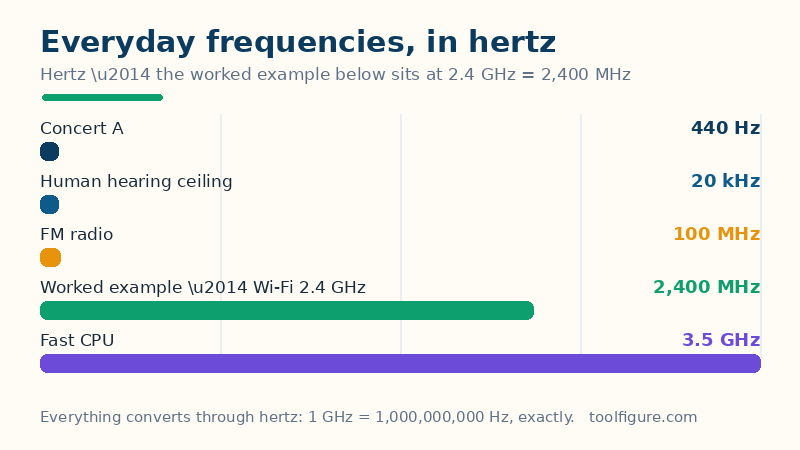
Frequency is just counting: how many times something repeats in one second. That one idea turns up everywhere, and each trade has its own favourite key for it. Audio people speak hertz — a concert A is 440 Hz, and human hearing tops out around 20,000 Hz. Radio engineers work in kilohertz for AM and megahertz for FM, where 88 to 108 MHz is the dial you grew up with. Computing and wireless live in gigahertz — your Wi-Fi's 2.4 GHz band, a 3.5 GHz processor — while research papers flirt with terahertz. Motor people talk revolutions per minute: a 3,600 RPM motor is a 60 Hz rotation, which is why American mains hum and a two-pole motor agree. And physicists carry radians per second, the angular frequency ω, where a full turn contributes 2π radians. Same counting, different dialects — this page restates any rate in all seven units at once, worked through the hertz with every factor defined, and tells you how long a single cycle takes.
The formula
answer = hertz ÷ (hertz in one "to" unit)
Three terms, all visible on the page. value is the number you enter. hertz in one "from" unit is the exact definition of the unit you are converting from — 1,000 for the kilohertz, 1,000,000 for the megahertz, 1,000,000,000 for the gigahertz, 1,000,000,000,000 for the terahertz, 1/60 for the revolution per minute, and 1/(2π) ≈ 0.15915494 for the radian per second. answer is the result in the unit you asked for. The prefixes are exact decimal steps by definition — no measurement, no calibration, just powers of ten — so converting between them is multiplication by an exact number, never an approximation.
Worked example
Convert 2.4 GHz to megahertz — the Wi-Fi band your router probably uses — the way the tool does it.
Step 1 — get to hertz. One gigahertz is 1,000,000,000 Hz, so 2.4 × 1,000,000,000 = 2,400,000,000 Hz.
Step 2 — divide by the target factor. One megahertz is 1,000,000 Hz, so 2,400,000,000 ÷ 1,000,000 = 2,400.
Step 3 — read the display. The page prints four decimals below 10 and two above, so the headline reads 2,400 MHz, and the detail line shows the working: 2.4 GHz = 2,400 MHz — worked through hertz: 2,400,000,000 Hz ÷ the Megahertz factor.
One cycle. A frequency of 2,400,000,000 Hz means each cycle lasts 1 ÷ 2,400,000,000 seconds = 0.4167 nanoseconds — the detail line carries that period beside every answer, because the reciprocal is often the number an engineer actually needs.
Check it. Multiplying back, 2,400 × 1,000,000 = 2,400,000,000 Hz exactly — the prefix arithmetic closes with nothing lost. The table underneath restates the same 2.4 GHz in all seven units (2,400,000 kHz, 0.0024 THz, 144,000,000,000 RPM, 15,079,644,737.23 rad/s), so the from/to choice only changes which row is the headline.
Conversions worth memorising
Every row below is the tool's own output, checked figure by figure:
| From | To | Result |
|---|---|---|
| 440 Hz | kilohertz | 0.44 kHz |
| 1 kHz | hertz | 1,000 Hz |
| 1 MHz | kilohertz | 1,000 kHz |
| 1 GHz | megahertz | 1,000 MHz |
| 100 MHz | gigahertz | 0.1 GHz |
| 88 MHz | gigahertz | 0.088 GHz |
| 60 Hz | revolutions per minute | 3,600 RPM |
| 1,800 RPM | hertz | 30 Hz |
| 1 rad/s | hertz | 0.1592 Hz |
| 3.5 GHz | megahertz | 3,500 MHz |
| 44,100 Hz | kilohertz | 44.1 kHz |
| 1 THz | gigahertz | 1,000 GHz |
Three rows deserve a second look. The 440 Hz row is concert pitch — 0.44 kHz — and its period is 2.2727 milliseconds, which is why a 44,100 Hz sample rate (the CD standard, 44.1 kHz) captures it about a hundred times over per cycle. The 60 Hz row is the American mains frequency, and 3,600 RPM is the two-pole induction motor it was built to drive — the same physical rate wearing an electrical key and a mechanical one. And the 1 rad/s row is the one that catches people: one radian per second is not one cycle per second, it is 1/(2π) of a cycle, 0.1592 Hz — the 2π trap is real, and it is stated in the open here.
Three traps worth knowing
RPM is a rotation rate, not always a wave. Converting 3,600 RPM to 60 Hz is honest arithmetic, but the physical meaning depends on context: a motor shaft, a hard drive platter and an AC waveform are different things that happen to share the number. Do not use the RPM row to reason about a signal's bandwidth or a tone's pitch.
Angular frequency is 2π times the plain frequency. If a formula calls for ω and you feed it f, your answer is wrong by a factor of about 6.28 — the single most common frequency mistake in physics and engineering homework. This page keeps the two side by side: 1 rad/s = 0.1592 Hz, and 1 Hz = 6.2832 rad/s, so the conversion is checked rather than guessed.
Tiny values hit the display floor. The page prints four decimals below 10 and two above, so 0.0003 Hz prints as 0 Hz. The factor is exact; the display is rounded. Convert a larger multiple instead — or read the terahertz, RPM and rad/s rows, which put the same quantity on a more readable scale.
How to read your result, and the limits
Results show four decimal places below 10 and two above — more precision than most signal generators and tachometers justify, so round to the instrument for real use. Four limits belong with the page. Negative values are refused: −5 Hz gets a clear error, because a negative repetition rate has no physical meaning here — if your sign carries direction information, that is a velocity problem, not a frequency one. Empty input clears quietly; type and the table rebuilds, delete and the page waits. Anything past a trillion hertz gets a clear error instead of a meaningless digit string. And this page converts units, not signals: it will restate any repetition rate in any dialect, but it will not measure one — for that you need an oscilloscope, a counter, or the specification sheet.
Related tools: Unit Converter — Convert length, weight, temperature and volume — km to miles, kg to pounds, °C to °F, litres to gallons; Data Storage Converter — Convert bits, bytes, KB–TB and KiB–TiB — every answer in all ten units, both systems explained; Data Transfer Rate Converter — Mbps to MB/s, Gbps and more — every answer in all nine units, plus the download time for your file.
Frequently asked questions
How do I convert GHz to MHz?
Multiply by 1,000. So 2.4 GHz becomes 2,400 MHz, 1 GHz is 1,000 MHz, and 3.5 GHz is 3,500 MHz. To go back, divide megahertz by 1,000: 100 MHz is 0.1 GHz. This page does both directions and restates every answer in all seven units at once.
How many hertz is 1 RPM?
One revolution per minute is 1/60 of a hertz — about 0.016667 Hz — because a hertz is one cycle per second and a minute has 60 seconds. So 3,600 RPM is 60 Hz and 1,800 RPM is 30 Hz. Note this converts the rotation rate; the physical meaning depends on whether you are talking about a motor, a disk or a waveform.
What is the difference between Hz and rad/s?
Hertz counts whole cycles per second; radians per second counts angle swept per second, and one full cycle sweeps 2π radians. So 1 Hz = 6.2832 rad/s and 1 rad/s = 0.1592 Hz. Mixing them up introduces a factor-of-2π error — the most common frequency mistake in physics homework.
What is the period of a frequency?
The period is how long one cycle takes: T = 1/f. A 2.4 GHz signal has a period of 0.4167 nanoseconds, concert A at 440 Hz repeats every 2.2727 milliseconds, and 60 Hz mains power cycles every 16.6667 milliseconds. This page shows the period beside every conversion, in ns, µs, ms or seconds whichever reads best.
