The standard chart, stated plainly
The guides agree on the method even where brands disagree on the cut: measure the foot in centimetres (or millimetres — the millimetre figure is the mondopoint), then read the size off the standard chart. The chart's rule is a single subtraction, rounded to the nearest half size, and the women's, UK and EU figures follow from the same row — which is why this page can give all four systems from one measurement instead of chaining conversions that drift.
US men's roller skate size = foot length (cm) − 18, rounded to the nearest half size — US women's = men's − 1, UK = men's − 1, EU from the chart row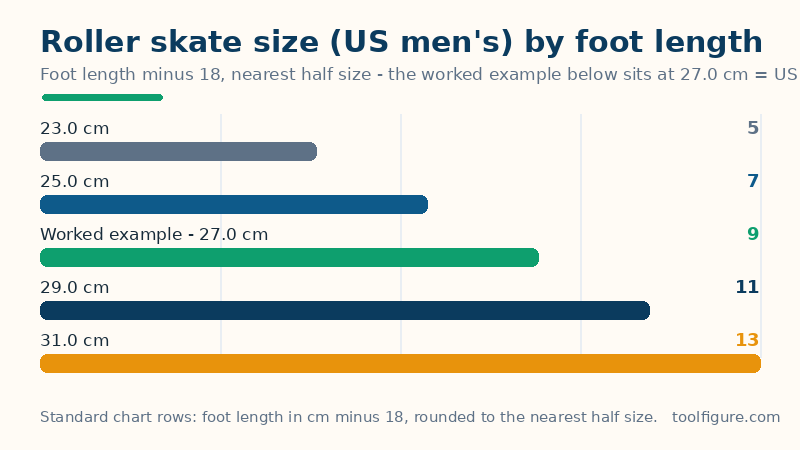
| Foot length | Inches | US men's | US women's | UK | EU |
|---|---|---|---|---|---|
| 23.0 cm | 9.06 in | 5 | 4 | 4 | 38 |
| 25.0 cm | 9.84 in | 7 | 6 | 6 | 40 |
| 27.0 cm | 10.63 in | 9 | 8 | 8 | 42 |
| 28.5 cm | 11.22 in | 10.5 | 9.5 | 9.5 | 44 |
| 29.0 cm | 11.42 in | 11 | 10 | 10 | 45 |
The inch figures are exact conversions (centimetres ÷ 2.54): 23.0 ÷ 2.54 = 9.06 in, 25.0 ÷ 2.54 = 9.84 in, 27.0 ÷ 2.54 = 10.63 in, 28.5 ÷ 2.54 = 11.22 in, 29.0 ÷ 2.54 = 11.42 in. The EU column follows the standard chart row for row: 23.0 cm is EU 38, 25.0 cm is EU 40, 27.0 cm is EU 42, 28.5 cm is EU 44 and 29.0 cm is EU 45 — note the EU step from 43 to 44 between US 10 and US 10.5, which is the chart's own step, not a rounding slip.
Worked example: 27.0 cm foot
A 27.0 cm foot (10.63 in) takes US men's 9, US women's 8, UK 8, EU 42: 27.0 − 18 = 9.0 exactly, so no rounding is involved and all four figures come from that one row. Four more spot checks from the same rule: a 23.0 cm foot takes US men's 5 (EU 38); a 25.0 cm foot takes US men's 7 (EU 40); a 28.5 cm foot takes US men's 10.5 (EU 44); and a 29.0 cm foot takes US men's 11 (EU 45). The rule also explains the chart's floor: feet below 22.0 cm fall under US men's 4, where youth sizing takes over, and feet above 33.0 cm sit above US men's 15, where brands diverge too far for one chart to be honest.
How to read your result, and its limits
Three checks before ordering. First, measure, do not convert from a shoe size: the guides say so explicitly, because shoe sizes vary between brands while a centimetre does not — and a skate bought from a shoe size inherits whatever that shoe brand's cut was. Second, quad and inline share this chart but not the fit: the size number is the same, yet a stiff inline boot and a soft quad boot feel different at the same number, and speed skates run tighter than recreational skates by design. Third, brands vary by up to a full size around the chart: the standard row is the starting point, and the brand's own chart for the exact model is the final word — several guides say to order from the brand chart once the foot is measured, not from this page alone. New skates should feel snug rather than roomy: liners pack out a little with use, and a roomy skate lets the foot slide and costs control.
Common mistakes
- Ordering your shoe size and skipping the ruler. Shoe sizes drift between brands; a centimetre measurement does not. Measure both feet standing, and use the longer one.
- Buying room to grow into. A half size of spare room feels comfortable standing still and sloppy at speed — skates break in wider, never narrower.
- Measuring one foot. Feet differ, and the shorter foot's size pinches the longer one. Always fit the longer foot.
- Ignoring the brand chart. The standard chart gets you to the right neighbourhood; the exact model's chart settles the size, especially for speed and wide-fit models.
Related tools: Ice Skate Size Calculator — Your ice skate size from foot length: hockey or figure, with US and UK equivalents; Skateboard Size Calculator — Recommended skateboard deck width from your shoe size and riding style, and deck length from your height, with the adjustment shown openly; Shoe Size Converter — US, UK, EU and Japan shoe sizes — every system at once, men and women.
Frequently asked questions
Do roller skates run true to shoe size?
Roughly, but not exactly — which is why this page measures the foot instead of converting a shoe size. Shoe sizes vary between brands, while a foot length in centimetres maps to one row of the standard chart; a 27.0 cm foot takes US men's 9 on that chart whatever the shoe brand says.
Are quad skates and inline skates sized the same?
The size number is the same — this chart covers both — but the fit is not: a stiff inline boot feels tighter than a soft quad boot at the same number, and speed skates run tighter than recreational skates by design. Check the brand's chart for the exact model.
Should I size up for thick socks?
Measure while wearing the socks you will skate in, rather than adding a size afterwards. The guides that add a comfort allowance add only 3–5 mm to the foot measurement before reading the chart — about a quarter size, not a full size.
What if I am between sizes?
Take the larger size if you want room, or the smaller if you want a snug performance fit — the chart rounds to the nearest half size, so a foot landing exactly between two rows is genuinely either. Wide feet should go up half a size rather than hoping a standard width stretches.
