Three steps: heater watts, heating hours, jets watts
The whole calculation is two small multiplications added together, and the heating hours are the one people get wrong. Heater watts divided by 1,000 is heater kilowatts; heater kilowatts times the heating hours a day is the heater's energy for the day; jets watts divided by 1,000 is jets kilowatts; jets kilowatts times the soak hours is the jets' energy for the day; the two together are the day's energy; the day's energy times 365 days is the year's energy; the year's energy times the price is the year's money. The month is the year divided by 12, not the day times 30 — the two differ by about seventy cents on a hot tub, and the year-divided-by-12 figure is the one this page uses, so it agrees with the yearly total exactly:
heater energy per day (kWh) = heater watts ÷ 1,000 × heating hours a day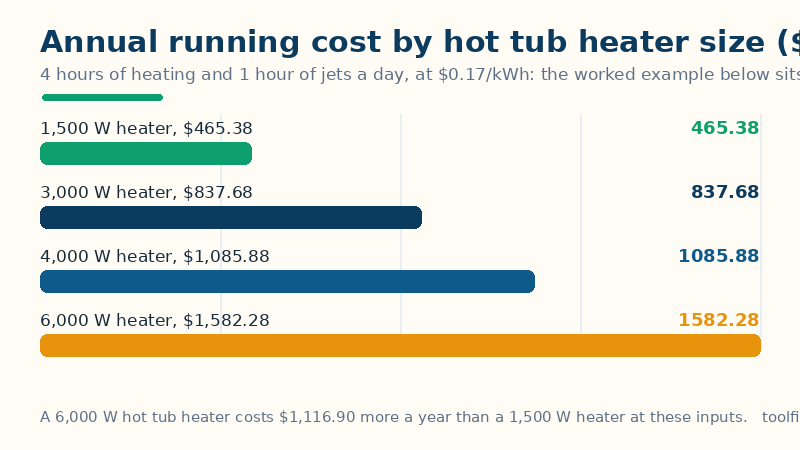
jets energy per day (kWh) = jets watts ÷ 1,000 × soak hours a dayannual cost ($) = (heater energy + jets energy) per day × 365 × electricity priceThe heater watts on the label are the tub's maximum draw, and the heater does not draw them all day. Most hot tubs sold in the US run 1,500 to 6,000 W — 120 V plug-and-play tubs at 1,500 W, standard 240 V tubs at 3,000 to 4,000 W, large hardwired tubs at 5,500 to 6,000 W. What matters is the heating hours: the heater cycles on and off as the thermostat holds the water at temperature, and the heating hours are the hours it actually draws full power. Four hours of full-power heating is a heavy-use figure — a well-insulated tub with a good cover in a mild climate heats for closer to 2 hours a day, about 7.5 kWh a day with an hour of jets, which is 228.1 kWh a month and sits inside onlycalculators' typical 150 to 300 kWh a month for a 240 V hot tub.
Worked example: 3,000 W heater, 4 heating hours, 1,500 W jets, 1 soak hour, $0.17/kWh
A 3,000 W heater running 4 hours a day uses 3 × 4 = 12.000 kWh of heat a day, costing $2.04, and 1,500 W of jets for 1 hour uses 1.500 kWh, costing $0.26. Together that is 13.5 kWh a day, costing $2.30. A month is 4,927.5 ÷ 12 = 410.6 kWh, costing $69.81. A year is 13.5 × 365 = 4,927.5 kWh, costing $837.68. The table above shows the same maths for the other heater sizes at 4 hours of heating and 1 hour of jets: a 1,500 W plug-and-play heater uses 7.5 kWh a day, costing $1.28 a day, $38.78 a month and $465.38 a year, a 4,000 W large heater uses 17.5 kWh a day, costing $2.98 a day, $90.49 a month and $1,085.88 a year, and a 6,000 W extra-large heater uses 25.5 kWh a day, costing $4.34 a day, $131.86 a month and $1,582.28 a year. One hour of heating costs 51.0¢ and one hour of jets costs 25.5¢; the heater alone costs $744.60 a year and the jets alone $93.08. Soaking 2 hours a day instead of 1 costs $930.75 a year, and ten years of soaking at this pace costs $8,376.75. Three published cross-checks reproduce exactly: wattcostcalc's 3,000 W hot tub at 4 hours a day and 17.5 cents costs $2.10 a day, $63.00 a month and $766.50 a year — this page gives the same $2.10 a day and $766.50 a year for the heater alone, while its $63.00 a month is the day times 30 against this page's $63.87, the year divided by 12. freetooler's well-insulated 4-person tub at 8 kWh a day and 16 cents costs $38.40 a month and $467.20 a year — this page gives the same $467.20 a year at 8 kWh a day, while its $38.40 a month is the day times 30 against this page's $38.93. And onlycalculators' worked example at 22.72 kWh a day and 16 cents costs $111 a month — this page gives $110.57 a month at the same daily energy and rate, the difference being their rounding of the monthly figure.
How to read your result, and its limits
Four cautions keep the number honest. First, the heater is the bill and the jets are the garnish: at the worked example's inputs the heater costs $744.60 a year and the jets $93.08 — about nine-tenths heater, one-tenth jets — so a second jet pump matters far less than an extra hour of heating. Second, the heating hours are not the soak hours: the tub heats in bursts all day and night to hold temperature, so a tub nobody soaks in still costs $744.60 a year at the worked example's heater and hours — the jets are the only part that stops when nobody soaks. Third, insulation and the cover move the heating hours more than the heater size: steamandoak puts a modern well-insulated hot tub with a good cover at £40 to £85 a month in the UK at about 25p a kWh, and the same 8 kWh a day at 25p is £2.00 a day and £60.83 a month — inside their band — while a poorly insulated older tub or one left uncovered costs considerably more, and an inverter heat pump cuts the same usage to roughly £12 to £35 a month. For the pool beside the tub, the pool pump cost calculator prices the pump by watts, hours and season. Fourth, this page prices electricity only: chemicals, water, filters and maintenance are separate lines — onlycalculators puts total running costs at $60 to $180 a month including those, with electricity 40 to 60% of it — and the electricity price is the all-in rate, the total on the bill divided by the kilowatt-hours on the bill. For the cost of running anything else in the house, the electricity cost calculator prices any appliance by watts and hours.
Common mistakes
- Pricing only the soak hours. A hot tub at 3,000 W for 1 hour of soaking uses 3 kWh, not 12 — but the heater runs about 4 hours a day whether anyone soaks or not, so the day is 13.5 kWh, not 4.5. Enter the heating hours, not just the soak hours.
- Pricing the heater watts as if they ran all day. A 3,000 W heater does not use 72 kWh a day — at 4 heating hours it uses 12 kWh, $2.04 a day, not $12.24. The heater cycles; enter the hours it actually draws full power.
- Multiplying the daily cost by 30 for the month. Thirty days is not a twelfth of a year: the day times 30 gives $69.00 a month at the worked example's inputs, while the year divided by 12 gives $69.81. Use the year-divided-by-12 figure, which is the one that adds up.
- Leaving the cover off. An uncovered tub loses heat to the air all day and night, so the heater runs far longer to hold temperature — the cover is the cheapest running-cost cut there is, and a tub left uncovered in winter can cost double the figure on this page.
- Adding the standing charge to every hour. The daily supply charge is payable whether the tub runs or not. Only the per-kWh rate belongs in the per-hour maths — the fixed charge is a separate line on the bill.
Related tools: Water Heater Cost Calculator — What does your water heater really cost to run? Compare tank, tankless and heat pump on the same hot water.
Frequently asked questions
How much does it cost to run a hot tub per month?
At the worked example's inputs — a 3,000 W heater running 4 hours a day with 1 hour of jets — a hot tub uses 410.6 kWh a month and costs $69.81 at $0.17 per kWh, or $837.68 a year. A 1,500 W plug-and-play tub costs $38.78 a month and a 6,000 W large tub $131.86 a month at the same hours and rate.
How much electricity does a hot tub use per day?
The worked example uses 13.5 kWh a day — 12 kWh of heat and 1.5 kWh of jets. A well-insulated tub with a good cover in a mild climate uses about 7.5 kWh a day, and onlycalculators puts a typical 240 V hot tub at 150 to 300 kWh a month, which is 5 to 10 kWh a day.
What costs more to run — the heater or the jets?
The heater, by a long way: at the worked example's inputs the heater costs $744.60 a year and the jets $93.08 — about nine-tenths heater, one-tenth jets. The jets only run while someone is soaking, while the heater cycles all day and night to hold the water at temperature.
How can I reduce my hot tub running costs?
Keep the cover on whenever the tub is not in use, drop the temperature by 1 to 2 degrees, and soak in the evening so the heater does its work off-peak if your tariff allows it. Steam & Oak report that an inverter heat pump cuts a modern insulated tub's running cost by 70 to 80% — from roughly £40 to £85 a month to roughly £12 to £35 a month in the UK — and a well-insulated tub with a good cover heats for about 2 hours a day instead of 4.