The anchor: one inch is exactly 2.54 centimetres
Length conversions are unusually honest, because the whole system hangs off one fixed anchor. In 1959 the English-speaking world agreed that one inch is exactly 2.54 centimetres — not measured, not approximate, defined. Everything else stacks on it: the foot is 12 inches (0.3048 m), the yard is 3 feet (0.9144 m), the mile is 1,760 yards (1,609.344 m), and the nautical mile is exactly 1,852 metres — one minute of latitude at sea level. The metric side needs no stacking at all: a centimetre is 0.01 m, a kilometre is 1,000 m, and the nano and micro scales are just further decimal places. This converter routes every conversion through metres on those exact factors, so the only rounding in the answer is the two-decimal display.
The factors, with every variable defined
Step 1 — into metres: m = value × the from-unit's mStep 2 — out to the target: result = m ÷ the to-unit's mm per unit: nm 0.000000001 · µm 0.000001 · mm 0.001 · cm 0.01 · m 1 · km 1,000 · inch 0.0254 · foot 0.3048 · yard 0.9144 · mile 1,609.344 · nautical mile 1,852The inch rule: divide centimetres by 2.54 for inches, multiply inches by 2.54 for centimetres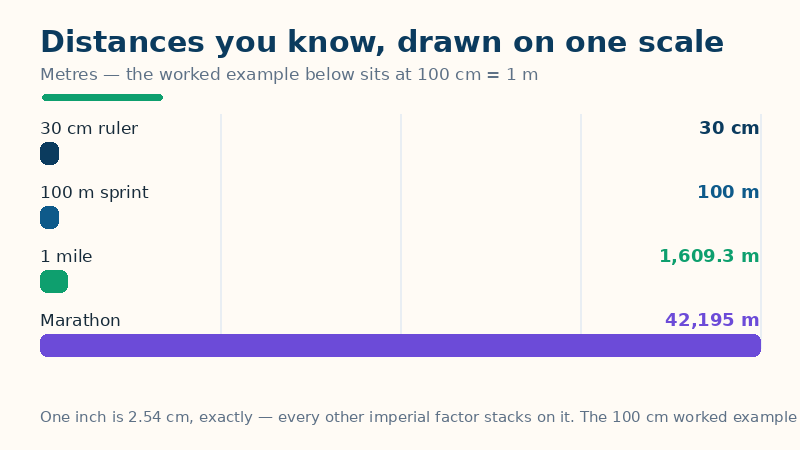
There is no conversion table to memorise — the two-step route through metres handles every pairing, and the step table under the answer shows both steps so the working can be checked by hand. The imperial factors are all exact consequences of the inch definition, not measured values that might drift: 12 × 2.54 = 30.48 cm per foot, 36 × 2.54 = 91.44 cm per yard, 63,360 × 2.54 = 160,934.4 cm per mile.
Worked example, done step by step
Convert 100 cm to inches — the sizing question. Step 1: into metres. 100 × 0.01 = 1 m. Step 2: out to inches. 1.00 ÷ 0.0254 = 39.37 inches at the tool's display precision (exactly 39.37007874). Reversed, the two-step route runs the other way: 39.3701 inches × 0.0254 = 1.00 m, then ÷ 0.01 = 100 cm.
The height version — 5 ft 10 in. Five feet ten inches is 70 inches: 70 × 0.0254 = 1.778 m, and 1.778 ÷ 0.01 = 177.8 cm. Every height on this site's height converter uses the same arithmetic, restated in feet and inches both ways.
Distances you know, in every unit
| Distance | As you meet it | In metres | And across the ocean |
|---|---|---|---|
| A school ruler | 30 cm | 0.3 m | 11.81 in |
| A 100 m sprint | 100 m | 100 m | 109.36 yd |
| 1 mile | 1 mi | 1,609.34 m | 1.6093 km |
| Marathon (42,195 m) | 42.2 km | 42,195 m | 26.22 mi |
The ratio between any two columns never changes: every kilometre is 0.621371 miles, every yard is 0.9144 metres. That fixed ratio is why the chart above can draw a ruler and a marathon on one scale — only the labels change, never the arithmetic.
Reading the result, and its limits
Three honest notes. First, display precision: values below 10 show four decimals and values at 10 and above show two — plenty for sizing, shipping and sport, and the every-unit table uses the same rounding. Second, the nano and micro scales are only as meaningful as the instrument behind them: this page converts them exactly, but a home measurement typed in centimetres has no real nanometre information to give. Third, negative lengths are refused by the tool on purpose — this page converts distances and sizes, not directed displacements in a physics problem. For human heights restated both ways, the height converter sits beside this one; for the squares of these units, the area converter applies the same anchor squared.
Frequently asked questions
How many inches are in a centimetre?
One centimetre is exactly 0.39370079 inches — the reverse of the 2.54 cm definition. Divide centimetres by 2.54 for a quick answer: 100 cm ÷ 2.54 = 39.37 inches. The factor is exact by the 1959 international agreement, so any calculator using it should agree to every decimal place.
Why is 1 inch exactly 2.54 centimetres?
Because the English-speaking countries agreed it so in the 1959 international yard and pound agreement. Before that, the US and UK kept slightly different inches, which made international manufacturing and trade needlessly fiddly. The fixed definition makes every imperial factor above a matter of arithmetic rather than measurement.
How do I convert feet and inches to centimetres?
Combine the height into total inches first: 5 ft 10 in is 5 × 12 + 10 = 70 inches, and 70 × 2.54 = 177.8 cm. To go the other way, divide centimetres by 2.54 for total inches, then divide by 12: 180 cm is 70.87 in, which is 5 ft with 10.87 in remaining. The height converter on this page does both directions for you.
How long is a marathon in miles and kilometres?
The marathon distance is fixed at 42,195 metres — the tool shows that as 42.2 km at its display precision (42.195 exactly) and 26.2188 miles, usually quoted as 26 miles 385 yards. The nautical mile on this page is a separate unit entirely: exactly 1,852 metres, used at sea and in the air, roughly 1.1508 statute miles.
