One pascal is absurdly small — that is the whole story
The SI unit of pressure is the pascal: one newton of force on one square metre. A newton is roughly the weight of an apple, and a square metre is a large tile — spread one apple's weight over that tile and you have one pascal. Nobody's tyre holds one pascal of pressure, which is why the working world uses bigger units: the kilopascal (a thousand pascals), the bar (a hundred thousand), the atmosphere (the air's own weight at sea level) and the PSI of every American tyre gauge. This converter translates between all of them through the pascal, with exact defined factors, and answers in every unit at once.
The factors, with every variable defined
Step 1 — into pascals: Pa = value × the from-unit's PaStep 2 — out to the target: result = Pa ÷ the to-unit's PaPa per unit: Pa 1 · kPa 1,000 · MPa 1,000,000 · bar 100,000 · mbar 100 · atm 101,325 · psi 6,894.757293168 · mmHg 133.322368421 · inHg 3,386.388158 · inH2O 249.08891The bar rule: 1 bar = 100 kPa = 14.5037738 psi, exactly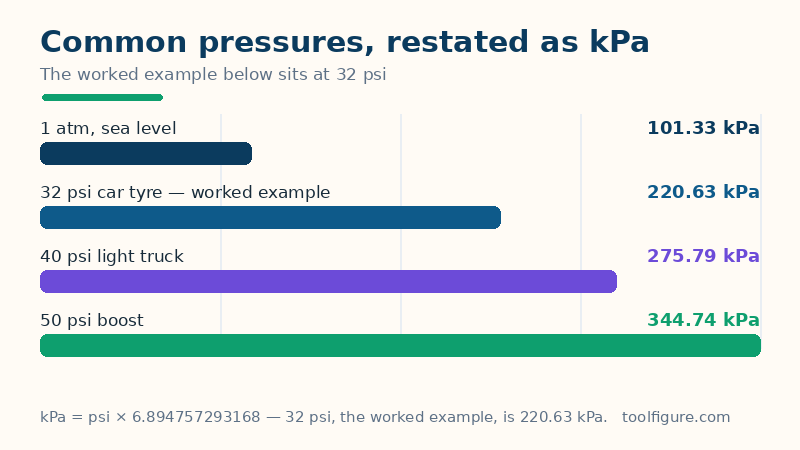
The metric factors are definitions, not measurements: the bar was fixed at exactly 100,000 pascals, the atmosphere at exactly 101,325, the millimetre of mercury at exactly 101,325 ÷ 760 — which is why a torr and a mmHg are the same number here. The PSI is the odd one out, built from three definitions stacked together: the pound as exactly 0.45359237 kg, standard gravity as 9.80665 m/s², and the inch as 0.0254 m, which combine to 6,894.757293168 pascals per PSI. The water column comes from the same stacking with water's density.
Worked example, done step by step
Convert 32 PSI to bar — the tyre question. Step 1: into pascals. 32 × 6,894.757293168 = 220,632.23 Pa. Step 2: out to bar. 220,632.23 ÷ 100,000 = 2.2063 bar. The same reading is 220.63 kPa, 2.1775 atm and 1,654.88 mmHg — all ten units sit in the every-unit table the moment you type.
The atmosphere restated. One standard atmosphere is defined as 101,325 Pa, which the tool shows as 1.0133 bar, about 14.7 PSI and 101.33 kPa. Every weather report's millibars divide straight out of it: 1,013.25 mbar, since a millibar is exactly 100 pascals.
Tyre pressures, door placard to gauge
| Tyre reading | kPa | bar | atm |
|---|---|---|---|
| 28 PSI — low (passenger car) | 193.05 | 1.9305 | 1.9053 |
| 32 PSI — normal (worked example) | 220.63 | 2.2063 | 2.1775 |
| 35 PSI — performance setting | 241.32 | 2.4132 | 2.3816 |
| 40 PSI — light truck | 275.79 | 2.7579 | 2.7218 |
| 45 PSI — near max sidewall | 310.26 | 3.1026 | 3.0621 |
Most car door placards outside North America quote kilopascals, most American placards quote PSI, and many European gauges show bar — one car, three numbers, all saying the same thing. A placard reading 220 kPa is the worked example above: 32 PSI, or 2.2 bar on a European gauge.
Reading the result, and its limits
Three honest notes. First, the big one: gauges do not read from zero. A tyre gauge showing 32 PSI is measuring 32 pounds above the atmosphere pressing on it from outside — engineers call this gauge pressure. The absolute pressure in that tyre is 32 + 14.7 = 46.7 PSI, because the atmosphere itself weighs about 14.7 PSI at sea level. This converter moves between units, not between gauge and absolute: add or subtract one atmosphere when you cross that line. Second, negative readings are refused by the tool on purpose: this page covers ordinary positive pressures, and vacuum readings below zero need their own gauges and their own page. Third, high-precision engineering should check the gauge's own calibration too — the conversion above is exact, but the number typed in is only as honest as the instrument that produced it. For the other everyday conversions, the temperature converter, the speed converter and the fuel economy converter work the same way, through one exact base unit each.
Frequently asked questions
How many PSI is 1 bar?
14.5038 PSI by definition — the tool shows 14.5 at its display precision. The other way round, 1 PSI is 0.0689476 bar. Car tyres sit in the 2 to 2.5 bar band, which is 29 to 36 PSI. The bar is an exact unit: 1 bar = 100,000 pascals, so these figures are definitions, not approximations.
What is the difference between gauge and absolute pressure?
A gauge measures pressure relative to the air outside the tyre — that is what 32 PSI on a tyre gauge means. Absolute pressure measures from a perfect vacuum, so it is the gauge reading plus one atmosphere, about 14.7 PSI. The same tyre is 32 PSI gauge and about 46.7 PSI absolute. This converter translates between units; add or subtract one atmosphere when crossing between gauge and absolute.
How many kPa are in 1 PSI?
6.8948 kPa at the tool's display precision — exactly 6.894757293168 kPa by definition. This is the number that bridges American tyre placards (PSI) and metric ones (kPa): 32 PSI × 6.89476 = 220.63 kPa, the normal car-tyre figure used in the worked example above.
Is a millibar the same as a hectopascal?
Yes — exactly. 1 mbar = 1 hPa = 100 pascals, so the two words are the same unit with two names. Weather services that switched from millibars to hectopascals changed nothing but the label: standard sea-level pressure is 1,013.25 of either.
