The cup is not the cup — three standards, one page
The volume converter's honest centrepiece is the cup, because there are three different ones in the world. The US customary cup of American recipes is 236.588 millilitres; the US legal cup used on nutrition labels is 240 mL; and the metric cup used in Australia, New Zealand, Canada and the UK is exactly 250 mL. A recipe that crosses systems mismeasures by up to about 5.7%. This page converts US customary cups — stated on every label — and keeps the other standards out of the answers rather than quietly merged. The US side is anchored exactly: 1 US gallon is defined as 231 cubic inches, which is 3.785411784 litres, and every smaller unit stacks on it — 4 quarts to the gallon, 2 pints to the quart, 2 cups to the pint, 8 fluid ounces to the cup, 2 tablespoons to the fluid ounce, 3 teaspoons to the tablespoon.
The factors, with every variable defined
Step 1 — into litres: L = value × the from-unit's LStep 2 — out to the target: result = L ÷ the to-unit's LL per unit: mL 0.001 · L 1 · m³ 1,000 · US tsp 0.00492892159375 · US tbsp 0.01478676478125 · US fl oz 0.0295735295625 · US cup 0.2365882365 · US pint 0.473176473 · US quart 0.946352946 · US gallon 3.785411784The gallon rule: 1 US gallon = 231 in³ = 16 cups = 8 pints = 4 quarts, exactly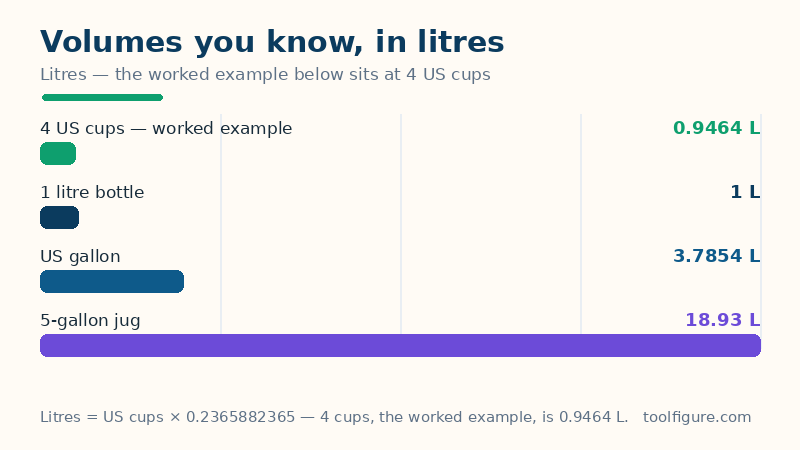
The nesting is what makes the US side checkable: 16 × 236.5882365 mL = 3,785.411784 mL, the gallon, exactly. The metric side needs no stacking: a millilitre is 0.001 L, a cubic metre is 1,000 L. The two-step route through litres handles every pairing, and the step table under the answer shows both steps so the working can be checked by hand.
Worked example, done step by step
Convert 4 US cups to litres — the recipe question. Step 1: into litres. 4 × 0.2365882365 = 0.9464 L at the tool's display precision (exactly 0.946353). Step 2: out to litres — divide by 1, so the answer stands. Notice what else the every-unit table says: 4 cups is also 1 US quart, 2 pints, 32 tablespoons and 946.35 mL — one entry, every honest restatement.
The reverse — 2 litres to gallons. Step 1: into litres — already there, 2 L. Step 2: out to US gallons. 2 ÷ 3.785411784 = 0.5283 US gallons. A 2-litre bottle is a touch over half an American gallon, which is why American cars' fuel economy and litres-per-100-km numbers cross each other on the fuel economy converter.
Volumes you know, in every unit
| Volume | As you meet it | In millilitres | And in litres |
|---|---|---|---|
| 1 US teaspoon | 1 US tsp | 4.9289 mL | 0.0049 L |
| 1 US tablespoon | 1 US tbsp | 14.79 mL | 0.0148 L |
| 1 US cup | 1 US cup | 236.59 mL | 0.2366 L |
| 1 US quart | 1 US qt | 946.35 mL | 0.9464 L |
| 1 US gallon | 1 US gal | 3,785.41 mL | 3.7854 L |
| 1 cubic metre | 1 m³ | 1,000,000 mL | 264.17 US gal |
The ratio between any two columns never changes: every US cup is 0.2365882365 litres, every gallon is 3.785411784. That fixed ratio is why the chart above can draw a teaspoon and a five-gallon jug on one scale — only the labels change, never the arithmetic.
Reading the result, and its limits
Three honest notes. First, the scope is stated on every US label for a reason: the imperial (UK) gallon is 4.54609 L — about 20% bigger than the US gallon — and it is not in this converter; the questions below give its figure, but this page answers US customary and metric only. Second, the teaspoon gap: a metric teaspoon is 5 mL, a US teaspoon is 4.9289 mL, a 1.4% difference that matters in baking but not in a pint. Third, ingredient weights are not volumes — flour's cup-to-gram figure depends on the flour, so once the volume is converted, the cooking converter takes over for cups-to-grams by ingredient.
Frequently asked questions
How many litres are in 1 US cup?
Exactly 0.2365882365 litres — 236.588 mL. For quick mental maths, multiply cups by 0.237: 4 cups is about 0.95 L. That 4-cup figure is exact enough to remember: 4 US cups = 1 US quart = 0.946353 L, a touch under a litre.
What is the difference between a US cup, a metric cup and a US legal cup?
The US customary cup of recipes is 236.588 mL; the US legal cup on nutrition labels is 240 mL; the metric cup used in Australia, Canada, New Zealand and the UK is exactly 250 mL. This page uses US customary cups throughout and says so on every label. A metric recipe's cup carries about 5.7% more liquid than a US one — enough to matter in baking.
How many cups are in a gallon?
16 US cups in 1 US gallon — the US nesting is cups to pints (2:1), pints to quarts (2:1), quarts to gallons (4:1). So a gallon is also 8 pints and 4 quarts. In metric terms the gallon is 3.7854 litres and the cup is 236.59 mL, and 16 × 236.588 mL gives the gallon exactly.
Is a US gallon the same as a UK gallon?
No — and this is the costliest volume confusion in everyday life. The US gallon is 3.785411784 litres; the imperial (UK) gallon is 4.54609 litres, about 20% bigger. An American car drinking a gallon of fuel has drunk noticeably less than the same number of UK gallons. This converter's gallon is the US one; the fuel economy converter distinguishes US MPG from UK MPG on the same principle.
