What specific heat capacity is
Specific heat capacity says how much heat a kilogram of something soaks up for each degree it warms: a high value means a stubborn material that resists warming, a low value means one that heats quickly. It is the number behind every heating calculation. Europe and the science world quote joules per kilogram kelvin (J/(kg·K)); chemistry tables quote calories per gram degree Celsius (cal/(g·°C)); American engineering quotes Btu per pound degree Fahrenheit (Btu/(lb·°F)); and heating engineers once quoted the CHU — and all of them measure the same quantity, so a material that is 897 J/(kg·K) in one catalogue is 0.2142 Btu/(lb·°F) on the datasheet it arrives with. This page restates any specific heat capacity in all ten units at once, worked through J/(kg·K) with every factor defined, and answers the question the conversion alone cannot: how much heat does warming a mass you enter by a temperature rise you enter actually take?
The formula
J/(kg·K) = value × (J/(kg·K) in one "from" unit)
answer = J/(kg·K) ÷ (J/(kg·K) in one "to" unit)
heat Q = mass × specific heat × temperature rise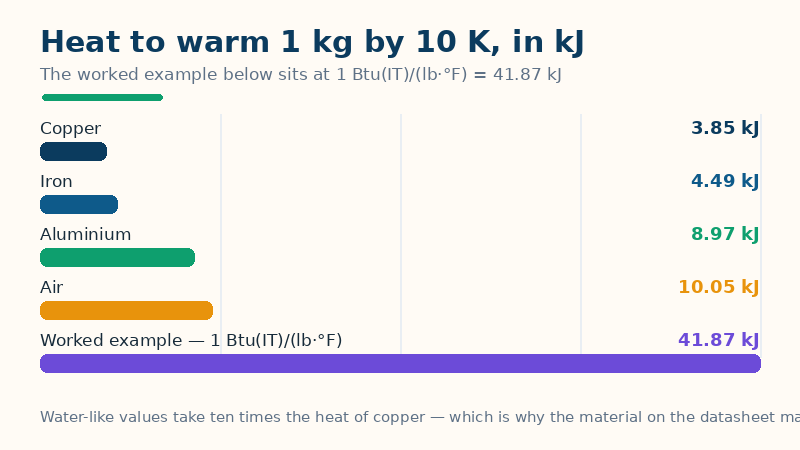
Three terms, all visible on the page. value is the number you enter. J/(kg·K) in one "from" unit is the definition of the unit you are converting from: 1 for the joule per kilogram kelvin itself and for the joule per kilogram degree Celsius, 1,000 for the kilojoule per kilogram kelvin and for the joule per gram degree Celsius, 4,186.8 for the calorie per gram degree Celsius (IT), for the kilocalorie per kilogram degree Celsius, for the Btu per pound degree Fahrenheit (IT), for the Btu per pound degree Rankine (IT) and for the CHU per pound degree Celsius, and 4,183.9989504 for the Btu per pound degree Fahrenheit (th). answer is the result in the unit you asked for. heat Q is the mass you enter times the specific heat times the temperature rise you enter, in joules, so the datasheet figure turns into the energy a heater must actually supply.
Worked example
Convert 1 Btu(IT)/(lb·°F) to joules per kilogram kelvin — the unit jump every American material datasheet forces on a metric reader — the way the tool does it.
Step 1 — get to J/(kg·K). One Btu(IT)/(lb·°F) is 4,186.8 J/(kg·K), so 1 × 4,186.8 = 4,186.8 J/(kg·K).
Step 2 — read the display. The headline reads 4,186.8 J/(kg·K), and the detail line shows the working: 1 Btu(IT)/(lb·°F) = 4,186.8 J/(kg·K) — worked through J/(kg·K): 4,186.8 J/(kg·K) ÷ the Joule per kilogram kelvin factor. The full table for this example reads: 4,186.8 J/(kg·K), 4,186.8 J/(kg·°C), 4.1868 kJ/(kg·K), 4.1868 J/(g·°C), 1 cal(IT)/(g·°C), 1 kcal(IT)/(kg·°C), 1 Btu(IT)/(lb·°F), 1.0007 Btu(th)/(lb·°F), 1 Btu(IT)/(lb·°R) and 1 CHU/(lb·°C). The extra line, at the default mass of 2 kg and temperature rise of 10 K, reads: Heat to warm 2 kg by 10 K at this specific heat: 83,736 J (83.74 kJ).
Check it. Multiplying back, 4,186.8 J/(kg·K) ÷ 4,186.8 = 1 Btu(IT)/(lb·°F) exactly, and the heat line checks the same way: 83,736 J ÷ (2 kg × 10 K) = 4,186.8 J/(kg·K), the specific heat we started from.
Conversion table
The conversions material datasheets, chemistry tables and heating manuals reach for most, each one the same two steps as the example:
| From | To |
|---|---|
| Water, 4,186 J/(kg·K) | 0.9998 Btu(IT)/(lb·°F) |
| Copper, 385 J/(kg·K) | 0.092 Btu(IT)/(lb·°F) |
| Aluminium, 897 J/(kg·K) | 0.2142 Btu(IT)/(lb·°F) |
| Iron, 449 J/(kg·K) | 0.1072 Btu(IT)/(lb·°F) |
| Air, 1,005 J/(kg·K) | 0.24 Btu(IT)/(lb·°F) |
| 1 cal(IT)/(g·°C) | 4,186.8 J/(kg·K) |
| 1 kcal(IT)/(kg·°C) | 4,186.8 J/(kg·K) |
| 1 Btu(th)/(lb·°F) | 4,184 J/(kg·K) |
| 1 Btu(IT)/(lb·°R) | 4,186.8 J/(kg·K) |
| 1 CHU/(lb·°C) | 4,186.8 J/(kg·K) |
Three everyday cross-checks for the scale, each one the same two steps: warming 1 kg of water by 1 K takes about 4,186 J, which is why water is the coolant and the heat store everywhere; warming 5 kg of aluminium by 20 K takes 5 × 897 × 20 = 89,700 J, under a tenth of a megajoule for a real workshop part; and copper, at 385 J/(kg·K), warms roughly eleven times faster per kilogram than water does, which is why a copper pan responds to the burner while a pot of water barely notices it.
Reading the result, and its limits
Four distinctions keep this page honest. First, specific heat capacity is per unit mass, not for the whole object: the heat capacity of one particular pot, in joules per kelvin, is its mass times its specific heat — a different quantity with no mass in the denominator — and it must never be fed into this converter as if it were a specific heat. Second, the numerically equal family is not a coincidence: cal/(g·°C), kcal/(kg·°C), Btu/(lb·°F) and CHU/(lb·°C) all read the same number because every one of them was defined from water — the calorie from a gram of water, the Btu from a pound of water, the CHU from a pound of water — so water is 1 in all of them and every other material scales from there. Third, IT and th differ by about 0.07%: a table that does not say which calorie or Btu it means cannot be checked to better than that, so this page carries both, separately. Fourth, specific heat is not truly constant: it drifts with temperature and jumps at a phase change, so mass × c × temperature rise is exact only while c stays put — melting ice or boiling water needs the latent heat on top, which this page does not add.
Related tools: Thermal Conductivity Converter — W/m·K to Btu/h·ft·°F, Btu·in/h·ft²·°F, cal/s·cm·°C and more — every answer in all ten units; Heat Transfer Coefficient Converter — U-value W/(m²·K) to Btu/(h·ft²·°F), kcal and cal — every answer in all ten units; Thermal Resistance Converter — R-value to RSI, m²·K/W to ft²·°F·h/Btu, clo and tog — every answer in all ten units.
Frequently asked questions
How do I convert J/(kg·K) to Btu/(lb·°F)?
Divide by 4,186.8. Water at 4,186 J/(kg·K) is 4,186 ÷ 4,186.8 = 0.9998 Btu(IT)/(lb·°F). To go the other way, multiply by 4,186.8 — the worked example's 1 Btu(IT)/(lb·°F) is 4,186.8 J/(kg·K).
Why are cal/(g·°C), kcal/(kg·°C), Btu/(lb·°F) and CHU/(lb·°C) the same number?
Because all four were defined from water: the calorie warms a gram of water by a degree, the Btu warms a pound of water by a degree Fahrenheit, and the CHU warms a pound of water by a degree Celsius. Water is therefore 1 in every one of them, and every other material keeps the same ratio in all four.
What is the difference between specific heat capacity and heat capacity?
Specific heat capacity is per unit mass — joules per kilogram kelvin — while heat capacity is for one particular object — joules per kelvin — and equals its mass times its specific heat. A 2 kg aluminium block at 897 J/(kg·K) has a heat capacity of 1,794 J/K, and only the per-mass figure belongs in this converter.
Is J/(kg·°C) the same as J/(kg·K)?
For temperature differences, yes: a rise of 1 °C is exactly a rise of 1 K, so the two units read identically. For absolute temperatures the scales differ by 273.15, but this page converts differences, where the interval is what matters.
