One height, one chart, one sold length
Published ice axe guides size a general mountaineering axe from height alone, and the chart they agree on runs like this. Under 5 ft 6 in: 45–50 cm (17.7–19.7 in). 5 ft 6 in to 5 ft 8 in: 50–55 cm (19.7–21.7 in). 5 ft 9 in to 6 ft 0 in: 50–60 cm (19.7–23.6 in). 6 ft 1 in to 6 ft 4 in: 50–65 cm (19.7–25.6 in). Over 6 ft 4 in: 60–70 cm (23.6–27.6 in). The ranges overlap on purpose: a taller climber is not automatically given a longer axe, because the modern trend is shorter — axes used to be long enough to walk with, but today most climbers use trekking poles on the trail and want the axe short and versatile, and the guides agree that too long is the real problem while a slightly short axe is rarely a disadvantage. This page turns the range into something you can actually buy by taking its midpoint and rounding to the 5 cm steps axes are sold in, and it says so openly instead of pretending the midpoint is a measured rule.
Band by height: under 5 ft 6 in 45–50 cm · 5 ft 6 in–5 ft 8 in 50–55 cm · 5 ft 9 in–6 ft 0 in 50–60 cm · 6 ft 1 in–6 ft 4 in 50–65 cm · over 6 ft 4 in 60–70 cm — Sold length = midpoint of the band, rounded to the nearest 5 cm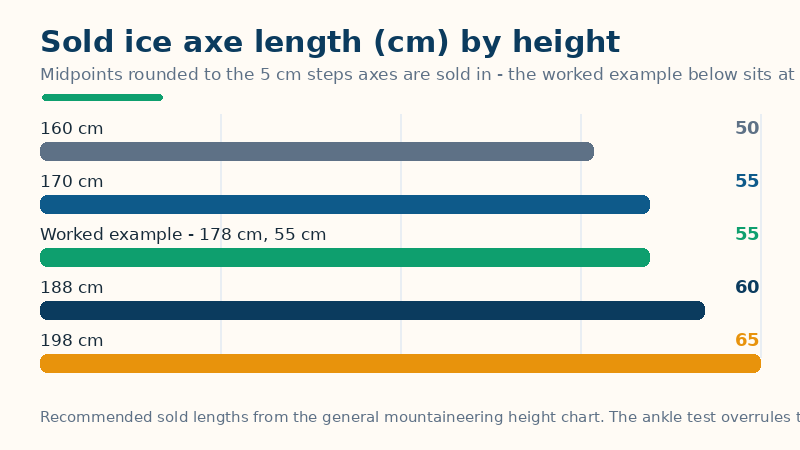
A height exactly on a boundary belongs to the taller band: exactly 5 ft 6 in reads as 50–55 cm, not 45–50 cm, and exactly 6 ft 4 in reads as 60–70 cm, not 50–65 cm. That follows the chart as published — each band starts at its stated height — and the ankle test below, not the boundary rule, is the final word.
Worked example: 178 cm tall
A climber who is 178 cm tall should buy a 55 cm axe. The working: 178 cm ÷ 2.54 = 70.1 in, which is 5 ft 10 in, falling in the 5 ft 9 in to 6 ft 0 in band, 50–60 cm (19.7–23.6 in). The midpoint of 50 and 60 cm is 55 cm, which is already a sold length, so the answer is 55 cm (21.7 in). The same arithmetic at other heights shows both the range and the rounding in action:
| Height | Working | Range | Sold length |
|---|---|---|---|
| 160 cm | 63.0 in (5 ft 3 in) | 45–50 cm | 50 cm (midpoint 47.5, rounded up to the 5 cm step) |
| 170 cm | 66.9 in (5 ft 7 in) | 50–55 cm | 55 cm (midpoint 52.5, rounded up to the 5 cm step) |
| 178 cm | 70.1 in (5 ft 10 in) | 50–60 cm | 55 cm (midpoint 55, already a sold length) |
| 188 cm | 74.0 in (6 ft 2 in) | 50–65 cm | 60 cm (midpoint 57.5, rounded up to the 5 cm step) |
| 198 cm | 78.0 in (6 ft 6 in) | 60–70 cm | 65 cm (midpoint 65, already a sold length) |
Notice the first two rows together: the 160 cm and 170 cm climbers sit in different bands, yet both round to a sold length one step above their band's midpoint — 47.5 cm becomes 50 cm and 52.5 cm becomes 55 cm — because axes are not sold in half steps, and rounding up is the honest side of the step for a general axe.
How to read your result, and its limits
Three checks before trusting the length. First, the ankle test overrules the chart: hold the axe by its head, standing straight, and the spike should reach about your ankle — if it hangs below your ankle, the axe is too long, whatever the chart said. Second, the use moves the pick inside the range: for steep technical ice, pick the short end of the range — a 50 cm technical tool is the usual choice, and true ice tools, used in pairs, are shorter still at around 45–50 cm — while for gentle glacier travel, where the axe is a walking aid and a self-arrest anchor, pick the long end. Third, the maker's chart outranks this page for the axe you buy: brands cut lengths differently, and a 60 cm axe from one maker is not the same tool as a 60 cm axe from another — check the length, the pick shape and the weight together, and try it in hand if you can. This page also does not choose the axe type — general mountaineering, technical or ski-mountaineering — it only lengths the general axe once the type is chosen, and it does not replace instruction: self-arrest and glacier travel need practice, not just the right length.
Common mistakes
- Buying the longest axe in the range. The old walking-stick habit dies hard, but the guides agree: too long hinders you on steep ground, while slightly short rarely hurts — pick the midpoint, not the top.
- Measuring height in boots. Boots add height that is not leg length, and push the band one step too long — measure barefoot, standing straight.
- Using a general axe for technical ice. A general axe at the long end of its range is the wrong tool for steep ice, whatever its length — technical climbing wants a short, curved tool, usually in a pair.
- Trusting the chart over the ankle test. If the spike hangs below your ankle when you hold the axe by its head, the axe is too long — try the shorter sold length.
Related tools: Trekking Pole Size Calculator — Your trekking pole length from height: flat, uphill and downhill settings in one page; Climbing Harness Size Calculator — Your climbing harness size from waist and leg measurements — S, M, L or XL — with the fit checks that settle it; Backpack Size Calculator — Your backpack size in two parts: frame size from torso length, and litres from trip length, packing style and season.
Frequently asked questions
What length ice axe do I need?
It comes from your height on the general mountaineering chart: for example, 178 cm (5 ft 10 in) falls in the 50–60 cm band, and the midpoint, 55 cm, is the sold length to buy. For steep technical ice, pick the short end of the range instead, and always confirm with the ankle test below.
How do I check if an ice axe is the right length?
Hold the axe by its head, standing straight: the spike should reach about your ankle, not below it. If the spike hangs below your ankle, the axe is too long. This ankle test overrules the chart for any close call.
Is a shorter or longer ice axe better?
Shorter, on the guides' evidence: an axe that is too long hinders you on steep ground and raises your balance point, while a slightly short axe is rarely a disadvantage. That is why this page takes the midpoint of the band, not the top of it.
What ice axe length do I need for technical ice climbing?
A shorter one than the general chart suggests — around 50 cm for a single technical tool, and true ice tools used in pairs are shorter still, around 45–50 cm. The general chart on this page is for mountaineering axes; for steep ice, pick the short end of your band or a dedicated technical tool.
