Three steps: watts, minutes, uses a week
The whole calculation is three multiplications, and the minutes are the one people get wrong. Watts divided by 1,000 is kilowatts; kilowatts times the minutes divided by 60 is the energy of one use; the energy per use times the uses a week times 52 weeks is the year's energy; the year's energy times the price is the year's money. The month is the year divided by 12, not the week times 4 — the two differ by a few cents, and the year-divided-by-12 figure is the one this page uses, so it agrees with the yearly total exactly:
energy per use (kWh) = watts ÷ 1,000 × minutes ÷ 60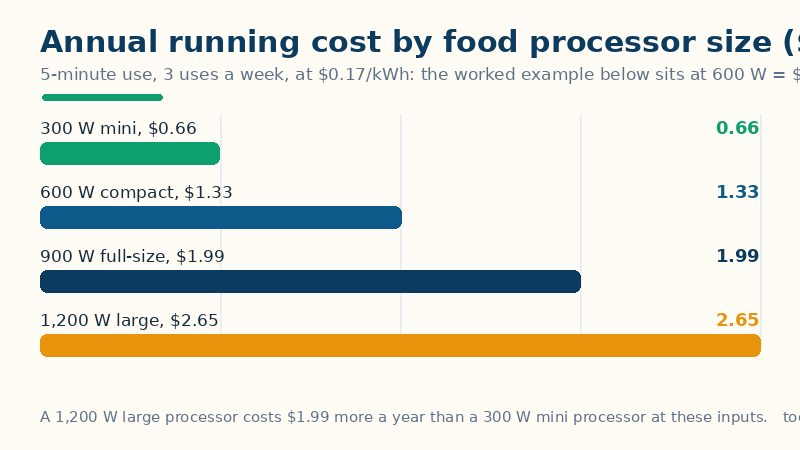
energy per week (kWh) = energy per use × uses a weekannual cost ($) = energy per week × 52 × electricity priceThe watts on the label are the motor's rated draw, and the processor does not draw them for long. A mini processor draws about 300 W, a compact processor about 600 W, a full-size processor about 900 W and a large processor up to 1,200 W — and a chop takes two to five minutes, a dough or paste up to ten. What matters is the uses a week: one use is 0.050 kWh, but seven uses is 0.350 kWh, and the processor that runs every day will always cost more than the one that runs once a week.
Worked example: 600 W, 5 minutes a use, 3 uses a week, $0.17/kWh
A 600 W food processor running for 5 minutes uses 0.6 × 5 ÷ 60 = 0.050 kWh, costing 0.9¢. A week is 0.050 × 3 = 0.150 kWh, costing $0.03. A month is 7.8 ÷ 12 = 0.7 kWh, costing $0.11. A year is 0.150 × 52 = 7.8 kWh, costing $1.33. The table above shows the same maths for the other processor sizes at a 5-minute use and 3 uses a week: a 300 W mini processor costs 0.4¢ a use and $0.66 a year, a 900 W full-size processor costs 1.3¢ a use and $1.99 a year, and a 1,200 W large processor costs 1.7¢ a use and $2.65 a year. One hour at full power costs 10.2¢ at these settings, and ten years of food processing at this pace costs $13.26. A 2-minute use costs $0.53 a year and a 10-minute use $2.65; using it every day costs $3.09 a year, once a week $0.44. Four published cross-checks reproduce exactly: quickpickdeal's 400 W food processor at 1 hour a day and 10 cents uses 0.4 kWh a day and costs $0.04 a day, 12 kWh a month and $1.20 a month — this page gives the same 0.4 kWh a day and $0.04 a day, while its $1.20 a month is the day times 30 against this page's $1.21, on 12.1 kWh; desiutility's 500 W food processor at 0.3 hours a day uses 0.15 units a day — this page gives the same 0.15 kWh a day, ₹1.20 a day at ₹8 a unit — while its 5 units a month is a rounded day-times-30 figure against this page's 4.6 units; the RG&E home energy guide's 405 W food processor at 6 hours a month uses 2.4 kWh a month and costs $0.27 at 11 cents — this page gives 2.43 kWh and the same $0.27; and quickpickdeal's type table runs from a 200–400 W mini to a 600–1,200 W full-size processor — the same bands this page uses.
How to read your result, and its limits
Four cautions keep the number honest. First, the minutes are the whole story: a 2-minute use costs $0.53 a year and a 10-minute use $2.65 at the worked example's inputs — the dough that takes five times as long costs five times as much, whatever the watts on the box. Second, the uses a week are the count, not the days: 3 uses a week is 156 uses a year, so the year is the week times 52 — 7.8 kWh and $1.33 — while multiplying one use by 365 days would give $3.10, as if you chopped every single day. Third, pulses still count as running time: a food processor rarely runs continuously — it pulses in short bursts — so add up the seconds the blade is actually turning; a recipe that says "pulse ten times" is a minute or two of running, not ten minutes, and the real use may cost less than the minutes you entered. Fourth, the electricity price is the all-in rate: the total on the bill divided by the kilowatt-hours on the bill, including delivery charges. For the smoothie that follows the chopping, the blender cost calculator prices the blend by watts, minutes and blends a week — one 2-minute blend at 600 W is 0.020 kWh and 0.3¢, about a third of a processor use — for the all-day cook the chopped vegetables go into, the slow cooker cost calculator prices the stew by watts, hours and cooks a week; and for the cost of running anything else in the house, the electricity cost calculator prices any appliance by watts and hours.
Common mistakes
- Pricing the label watts for a whole hour. A 600 W food processor for an hour is 0.6 kWh and 10.2¢, but a 5-minute use is 0.050 kWh and 0.9¢ — the hour figure is twelve uses, not one. Price the minutes, not the hour.
- Multiplying one use by 365 days. Three uses a week is 156 uses a year, not 365: $0.0085 × 365 gives $3.10, while the real year is $1.33. Count the uses a week, then multiply by 52.
- Multiplying the weekly cost by 4 for the month. Four weeks is not a twelfth of a year: the week times 4 gives $0.10 a month at the worked example's inputs, while the year divided by 12 gives $0.11. Use the year-divided-by-12 figure, which is the one that adds up.
- Comparing processors on watts. A 1,200 W large processor and a 600 W compact processor look far apart on watts, but the use is 5 minutes either way: 0.10 kWh against 0.050 kWh, 1.7¢ against 0.9¢ — and the bigger processor may finish the same chop in half the time, so the cost per use can be closer still. Compare kilowatt-hours per use, not watts.
- Adding the standing charge to every use. The daily supply charge is payable whether the processor runs or not. Only the per-kWh rate belongs in the per-use maths — the fixed charge is a separate line on the bill.
Frequently asked questions
How much does a food processor cost per use?
A 600 W food processor costs 0.9¢ a use for a 5-minute chop at $0.17 per kWh — 0.050 kWh a use, $1.33 a year at 3 uses a week. A 2-minute use costs $0.53 a year and a 10-minute use $2.65.
How many watts does a food processor use?
Most home food processors draw 200 to 1,200 W: a mini processor about 200 to 400 W, a compact processor about 400 to 600 W and a full-size processor about 600 to 1,200 W. The watts on the label are the motor's rated draw at full load.
Does a food processor use a lot of electricity?
No: 3 uses a week is 7.8 kWh a year and $1.33 at $0.17 per kWh — less than a 60 W bulb left on 5 hours a day, which costs $18.62 a year. A food processor is one of the cheapest appliances in the house to run.
Is a food processor cheaper to run than a blender?
Per use the blender is cheaper, because it runs for less time: a 2-minute blend at 600 W is 0.020 kWh and 0.3¢, against 0.050 kWh and 0.9¢ for a 5-minute processor use. Over a year the difference is still small — $0.88 against $1.33 at the worked examples' routines.