Why foot length, not your usual size
Shoe labels disagree with each other by design: a US men's 10 is a UK 9.5 and an EU 44, a US women's 8 is a UK 6 and an EU 39, and brands vary by up to a full size around any published table. Foot length in centimetres is the one figure that stays the same across all of them — it is the Mondopoint idea, the measurement the Japanese system uses directly — so this page converts from centimetres and treats the label as the output, never the input. Measure standing up with your heel against a wall, mark your longest toe, and use the longer foot: most people have one foot slightly longer than the other, and the boot must fit the longer one. Measure in the afternoon if you can, because feet swell through the day by up to half a size, and a morning measurement is the smallest your feet will ever be on the trail.
Measured size = the smallest table row whose foot length is at least your foot length — Order size = measured size + 0.5 (thick hiking socks) — UK men = US − 0.5, UK women = US − 2 — Order EU for a half size = the midpoint of the two neighbouring rows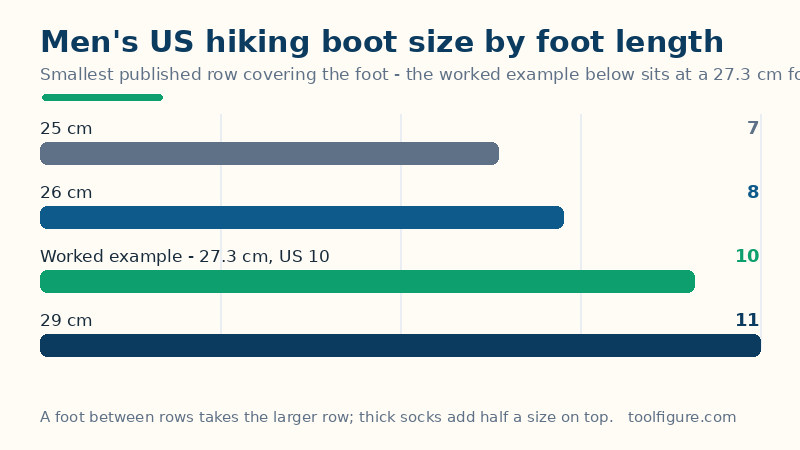
The tables this page uses are the published centimetre tables. Men's: 24 cm is US 6 / UK 5.5 / EU 39, 25 cm is US 7 / UK 6.5 / EU 40, 26 cm is US 8 / UK 7.5 / EU 41, 27 cm is US 9 / UK 8.5 / EU 42.5, 28 cm is US 10 / UK 9.5 / EU 44, 29 cm is US 11 / UK 10.5 / EU 45, 30 cm is US 12 / UK 11.5 / EU 46, 31 cm is US 13 / UK 12.5 / EU 47. Women's: 22 cm is US 5 / UK 3 / EU 36, 23 cm is US 6 / UK 4 / EU 37, 24 cm is US 7 / UK 5 / EU 38, 25 cm is US 8 / UK 6 / EU 39, 26 cm is US 9 / UK 7 / EU 40, 27 cm is US 10 / UK 8 / EU 41, 28 cm is US 11 / UK 9 / EU 42.
Worked example: a 27.3 cm foot, men's, thick hiking socks
A 27.3 cm foot (10.7 inches) measures as US men's 10 — UK 9.5, EU 44, because the 27 cm row is built for a foot up to 27 cm and 27.3 cm passes it, so the next row up, 28 cm, is the size. With thick hiking socks the order size is half a size up: US men's 10.5 — UK 10, EU 44.5 (the midpoint of the EU 44 and EU 45 rows). The same rounding-up rule on other feet:
| Foot, fit | Measured size (US / UK / EU) | Order size, thick socks |
|---|---|---|
| 25.0 cm, men | 7 / 6.5 / 40 | 7.5 / 7 / 40.5 |
| 26.5 cm, men | 9 / 8.5 / 42.5 | 9.5 / 9 / 43.25 |
| 27.0 cm, men | 9 / 8.5 / 42.5 | 9.5 / 9 / 43.25 |
| 27.3 cm, men (worked example) | 10 / 9.5 / 44 | 10.5 / 10 / 44.5 |
| 24.2 cm, women | 8 / 6 / 39 | 8.5 / 6.5 / 39.5 |
| 26.0 cm, women | 9 / 7 / 40 | 9.5 / 7.5 / 40.5 |
Check the 26.5 cm men's row by hand: 26.5 cm passes the 26 cm row, so the smallest row covering it is 27 cm — US 9, UK 8.5, EU 42.5 — and with thick socks that becomes US 9.5, UK 9, EU 43.25, the midpoint of 42.5 and 44. The quarter-size EU figures are the honest arithmetic of the midpoint rule, and they are also the warning: half sizes in EU sizing vary by brand, so for a half-size order, check the brand's own chart for its 9.5 row rather than trusting the midpoint blindly. And note what the worked example's 27.3 cm foot is not: it is not a US 9, even though 27 cm is close — a boot built for a 27 cm foot has no room left for a 27.3 cm foot plus a thick sock, which is exactly how toenails get bruised on the first descent.
How to read your result, and its limits
Three checks before ordering. First, fit the socks you will hike in: try boots on in the thick socks you actually wear, not the thin pair you walked into the shop in — the half-size step in this page is the arithmetic version of that advice, not a replacement for it. Second, leave a thumb's width at the toe: standing with the boot unlaced and your foot pushed forward, you should just fit a finger behind your heel, and on a downhill slope your toes should not touch the front — if they do, go up half a size even past this page's answer. Third, width is a separate question this page does not answer: a foot that measures the right length but feels tight across the ball needs a wide fit, not a longer size, and going longer for width is how blisters and rolled ankles start. Brands vary by up to a full size around these tables, so the centimetre figure is the thing to carry into the brand's own chart.
Common mistakes
- Ordering your everyday shoe size for the trail. Everyday shoes are worn in thin socks on flat ground; hiking boots carry thick socks, swollen feet and descents — order the half size up.
- Measuring sitting down, or in the morning. Feet lengthen under body weight and swell through the day; a seated morning measurement is the smallest your feet will ever be.
- Fitting the shorter foot. Fit the longer foot — the shorter one adapts with lacing, the longer one does not adapt at all.
- Going longer to fix a tight width. Width needs a wide fit, not a longer boot; a boot that is too long lets the foot slide, and sliding is what causes blisters.
Related tools: Shoe Size Converter — US, UK, EU and Japan shoe sizes — every system at once, men and women; Trekking Pole Size Calculator — Your trekking pole length from height: flat, uphill and downhill settings in one page; Sock Size Converter — Men's & women's sock sizes — US, UK & EU shoe sizes into the XS–XXL sock letter.
Frequently asked questions
Should I order hiking boots half a size larger than my normal shoes?
Usually yes, when you will wear thick hiking socks: this page adds half a size for thick socks, because socks take up room, feet swell through a day on the trail, and descents push toes forward. A boot that fits in thin socks in the shop is the boot that bruises toenails on the first descent.
How do I measure my foot for hiking boots?
Stand up with your heel against a wall, mark your longest toe, and measure from the wall to the mark in centimetres. Measure both feet and use the longer one, and measure in the afternoon if you can — feet swell through the day by up to half a size.
What is my hiking boot size if my foot is 27.3 cm?
US men's 10 (UK 9.5, EU 44) measured, and US men's 10.5 (UK 10, EU 44.5) to order with thick hiking socks — the 27 cm row is built for a foot up to 27 cm, so a 27.3 cm foot takes the next row up.
Why do hiking boot sizes differ between brands?
Because US, UK and EU labels are different scales laid over the same feet, and each brand cuts its lasts slightly differently — published tables vary by up to a full size. Foot length in centimetres is the anchor: carry it into the brand's own size chart before ordering.
