One foot, four honest sizes
Climbing shoe sizing starts from the foot, not from a street shoe size: measure the foot in centimetres, find the measured size, then move it up or down by the fit you want. The published rule — used by Mad Rock's sizing guide — is a subtraction for the measured size and a fixed step per fit, and this page applies both openly so every figure on it can be checked.
Measured size (US men's) = foot length (cm) − 18, rounded to the nearest half size — Comfort = measured + 1, Snug = measured + 0.5, Performance = measured, Downsized = measured − 0.5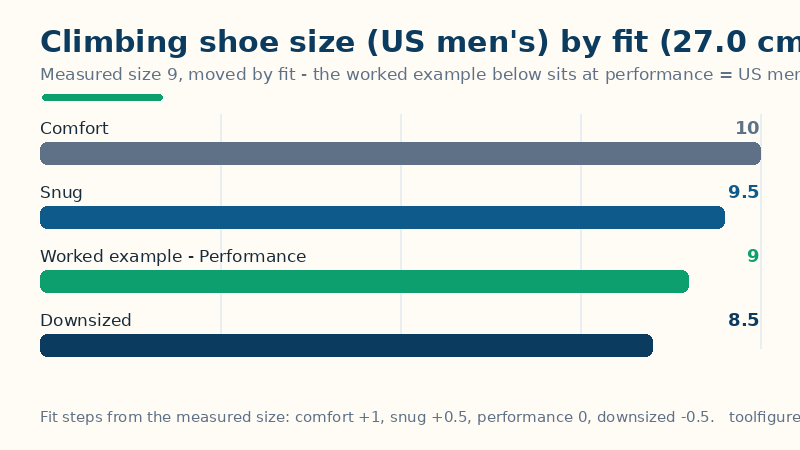
| Foot length | Measured size | Comfort | Snug | Performance | Downsized |
|---|---|---|---|---|---|
| 25.0 cm | US 7 | 8 | 7.5 | 7 | 6.5 |
| 27.0 cm | US 9 | 10 | 9.5 | 9 | 8.5 |
| 29.0 cm | US 11 | 12 | 11.5 | 11 | 10.5 |
The downsized column uses the gentler half-size step: Mad Rock's guide allows a full size down for climbers with high pain tolerance, so a 27.0 cm foot could also be sized to US 8 — but the half-size step is the defensible default, and the full-size step is a deliberate choice to make after trying the shoe, not a number to print as the answer.
Worked example: 27.0 cm foot, performance fit
A 27.0 cm foot measures to US men's 9 (27.0 − 18 = 9.0 exactly), and the performance fit keeps that number — so the answer is US men's 9, EU 42. The same foot takes US 10 for comfort, US 9.5 for a snug gym fit and US 8.5 downsized: four sizes, one foot, and the difference is the fit, not an error. Two more spot checks from the same rule: a 25.0 cm foot measures US 7, so comfort 8, snug 7.5, performance 7, downsized 6.5; and a 29.0 cm foot measures US 11, so comfort 12, snug 11.5, performance 11, downsized 10.5. The EU figures follow the Black Diamond chart rows for those US sizes: US 9 is EU 42, US 10 is EU 43, US 7 is EU 39.5 and US 11 is EU 44.5.
How to read your result, and its limits
Three checks before buying. First, brand lasts overrule this page: the guides agree that sizing varies by brand and even by model, because each last is shaped differently — Black Diamond's own line, for example, is built on its last dimensions rather than street shoe sizes and runs smaller than street shoes, so when a brand publishes its own chart for the exact shoe, that chart wins. Second, material changes the break-in: leather stretches about half a size, so a snug leather shoe ends near the comfort fit after a few sessions, while synthetic shoes barely stretch and must fit from the first wear. Third, women's lasts are not men's minus one: Black Diamond lists the same EU 42 as US men's 9 and US women's 10, so women should use the brand's women's chart rather than subtracting a size from the men's figure on this page. And the standing rule of the guides: pain that does not fade is the wrong size, not a rite of passage.
Common mistakes
- Ordering your street shoe size. Climbing shoes are sized from the foot, and the fit step moves the number by up to a size and a half — a street size ignores both.
- Downsizing as a beginner. A downsized shoe does not make a beginner climb harder; it makes feet hurt and sessions shorter. Start at comfort or snug and size down only when the climbing demands it.
- Measuring one foot, or measuring seated. Measure standing, both feet, and use the longer one — feet spread under body weight, and the shorter foot's size pinches the longer one.
- Trusting one brand's number on another brand's shoe. A size 9 in one brand's last is not a size 9 in another's. Re-check the brand chart for every new model.
Related tools: Roller Skate Size Calculator — Your roller skate size from foot length: quad or inline, in US, UK and EU; Shoe Size Converter — US, UK, EU and Japan shoe sizes — every system at once, men and women; Ice Skate Size Calculator — Your ice skate size from foot length: hockey or figure, with US and UK equivalents.
Frequently asked questions
What climbing shoe size am I if my foot is 27 cm?
Measured size US men's 9 — then pick the fit: US 10 for comfort, US 9.5 snug, US 9 performance, US 8.5 downsized. The foot is the same; the fit moves the number, which is why a single size without a fit is not an answer.
Should beginners downsize their climbing shoes?
No. Beginners should start at comfort or snug: a downsized shoe hurts without making a new climber climb harder, and pain that does not fade is the wrong size. Size down only when edging on small holds actually demands it.
Do climbing shoes stretch?
Leather shoes stretch about half a size with use; synthetic shoes barely stretch at all. That is why a snug leather shoe ends near the comfort fit after break-in, while a synthetic shoe must fit right from the first wear.
Why does my size differ between brands?
Each brand builds on its own last shape, so the same foot takes different numbers — Black Diamond's line, for example, is sized from its last dimensions and runs smaller than street shoes. When a brand publishes its own chart for the exact shoe, that chart overrules any general calculator.
