Two US scales, one foot
Kids' shoe sizing hides a trap in plain sight: the US scale restarts. Toddler shoes run 1C to 13.5C, and then youth shoes run 1Y to 7Y — and a 1Y is bigger than a 13.5C, not smaller, because the youth scale continues where the toddler scale stopped. The UK and EU scales do not restart: UK runs from 0.5 up through 13 and then, on the youth scale, from 1 to 6, while EU runs straight from 16 to 40. That is why the letter matters more than the number in the US system, and why a converter that drops the C or Y is worse than no converter at all. The one measurement that never restarts is the foot itself, in centimetres — every row below carries it, and it is the figure to trust when two systems disagree.
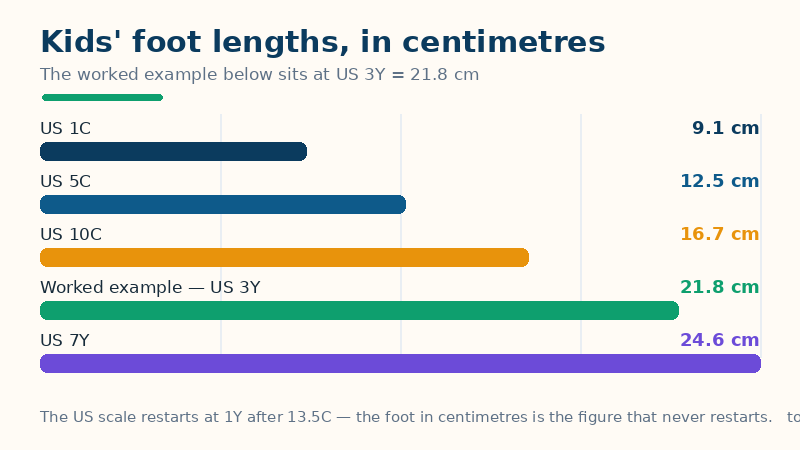
Worked example: a US 3Y
Take a US 3Y. The row gives UK 2.5, EU 35, foot 21.8 cm (8.6 in) — 21.8 ÷ 2.54 = 8.58, shown as 8.6. Four more rows prove the table holds across the restart and the scales: EU 32 is US 1Y, UK 13.5, 20.1 cm (7.9 in) — the first youth size, one step above 13.5C (EU 31.5, 19.7 cm); UK 10.5 is US 11C, EU 28, 17.6 cm (6.9 in); a foot of 17.6 cm is that same US 11C row; and a US 5C is UK 4.5, EU 21, 12.5 cm (4.9 in). Two more useful rows: US 13C is UK 12.5, EU 31, 19.3 cm (7.6 in), and US 3.5Y is UK 3, EU 35.5, 22.2 cm (8.7 in). The UK trap is real and the tool refuses to guess through it: UK 6 appears on both the 6.5Y row (EU 39, 24.3 cm) and the 7Y row (EU 40, 24.6 cm), so a UK 6 alone cannot be converted — the EU size or the foot length settles it.
Kids' shoe size table
| US kids | UK | EU | Foot (cm) | Foot (in) |
|---|---|---|---|---|
| 1C | 0.5 | 16 | 9.1 | 3.6 |
| 2C | 1.5 | 17 | 10 | 3.9 |
| 3C | 2.5 | 18.5 | 10.8 | 4.3 |
| 4C | 3.5 | 19.5 | 11.6 | 4.6 |
| 5C | 4.5 | 21 | 12.5 | 4.9 |
| 6C | 5.5 | 22 | 13.3 | 5.2 |
| 7C | 6.5 | 23.5 | 14.2 | 5.6 |
| 8C | 7.5 | 25 | 15 | 5.9 |
| 9C | 8.5 | 26 | 15.9 | 6.3 |
| 10C | 9.5 | 27 | 16.7 | 6.6 |
| 10.5C | 10 | 27.5 | 17.2 | 6.8 |
| 11C | 10.5 | 28 | 17.6 | 6.9 |
| 11.5C | 11 | 28.5 | 18 | 7.1 |
| 12C | 11.5 | 29.5 | 18.4 | 7.2 |
| 12.5C | 12 | 30 | 18.8 | 7.4 |
| 13C | 12.5 | 31 | 19.3 | 7.6 |
| 13.5C | 13 | 31.5 | 19.7 | 7.8 |
| 1Y | 13.5 | 32 | 20.1 | 7.9 |
| 1.5Y | 1 | 33 | 20.5 | 8.1 |
| 2Y | 1.5 | 33.5 | 20.9 | 8.2 |
| 2.5Y | 2 | 34 | 21.4 | 8.4 |
| 3Y | 2.5 | 35 | 21.8 | 8.6 |
| 3.5Y | 3 | 35.5 | 22.2 | 8.7 |
| 4Y | 3.5 | 36 | 22.4 | 8.8 |
| 4.5Y | 4 | 36.5 | 22.7 | 8.9 |
| 5Y | 4.5 | 37.5 | 23.2 | 9.1 |
| 5.5Y | 5 | 38 | 23.5 | 9.3 |
| 6Y | 5.5 | 38.5 | 23.8 | 9.4 |
| 6.5Y | 6 | 39 | 24.3 | 9.6 |
| 7Y | 6 | 40 | 24.6 | 9.7 |
How to read your result, and its limits
Three checks before ordering. First, measure, never guess from age: children's feet grow in bursts — up to two full sizes a year under age 3 — so two children of the same age can differ by two or three sizes; trace the foot on paper, measure heel to longest toe, and do it in the afternoon, when feet are largest. Second, fit the larger foot and leave about 1 cm of growing room: a shoe that fits exactly today is outgrown in weeks, and a foot measured between two rows takes the larger size, not the nearer one. Third, this is the standard table, and brands move a step either side of it: conversion points vary slightly between manufacturers, width is not covered here at all, and the table stops at 7Y — beyond that, youth sizes flow into adult sizing, so an older child may already be on the adult chart rather than this one.
Related tools: Shoe Size Converter — US, UK, EU and Japan shoe sizes — every system at once, men and women; Baby Size Converter — Baby & toddler clothing sizes — EU height sizes, US labels and UK ages, newborn to age 5; Sock Size Converter — Men's & women's sock sizes — US, UK & EU shoe sizes into the XS–XXL sock letter.
Frequently asked questions
What is a US 3Y in UK and EU kids' shoe sizes?
A US 3Y is UK 2.5 and EU 35, for a foot of 21.8 cm (8.6 in). Y is the youth scale, which follows the toddler C scale — 1Y is bigger than 13.5C, not smaller.
What is the difference between C and Y kids' shoe sizes?
C is the toddler scale (1C to 13.5C) and Y is the youth scale (1Y to 7Y). The US numbering restarts at 1Y after 13.5C, so a 6Y is a whole scale larger than a toddler 6C — never drop the letter.
Why does UK 6 give two kids' shoe sizes?
Because UK youth numbering repeats: UK 6 appears on both the 6.5Y row (EU 39, 24.3 cm) and the 7Y row (EU 40, 24.6 cm). A UK 6 alone cannot be converted — enter the EU size or the foot length to settle it.
Should I buy kids' shoes by age?
No — measure the foot instead. Children's feet grow in bursts and two children of the same age can differ by two or three sizes. Trace the foot, measure heel to longest toe in the afternoon, fit the larger foot, and leave about 1 cm of growing room.
