Three steps: average watts, minutes, sessions
The whole calculation is one multiplication repeated, and the average watts are the one people get wrong. Average watts divided by 1,000 is kilowatts; kilowatts times the session hours is the session's energy; the session's energy times the sessions a week times 52 is the year's energy; the year's energy times the price is the year's money. The month is the year divided by 12, not the week times 4 — the two differ by about eleven cents on a treadmill, and the year-divided-by-12 figure is the one this page uses, so it agrees with the yearly total exactly:
energy per session (kWh) = average watts ÷ 1,000 × minutes per session ÷ 60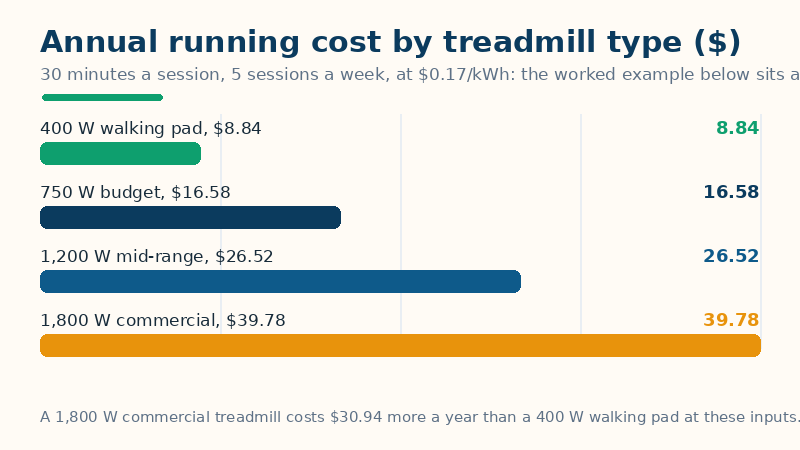
annual cost ($) = energy per session × sessions a week × 52 × electricity priceThe watts on the motor plate are the treadmill's maximum draw, and the motor does not draw them all day. Most home treadmills run 600 to 900 watts on average — about 60 to 65% of the rated figure — because the draw rises with speed, incline and the weight on the belt and falls again on the flat. A 2 HP motor is rated about 1,492 W, a 3 HP motor about 2,238 W and a 4 HP motor about 2,984 W, at 746 watts to the horsepower, but none of them draws its rating for a whole session. What matters is the average: toq.in's calculator puts the average at roughly 60 to 65% of rated watts, and a plug-in power meter on the treadmill for a week gives the real figure.
Worked example: 750 W average, 30 minutes a session, 5 sessions a week, $0.17/kWh
A 750 W treadmill running for 30 minutes uses 0.75 × 0.5 = 0.375 kWh a session, costing $0.06. A week is 0.375 × 5 = 1.875 kWh, costing $0.32. A month is 97.5 ÷ 12 = 8.125 kWh, costing $1.38. A year is 0.375 × 5 × 52 = 97.5 kWh, costing $16.58. The table above shows the same maths for the other treadmill types at 30 minutes a session, 5 sessions a week and $0.17/kWh: a 400 W walking pad uses 0.200 kWh a session, costing $0.03 a session, $0.74 a month and $8.84 a year, a 1,200 W mid-range treadmill uses 0.600 kWh a session, costing $0.10 a session, $2.21 a month and $26.52 a year, and a 1,800 W commercial treadmill uses 0.900 kWh a session, costing $0.15 a session, $3.32 a month and $39.78 a year. One hour at full power costs 12.8¢; an hour a day, every day, costs $46.54 a year; and ten years at this pace costs $165.75. Five published cross-checks reproduce exactly: treadmillreviewsite's 750 W treadmill at 30 minutes a day and 26.32p costs £0.10 a session and £36 a year — this page gives the same £0.10 a session, with £2.99 a month on the year-divided-by-12 figure against their £3.00, and £35.93 a year on the 52-week figure against their £36.03 on a 365-day year. EcoFlow's 750 W treadmill for an hour a day at $0.15 uses 0.75 kWh a day, 22.5 kWh a month on a 30-day month and costs $3.38 — this page gives the same 0.75 kWh a day, with 22.750 kWh a month on the year-divided-by-12 figure and $3.41. Their 600 W treadmill for 20 hours a month at $0.12 uses 12 kWh and costs $1.44 — the same 600 W for five 60-minute sessions a week is 21.7 hours a month on this page, 13.0 kWh and $1.56. Kingsmith's 700 W treadmill for an hour a day at $0.15 uses 0.7 kWh a day, 21 kWh a month on a 30-day month and costs $3.15 — this page gives the same 0.7 kWh a day, with 21.233 kWh a month on the year-divided-by-12 figure and $3.18; their table row for a 400 W treadmill at 30 minutes a day is $0.90 a month on a 30-day month against $0.91 here, and their 1,000 W row is $2.25 against $2.28 here. Joteo's worked session — 407.5 W for 40 minutes, four sessions a week — uses 0.272 kWh a session, 1.087 kWh a week and 56.507 kWh a year — this page gives the same 0.272 kWh, 1.087 kWh and 56.507 kWh, which is the 56.5 kWh they state. And toq.in's budget row — a 750 W average, three 45-minute sessions a week at ₹6.5 — is ₹48 a month; the same maths is ₹47.53, confirmed by a scaled check on this page at 0.65, one tenth of the rupee rate, which gives $4.75 a month — ₹47.53 at full scale (the tool's price field caps at $2 per kWh, so the rupee figure itself is the formula applied by hand); their mid-range row is ₹77, and the same maths gives ₹77.00 once their 70 kg weight factor (×1.0125) is applied to the 1,200 W average, taking it to 1,215 W — both inside their ₹60 to ₹120 a month band for a mid-range machine.
How to read your result, and its limits
Four cautions keep the number honest. First, the average watts are the estimate, not the nameplate: at the worked example's inputs a 750 W average costs $16.58 a year, but the same machine's nameplate is likely 1,500 W or more, which would price at $33.15 a year if entered as the average — double the real bill. Enter the average, and measure it with a plug-in power meter if you want the number exact. Second, a treadmill is cheap to run: the worked example adds $1.38 a month to the bill, and even an hour a day, every day, is $46.54 a year — the motor is a small load next to a water heater or an air conditioner, so the running cost should never decide whether to buy one. Third, the month is not thirty days: the day times 30 gives $1.27 a month at the worked example's inputs, while the year divided by 12 gives $1.38 — use the year-divided-by-12 figure, which is the one that adds up. Fourth, this page prices electricity only: the machine's purchase price, the belt lubricant and the mat underneath it are separate lines, and the electricity price is the all-in rate, the total on the bill divided by the kilowatt-hours on the bill. For the pace the treadmill is training for, the pace calculator converts between minutes per kilometre and minutes per mile; for the cost of running anything else in the house, the electricity cost calculator prices any appliance by watts and hours.
Common mistakes
- Entering the nameplate watts as the average. A treadmill rated 1,500 W does not draw 1,500 W for a whole session — at 60 to 65% of rated it averages about 900 to 975 W, $0.08 a session, not $0.13. Enter the average, not the plate.
- Pricing one session and stopping there. A session is $0.06, but five sessions a week for a year is $16.58 — the frequency is half the calculation. Count the sessions.
- Multiplying the weekly cost by 4 for the month. Four weeks is not a twelfth of a year: the week times 4 gives $1.27 a month at the worked example's inputs, while the year divided by 12 gives $1.38. Use the year-divided-by-12 figure, which is the one that adds up.
- Forgetting that incline and weight raise the draw. A steep incline with a heavier runner can push the average well above 65% of rated — the same machine costs more at 10% incline than on the flat. If you always run steep, measure the real average rather than trusting the 60 to 65% rule.
- Adding the standing charge to every session. The daily supply charge is payable whether the treadmill runs or not. Only the per-kWh rate belongs in the per-session maths — the fixed charge is a separate line on the bill.
Related tools: One Rep Max Calculator — Estimate a one-rep max from any set, with both classic formulas and a percentage table.
Frequently asked questions
How much does it cost to run a treadmill per month?
At the worked example's inputs — a 750 W average, 30 minutes a session, 5 sessions a week — a treadmill uses 8.125 kWh a month and costs $1.38 at $0.17 per kWh, or $16.58 a year. A 400 W walking pad costs $0.74 a month, a 1,200 W mid-range treadmill $2.21 and a 1,800 W commercial treadmill $3.32 a month at the same times and rate.
How many watts does a treadmill use?
Most home treadmills average 600 to 900 watts while running, with walking pads around 400 W and commercial machines up to about 1,800 W. The nameplate is higher — a 2 HP motor is rated about 1,492 W and a 3 HP motor about 2,238 W — because the average is roughly 60 to 65% of the rated figure. One hour at 750 W uses 0.75 kWh.
Does a treadmill use a lot of electricity?
No. At the worked example's inputs — 750 W, 30 minutes a session, 5 sessions a week — a treadmill uses 97.5 kWh a year and costs $16.58, about $1.38 a month. Even an hour a day, every day, costs $46.54 a year — far less than a water heater, a dryer or an air conditioner.
How can I reduce my treadmill's running cost?
Walk instead of run — the motor draws far less at walking speed — keep sessions as short as your training allows, and run on an off-peak tariff if your supplier offers one. The watts dominate the bill, so the biggest saving is a lower average draw, not fewer sessions: a 400 W walking pad costs $8.84 a year against $16.58 for a 750 W treadmill at the same times.